Showing posts with label romance. Show all posts

Thursday, October 3, 2019

The Light Over London: A WWII Novel of Romance, Secrets and Women's Autonomy

When a publicist pitches a book to me, the content of that pitch matters very much.   I want it to pique my interest, but I also want it to accurately reflect the book.  I should be made aware of what kind of book I'll be reading.  I try to do that in my blog review titles, so that the book will find its audience.

It seems to me that advance publicity for The Light Over London by Julia Kelly is trying to appeal to the sort of reader who is interested in the combat aspect of WWII.  There is an emphasis on the female historical protagonist joining an anti-aircraft unit and becoming a Gunner Girl.  The sort of reader who is interested in reading about Gunner Girls will expect that a high percentage of the book will contain action scenes or will at least take place in a military context. I requested this book for review on the strength of that publicity and received a copy from the publisher via Net Galley.


As I read Light Over London, I realized that I had to adjust my expectations.  It was a good book, just not the one that I thought it would be.   There was a combat sequence. There were also descriptions of training.  Julia Kelly captured the bonding between the women in the anti-aircraft unit very well. Yet I'd estimate that the Gunner Girl experience represented about 10% of the book.

I think that the other 90% was what the novel really focused on.   It was about the struggle of women to define themselves as individuals and live out their dreams.   It was also about how family, or the men in their lives supported or hindered them.   There were a number of  female characters in The Light Over London who were strong women.  They all went on to live the lives they chose for themselves.   There were no  relationships that involved a conventional romance genre HEA, but I think all these truly autonomous women found their own form of happiness.

There were a couple of major secrets.  One was a devastating scandal that infested the heart of a romantic relationship.   The other was a character building mistake that a family member made when she was young.   Both women moved on, and didn't allow themselves to be crushed by circumstances. I have to say that I was able to predict the nature of these secrets before they were revealed based on what I knew about the people involved.  So there were no surprises for me, but it was satisfying that I understood the characters so well.

I was glad to learn about the existence of Gunner Girls, and was delighted to find a novel like The Light Over London where all the major female characters were an inspiration. 


Monday, April 16, 2018

The Suffragette Scandal--Some of The Best Romance Dialogue Ever!

I haven't reviewed a suffragette novel in 2018.  It's about time that I did.  Suffragettes are my favorite historical subject. I'm so glad that I had a chance to read The Suffragette Scandal by Courtney Milan.  This historical romance is causing me to revise my Romance Top Ten of All Time list.  I should have redone it when I read the Jewish Regency Miss Jacobson's Journey by Carola Dunn in 2016 (which I reviewed here) but I completely forgot.  This means that the two titles at the bottom of my top ten fall off the list leaving The Black Knave by Patricia Potter, a Scottish version of The Scarlet Pimpernel, rounding out the top ten. 


The Suffragette Scandal was such fun!  The heroine of this romance, Frederica Marshall, known to her friends as Free, is the owner/editor of a woman's newspaper in England in 1877.    One of my favorite moments in the book is when she tells the hero Edward Clark that if he ever needs an exclamation point, he should come to see her because she has a whole box of them. 

She really does have a box of exclamation points.  Printing was done with moveable type.  So each page in a newspaper had to be set with little replicas of each letter and punctuation mark.  I'm borrowing from Free's box of exclamation points for this review.  I've used two of them.

It's often said that Jane Eyre is the grandmother of historical romance, but I think that The Suffragette Scandal is directly descended from Shakespeare's Much Ado About Nothing where Beatrice and Benedick have some really great dialogue exchanges.  I was thinking of Benedick calling Beatrice "my lady disdain" while I read this book.  Free could easily be a second "my lady disdain".   Her agile tongue can outwit all the other characters.

Aside from the dialogue, there's also a dramatic plot with threats to the newspaper, arrests at a suffragette rally, blackmail and forgery.  Free's background is amazing because it includes all the risks she took to publish exposés of institutions and businesses that were harming women.

  Edward, the hero, is unconventional because he rejects the class driven values of Victorian society.  This makes him an outcast from his aristocratic family.  His life has been a hard one, but he's a survivor with many talents.  I loved him almost as much as Free.

In the Author's Note, Courtney Milan reveals what I suspected about the inspiration of her feminist heroine.  She is modeled on Nellie Bly, the 19th century American investigative reporter.  I've linked a Biography.com article about her life.  The image of her below is a public domain photo from Wikipedia. 


Those who say that historical romances which contain feminist heroines are all inauthentic are wrong.  Nellie Bly really existed.  There were suffragettes.  Romance writers can draw on a rich heritage of strong women throughout history.   I give The Suffragette Scandal high marks for being a feminist romance that is hugely entertaining.


Saturday, September 16, 2017

Mistress Suffragette

My readers here know that I love to read and review novels about suffragettes.  This year  I've reviewed a YA mystery dealing with suffragettes here and a novel about a suffragette in South Carolina here.  Mistress Suffragette by Diana Forbes is a debut romance taking place in America during the Gilded Age.

I rarely read or review romances. I like unusual books, and romances tend to run to formula. So when I got the request for this review, I had to take a look at what was being said about Mistress Suffragette on Goodreads.  It sounded like there would be more emphasis on the context than I would normally find in a historical romance.  This is why I accepted a review copy, and I am now posting an honest review.


There is a repeating pattern for all three of the suffragette novels I've read this year.  It seemed to me that the protagonists aren't as strong or as interesting as supporting characters.  I always find this disappointing. In my review of In The Fullness of Time by Katherine Stillerman which is the second review linked above, I speculated that the authors may think their protagonists are more relatable.

  When we first meet Penelope Stanton, the protagonist of Mistress Suffragette,  she's sheltered, spoiled and somewhat shallow.   She makes the occasional witty remark, but frankly I found her thoroughly unsympathetic.   I told myself she would improve when she stopped being under her mother's thumb.  She did improve.  She began to be more thoughtful.   Yet throughout the novel, Penelope ends up being swayed by those who surround her.  Some of her worst decisions could only be explained by the proximity of a strong minded individual over-riding her judgment.  She seemed to lack self-determination.

I preferred Verdana, a feminist activist that Penelope encounters after she leaves home.  Verdana's focus is on women's clothing reform to increase mobility.  Verdana is bold within the context of her period.  I liked her self-acceptance and genuine desire to help other women.   For much of the book, Verdana's cause is more central than women's suffrage.  Yet I enjoyed Verdana's expansion of Penelope's consciousness by introducing ideas and experiences that were foreign to her.

Speaking of new experiences, I thought that the scene in which Penelope learns to use a gun and becomes an instant sharpshooter unrealistic.   If you've ever tried to handle a gun for the first time, you know that there's a kick that will be unexpected.  It tends to throw people off.  Diana Forbes should have consulted with someone who knows guns when she was writing that scene.

I  was also irritated by certain character name choices. Names like Daggers or Stalker sound like mustache twirling villains in staged melodramas from the period that Forbes was writing about.  Real people weren't likely to have names like those. I felt that they were heavy handed and predictable.  They would be more appropriate for a satire.

So although there were characters and moments in Mistress Suffragette that pleased me, the book definitely did have flaws.  Judging from reviews, some readers may overlook those issues.  I am hoping that Diane Forbes learned from the experience of writing this book and will produce better work in the future.
                              

Saturday, February 25, 2017

Mad Maggie--Alternative Healer and Eco Activist

Mad Maggie and the Mystery of the Ancients by Rod Raglin probably isn't going to be widely reviewed, but I think it deserves to be considered by more readers.  This isn't just because the author gifted it to me. 

 Maggie Whiteside, the heroine of this unusual romance, heals people with herbs and paranormal abilities.  She  also stands in opposition to a developer who intends to destroy the forest where she lives.   Yet those activities aren't what makes her stand out.  Maggie is a schizophrenic who is portrayed with sensitivity.  A schizophrenic heroine who gets her own HEA? I definitely haven't seen that before in a romance.  

 I love it when genres are expanded beyond their previous limits.  This can happen in indie books like this one because the author doesn't have to listen to the gatekeepers of the genre telling him or her that the audience doesn't want to read that sort of thing.   And maybe the gatekeepers are right about the majority of readers, but there are also readers like me who are interested in anything that's different.


I won Eagleridge Bluffs, another Eco-Warriors romance by Rod Raglin, in a Booklikes giveaway some time ago. That book has a new title and a new cover now.  It might have been revised.  At the time, I found an aspect of the heroine's portrayal  very unrealistic.   When I learned that this book's protagonist is schizophrenic, I wondered if I would be making similar comments about her.  Instead I was convinced by the characterization of Maggie because Raglin did his homework this time.  He cites a memoir of a schizophrenic woman in his acknowledgements.  

Maggie's psychotic episodes are severe and disruptive.   She faces prejudice and medications with significant side effects, but her healing and paranormal gifts are also portrayed as very real.  Some readers may not believe that Maggie could cope with schizophrenia in the way that she did,  but people need to realize that psychiatry hasn't been able to cure schizophrenia with medication.   Medication only controls the condition temporarily.  So there's a great deal that isn't known or understood about schizophrenia. 

Readers who don't prefer fantasy may wonder if this novel is too fantastical for them.   I'd say that the fantasy content represents only about 10% of the narrative.  Maggie's alternative healing involves more herbalism than magic.   Since the romantic hero is a lawyer, there is actually far more legal content than fantasy. 

Maggie is such an unexpected protagonist with so many barriers to achieving her dreams that I found her inspiring.  I cheered for every single one of her victories.  I feel that few romance heroines deserved HEA more.


Friday, June 5, 2015

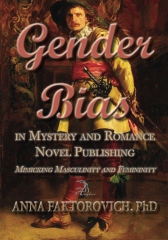
Gender Bias in Mystery and Romance Publishing by Anna Faktorovich


This is an academic study, but I thought I would try asking myself what a general reader would want to know about this book.  I reviewed The Romances of George Sand by Anna Faktorovich on Book Babe.  I also interviewed her.  More recently, I received a free copy of Gender Bias in Mystery and Romance Novel Publishing from the author in return for an honest review. 

                                               
Gender Bias in Mystery and Romance Novel Publishing

                                           
First, I’d like to discuss what Faktorovich did right from the perspective of general non-academic readers.

1) She was honest about the fact that she usually didn’t read these genres, and didn’t portray herself as an authority about them.
 2) She selected both 19th century and 20th century writers in each genre so that long-term trends could be identified.
3) She showed that in the mysteries she studied, authors of both genders tended to be disturbingly sexist in their character portrayals.  In fact, I read the results as showing that mysteries are more sexist than romances because women in most of the romances she studied are active characters, and romance tends to portray the male and female protagonists as having equal social and professional status.
4) She was willing to consider the idea that erotic romances might be explorations of women’s sexuality and could have a feminist impact for authors and readers.
5) She included short biographies of authors that contained interesting facts about their lives which aren’t well known.

Now I’d like to enumerate some serious flaws in this book.

1) She chose mysteries as the most male dominated genre.   Actually, science fiction is more male dominated.
2) She had outdated notions of both the mystery and romance genres.  Both genres have developed in directions that weren’t addressed in this study.
3)  She was completely unaware of mystery sub-genres.  The cozy and paranormal mystery sub-genres which are dominated by female authors would have been particularly relevant to this study.
4) She biased the sample of her survey by mainly distributing it on listservs for educators or librarians.

Although this was an interesting book, Faktorovich missed a great deal in her exploration of these genres.


Wednesday, October 8, 2014

Girl on a Wire: Magic, Bravery, Romance and Rivalry in the Circus World


I bought Girl on a Wire by Gwenda Bond as a Kindle First pre-release book and resolved to read it as soon as I had a little bit of breathing space between the R2Rs (Read To Review)and the blog tours.  I love circus novels. Girl on a Wire is a really wonderful example of circus fiction if you like daring stunts and have a taste for the paranormal.  If you were like me, and found The Night Circus by Erin Morgenstern  both inauthentic and superficial, then this book may be the magical circus experience that you were seeking.


The sixteen year old central character Julietta Maroni, who calls herself Jules, is a wire walker.  They are often called tightrope performers, but they walk on a wire.  Once they did use rope.  According to an article on The Oxford Dictionaries Blog, the first recorded reference to a “walker on ropes” occurred in 1542. I would tend to believe that performers eventually transitioned to wire because it’s more durable.  This circus skill is difficult enough to master without also having to deal with the possibility of a fraying rope.  

Jules has a role model in her discipline who actually existed.  Her name was Bird Millman who was a highwire artist with Barnum & Bailey.  She was best known for her grace and fearlessness.  Since a picture is worth a thousand words, this video on the Two Nerdy History Girls blog which documents a Bird Millman performance in 1931 ought to be worth at least ten thousand words.  I would love to read a biography or historical novel dealing with the life of this woman.

I enjoyed the circus traditions and vocabulary included in this novel.  The magical element occurs in the context of centuries old beliefs.  In circus families luck has always been considered an important factor in the success of an act, and losing that luck was often historically ascribed to a curse.

The two rival families that are the central focus of Girl on a Wire are the Maronis whose leading members are wire walkers, and the Garcias who star on the flying trapeze.  The commonality between these circus events is that they are both performed in midair.  This is why their practitioners are collectively known as aerealists.  I have always been a huge fan of the flying trapeze, but I came to appreciate the skill involved in walking that wire as a result of reading this book.  Wire walkers and trapeze artists are both risk takers who rely heavily on precision, timing and luck.   Despite these shared attributes, the Maronis and Garcias have not been allies.  Instead there is a legacy of hatred between these two circus dynasties that is rooted in the past.

 Jules wants to uncover the reasons behind the enmity between the Maroni and Garcia clans; especially after she meets a charismatic male performer of her own generation whose surname is Garcia.    Other reviews have called the Romeo and Juliet aspect of this novel predictable.  I prefer to call it archetypal. It’s also important to note that the resolution of this story is far from predictable.   I found it rather ingenious.  Shakespeare would never have envisioned it.   I expect to count this book among my top reads of 2014.