Showing posts with label women's suffrage. Show all posts

Sunday, May 16, 2021

The Book Woman of Troublesome Creek: Skin Color As A Litmus Test For A Packhorse Librarian

I recently discovered The Book Woman of Troublesome Creek by Kim Michele Richardson which deals with a Kentucky librarian who delivers books to people in the hill country riding a pack mule in the 1930's.  I love librarians and I'm interested in the hill people, so I checked this novel out of the library. 

 I understand that there are two other books that deal with this topic.  They are The Giver of Stars by Jojo Moyes and a children's book called Wonderland Creek by Lynn Austin.   I may read them because I am so interested in the way librarians and hill people are portrayed.  I understand that Kim Michele Richardson lives in Kentucky, and that reviewers have considered her authentic.  Since I don't live in Kentucky and have no knowledge of Kentucky hill life in the 1930's, I can't comment on the book's authenticity. 


Female protagonist Cussy had a hereditary medical condition that caused her skin to be blue. This is a real genetic disease called methemoglobinemia.  Her father, who also had the same condition, imagined that there was a man in Kentucky who could overlook her blue skin and marry her.  This would have to be an unusual man since most people in the area were deeply prejudiced against anyone who was different.  Cussy was aware of this problem, and didn't imagine she would ever marry.  Besides, she found her life as a Pack Horse Librarian satisfying.   She loved delivering reading material to people who had no access to libraries, and finding what they really wanted to read.  Yet it's important to note that Cussy only had access to discards which were books that other libraries didn't want or need in their collections.  Discards were Cussy's "new" books. 

Queenie, a black librarian who had also been delivering books in the hills of Kentucky, decided to go to Philadelphia.  She wrote to Cussy that there were colored doctors there who would treat her sick grandmother, and colored schools for her children.  Cussy thought there were opportunities for blacks in Philadelphia, but not for blues like her. She was probably right.  It was unlikely that Philadelphia would be any better for her.  There wouldn't be blue doctors there, or schools for blue students. 

 For another perspective, I'd like to mention a novel I'd read some time ago dealing with a blue skinned alien who thought himself superior to humans.  I reviewed it here .  

Harriet Hardin, the assistant supervisor at the library center, was a bigoted character that I very much disliked.  Yet her favorite book was The Stars Look Down  by A.J. Cronin which was a sympathetic portrait of a British mining family in the 1930's.  To us this would be historical fiction, but for Harriet and the other characters in this novel, it would have been considered contemporary fiction taking place in the present day.  I haven't read any A. J. Cronin, but I suspect I would like The Stars Look Down myself.  I have put a hold on it.  So we shall see. I noted that this novel was considered similar to The Ragged Trousered Philanthropists by Robert Tressell and put a hold on that one as well.

This book also led me to a highly regarded classic, The Good Earth by Pearl Buck.  Cussy was given the sequel, Sons, by a library patron who turned out to be a very pivotal character.  I looked up The Good Earth and decided that I should read it. After I finish it, I'll see if I want to read its sequels.  

No review that I've seen of The Book Woman of Troublesome Creek has mentioned medical research as one of the issues brought up in this novel.  Doctors wanted samples of Cussy's blood.  It seemed to me that the doctors were more interested in benefiting their own careers than Cussy.  They gave her a drug that had side effects.  Discussing the impact of the drug would be a spoiler, but I consider this racist medical research based on white supremacist ideology.  I applaud Kim Michelle Richardson for showing us so vividly that medicine can be racist.

As a feminist, I was struck by Cussy receiving a letter with a Susan B. Anthony stamp and not knowing who that was, or the meaning of "Suffrage for Women" which was written beneath the stamp.  I was sad that Cussy had never learned about the women who had struggled for women's suffrage, and I wondered if she had been taught about the 19th Amendment to the United States Constitution or its ratification on August 8, 1920.  

The Book Woman of  Troublesome Creek made me sit up and take notice of a Kentucky that was unknown to me, and showed me the tough librarians who supplied Kentuckians with books in all times and seasons.


Wednesday, April 28, 2021

Leaving Coy's Hill: A Novel About Suffragist Lucy Stone


 I haven't posted here for a while.  This is partly because I was moving in March, but I also hadn't been coming across books with strong female protagonists.  I recently got hold of a book about a woman's suffrage leader which was given to me for free by the publisher.

Many readers may never have heard of Lucy Stone.  In my case, I thought that Sherbrooke's novel showed a different side of Lucy Stone than the one I knew about. 


I thought of Lucy Stone solely in terms of her puritanical attacks on divorce and Victoria Woodhull, who is one of my favorite suffragists.  (See what I had to say about Woodhull in my review of Seance in Sepia here  , what  Karen J. Hicks had to say about her Woodhull book The Coming Woman here  and my review of the Woodhull novel Madame Presidentess here .)   Yet there was a good deal more to Lucy Stone than I had ever imagined. 

Lucy started thinking about women's rights as a child when she thought a cousin wasn't being well-treated by her husband. She told a woman friend who wanted to be a minister that the Bible was used to diminish women.Then when she was being paid to speak for the abolition of slavery by the Anti-Slavery Society,  she decided that she had to speak out for women as well. When she married Henry Blackwell, she insisted on keeping her own name.  At the time, this was revolutionary.   

This is a book that take's Lucy Stone's perspective.  It shows us where the women's suffrage movement fractured.  Although both Elizabeth Cady Stanton and Lucy Stone had husbands, Susan B. Anthony chose to demonize Lucy Stone's marriage as disloyal, but not Elizabeth Cady Stanton's.  I have always believed that feminists should respect women's choices. It seems to me that feminist leaders have gone wrong when they turn on each other because of life style differences.  Shared goals are the foundation of feminism.  Sherbrooke's novel shows that factions are unnecessary, and can have sad consequences. 

Saturday, May 13, 2017

In The Fullness of Time: A Novel About A Fictional South Carolina Suffragette

Suffragettes are a favorite historical topic of mine.  So far this year I've reviewed  The Poison in All of Us,  a murder mystery dealing with suffragettes, on this blog here.  I've also reviewed a biography of British suffragette Sylvia Pankhurst on Shomeret: Masked Reviewer here.   So I was glad to see a request to review another suffragette novel in my e-mail.   That book was In The Fullness of  Time by Katherine P. Stillerman.  I received a free copy in return for this honest review.
                                    

 I wasn't aware that this book was a sequel until I finished it and read the Author's Note.  The first book was Hattie's Place and dealt with the same protagonist.  Since I haven't read it, I can only speculate about Hattie's Place based on its description.  It sounds more character centered than In The Fullness of Time.

 There is a good deal of telling and conversing about events that occurred off the narrative stage.   When an author does this, it distances the readers from those events.   If they are events that are significant in the lives of the characters, the audience may also feel distanced from the characters.  We don't find out what the characters were feeling and thinking as we would if we got to experience the events in real time as the characters experienced them.  


When I read about the focus and source of inspiration for this book in the Author's Note, I understood why Stillerman made the choices that she did. Like many American feminists, she was impressed by the fact that a woman was running for President of the United States.  So the symbolism of publishing a suffragette novel in these circumstances was irresistible. As a feminist myself, I was sympathetic to that perspective.  Unfortunately, this meant that at times Stillerman was more focused on the history of women's suffrage than on the characters.  It seems to me that the result was that her novel had less impact.

Another problem for me is that I was most interested in Hattie's sister in law, Alice, because she was more independent minded than Hattie.  I often wished that Alice was the protagonist.   Perhaps Stillerman thought that Alice was too unconventional and therefore less relatable for her audience.   Some readers also might think that the book would feel more historically authentic with a more typical woman as the central character.  Yet women like Alice did exist,  and I believe that novels that feature them inspire current readers.  It's also possible that if I had read Hattie's Place, I would have considered Hattie a stronger protagonist.

The male character that I considered most interesting was dead before the novel opened.   He was Alice's husband, Raymond,  an innovative physician with extraordinary insight.   I would love to read a book about Alice's unusual  marriage to this man.   Instead the story of Alice's marriage was used as a learning experience for Hattie.  It seems to me that there would be more dramatic power in showing Alice's experiences first hand.

There was an aspect of In The Fullness of Time that I considered valuable because I love history.   Stillerman describes the political process of how women's suffrage became law in the U.S. on both the federal and state levels, and all the obstacles to achieving ratification.  I have never seen a novel that was this detailed about all the practical politics involved in this issue.  Stillerman cites an extensive bibliography in her Notes on Sources.  Her research definitely shows.  For me, all the details made fascinating reading.  Suffragette novels usually only show dramatic high points in the struggle which is more entertaining for the general reader.   I imagine that I am an outlier, and that most of her audience would prefer a book that is more novelistic.  


Saturday, September 3, 2016

Madame Presidentess by Nicole Evalina--The First Woman To Run For U.S. President

Feminist Victoria Woodhull is one of the irresistible historical personages for me.  She was the first woman to run a brokerage on Wall Street as well as being the first woman to run for President. Tara and I joint reviewed Seance in Sepia, a book that contained Woodhull as a side character, on this blog here.  I admit to not having been enthusiastic about the last book I reviewed by Nicole Evalina, Daughter of Destiny . Yet all the aspects of Victoria Woodhull's life that got short shrift in Seance in Sepia  are fully realized in Madame Presidentess by Nicole Evalina.  I obtained this book for free from the author in return for this honest review.


We find out about Victoria's childhood as the daughter of Buck Claflin, an abusive and self-destructive con man.  Earlier this year, I read a mystery called The Saints of the Lost and Found in which the central character came from a family very much like Victoria's.   I wouldn't be surprised if the author loosely  based her protagonist's childhood on Victoria's because her parents were so outrageous that they'd be more believable as fictional characters.
                               
In  Madame Presidentess we get the full story about Victoria's spiritualism including her visions and how they impacted her life.  For Evalina's Victoria, spiritualism was not the widely promoted fakery of her day.  It was a deeply felt religious practice. She was absolutely convinced that the ancient Greek historical personage Demosthenes  was guiding her life.   I am not so convinced.  There is no indication that Demosthenes ever advocated for women's rights during his lifetime.  The playwright Euripides would have been a more believable spirit ally from the ancient Greek world.  Euripides wrote powerful plays that centered on women.  He might conceivably have encouraged Victoria in her feminist political activity.   I am willing to believe that Victoria was a sincere practitioner who was duped by a spirit pretending to be Demosthenes for unknown purposes.

Yet Victoria wasn't always above pretending to receive messages from the spirits.  I suspect that she was deceiving herself about having escaped completely from her family's influence.  Evalina  depicted Victoria as capable of being a grifter like her father, and a blackmailer like her mother.   These tendencies eventually wrecked her Wall Street career, and her campaign for President.  In Madame Presidentess Victoria thought that her family betrayed her, but she also made some poor choices from an ethical perspective.  My conclusion is that Victoria was largely responsible for her own downfall.  Like many male Wall Streeters and the overwhelming majority of politicians, she probably felt that the ends justified the means.   Her more idealistic allies in the suffrage and labor movements probably felt that she had used them.

Victoria Woodhull is shown to be a complex individual in Madame Presidentess.  Whether Victoria inspired me or disappointed me, she always engaged me as a character even when I didn't agree with her choices.  I liked the thoroughness of this biographical novel and particularly appreciated the spiritualist content.


Sunday, November 16, 2014

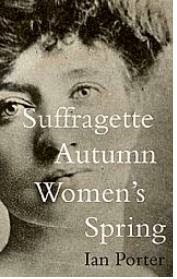
Joint Review: Titanic Survivors Join The Women's Suffrage Movement


Suffragette Autumn, Women’s Spring deals with two protagonists.  First, there’s Titanic crew member Ruby Martin surviving the sinking of the Titanic, and becoming involved in the women’s suffrage movement after her return to England.  Then there’s Alexander Nash, a rough and tumble working class Londoner who also survived the Titanic and unexpectedly becomes involved in the women’s suffrage movement as well.


To give you a taste of this book, here’s a quote:

“Her thoughts then drifted back to the sinking as she recalled holding back as the last lifeboat was about to be launched, a caricature of a poor working class girl who thought she was not good enough to be saved, allowing men to make decisions over whether she lived or died. It would not happen again. She was as good, though no better than, anyone else; any upper or middle class woman or any man.”  Suffragette Autumn, Women’s Spring by Ian Porter

Tara and Shomeret will be reviewing this novel jointly.  Tara received a free copy from Net Galley.  Shomeret purchased the novel on Amazon.  We have  different perspectives on this book.  Shomeret liked it a great deal better than Tara did.

                                                                  
Tara: The very beginning and thus the first half of this story grabbed me and sucked me in right from the get-go. The Titanic is sinking. The ship is chaos as women and children are rushed into lifeboats. Nash and Ruby meet and he literally throws her overboard into the arms of a crew member. She makes the very last boat.

And once the ship meets its tragic fate, there's frostbite to contend with, and the White Star Line trying to dishonestly bribe third-class victims.

Shomeret:  Perhaps this is a mis-perception.  It was my understanding that the money that White Star was issuing to all passengers that survived the Titanic’s sinking was intended as perfectly legal compensation for pain, suffering and losses. The scandal as I saw it, was that the compensation was so very inadequate for the lower class passengers.

Tara:  I guess because we were seeing it from Nash's POV, I interpreted it the way I felt he was?

Then there's Nash running around beating up White Star employees, and Ruby trying to get justice for her widowed mother... It's really entertaining stuff while at the same time showing readers what went down after the sinking. The drama and tragedy didn't stop once the boat reached the bottom of the ocean, even though its crew were officially unemployed and unpaid at that point.

I was riveted.

And strangely enough, I remained riveted until...Ruby joined the WSPU and began getting involved with the Pankhursts. This is nuts, I'll admit. That should have been my favorite part of the book, as into women's rights and history as I am, but to be frank, I found myself more appalled than inspired by the behavior of the women, by their militant antics.

Shomeret:  The second half involving the women’s suffrage movement in England was when I got invested in this novel.  My attention wandered in the first half involving the Titanic.  I had read about the Titanic disaster elsewhere, and this is not a particular interest of mine.  It’s only after I read the entire book that I understood how the two halves fit together.  They were both a record of how the lives of working class people weren’t valued in Victorian England.  Ruby went to Halifax to try to claim her crew member father’s body, and discovered that dead Titanic crew members had received a callous mass burial at sea.  Ruby’s mother received a heartbreakingly low widow’s pension. The White Star Line obviously didn’t care about their employees or their families. 

The tactics of the Pankhursts need to be placed in a larger context of protest movements in England going back centuries.   People had to die for the right to read the Bible in English, for example.  Before the Reformation, the Catholic Church didn’t want ordinary people to be able to read and interpret the Bible for themselves.  Today, we take it for granted. People died for what we consider very basic rights for workers in the struggle for labor unions.  Things like bathroom breaks and getting weekends off are the result of what was often a violent and bitter process.   I don’t endorse violence myself, but I understand why Emmeline and Christabel Pankhurst thought it was needed.  Martyrs have historically gained a great deal of support for causes.    It shows people the seriousness of the cause if people are willing to die for it.  It’s important to point out that the WSPU didn’t want to kill anyone outside the movement.  The WSPU were verging on terrorism, but I think the main difference is that terrorists do want to kill innocent bystanders.  The WSPU wanted to make sure that they only attacked unoccupied buildings or locations.

Tara: What exactly do you prove by starving yourself?

Shomeret:  Fasting as a protest goes back to ancient times.  In ancient Ireland, it was called Troscadh.   The goal was to make people feel guilty. The original hunger strikers in Ireland would fast at the door of someone who had committed an injustice against them.  If the person who was the target of the hunger strike didn’t let the hunger striker into the house and ignored the protest, they were violating hospitality which was considered a terrible sin in ancient Ireland. If the target of the protest let it continue until the person died, they would be required to give restitution to the hunger striker’s family.  There’s a web page that provides some history and context for hunger striking in Ireland at  Hunger Strike History in Ireland.   Hunger striking is ineffective if the target of the protest has no conscience or doesn’t think that the death of the protester will have an impact on their reputation.   In this case, the government of England cared very much about suffragettes dying in prison. That’s why their reaction was force feeding.  They understood that martyrdom would increase the number of people who supported women’s suffrage, and they emphatically didn’t want any martyrs for the cause. 

Tara:  What do you prove by getting murdered by a horse and risking the life of the horse and jockey? By throwing rocks through shop windows? While I get it was attention-grabbing, I don't think that was the kind of attention they needed. After all, if you act like a hoodlum, you'll be treated like one.

Shomeret:   The woman who sought to disrupt a horse race to call attention to women’s suffrage had actually been expelled from WSPU for being too extreme.  Ian Porter shows that this particular action had negative impact and that there were a number of people who resigned from the WSPU because of their violence.  There was even a split within the Pankhurst family.  Sylvia Pankhurst disagreed with the tactics of her mother and sister.  Sylvia is the Pankhurst who is portrayed most sympathetically in this novel. I think that Ian Porter intends readers to side with Sylvia Pankhurst because she understood the importance of working class support for women’s suffrage and was a pacifist.

Tara: It was also at this point that we begin to see less of Nash. And despite his terrible dialogue--can't understand what he's saying half the time--I really liked his character. He's simple, honest, and gives what for.

Shomeret:  Nash or Nashey, as he was called by his friends, was a wonderful character.  The stereotype is that men like him don’t respect women.  Nash respected anyone who he thought was worthy of respect. That’s why he stood up for Ruby and for Sylvia Pankhurst.  He understood that Sylvia Pankhurst cared about working class people, and that she was working for a better future for everyone regardless of class or gender.

Tara:  I'm so with you on that, Shomeret. I appreciate Ian Porter portraying a man in such a light. Too often in stories tackling this issue, the men are the naysayers. It's good to be reminded that they weren't all against the movement.

Despite the fact that my mind began to drift as I found the WSPU actions distasteful, I did gain a lot from the history revealed about the Pankhurst family, how Sylvia stood for working women and Christabel looked down on them. I learned about the Cat & Mouse law, and also prison life for suffragettes.

The book has one thing really standing against it though, IMO. It's told in omnipresent POV, god-like. This type of narrative prevents the reader from really becoming a part of the tale and getting to the know the characters on a deeper level. And though I loved the Titanic part, in the end, I don't see how--besides the women and children thing and Nash and Ruby having to meet somehow--it ties into the last half. Also didn't see the point for Nash's previous "association" with the Ripper murderer. It didn't quite all tie together for me.

Shomeret:  There are pros and cons for each type of narration.  I agree that there can be less depth in character viewpoints when omniscient narrative is used, but I think that there is also the plus of being able to go beyond a single character's viewpoint.  You can give the reader a panoramic portrait of an entire era which is what I think Ian Porter did very successfully.

 As I said above, I thought the two halves tied together by being a working class perspective on both events.  Every time I see the Titanic in a movie or on TV,  there are always scenes of  wealthy passengers dancing just before the disaster.   The poorer people in steerage and the Titanic crew are invisible to history.  In the second half, Sylvia Pankhurst eventually hires Ruby to start a suffrage school.  Her mother and Christabel had no time for the uneducated.   Sylvia thought it was important to educate them, so that they would understand the issue and its significance for their own lives and their families. 

I think that the Ripper case was brought up to show both how tough Nash was, and that he cared about women that society considered outcasts.  Jack the Ripper killed prostitutes.  It’s a famous case, but the authorities probably didn’t investigate as thoroughly as they might have if the victims were wives or daughters of wealthy and prominent men.  His victims were socially invisible like the lower class victims in the Titanic disaster and the people that Sylvia Pankhurst made her priority.  For me, it does all tie together.  I thought this was a really excellent novel.

Tara: Good point. For some reason, I just couldn't see the tie, but you make an excellent case.

 Tara’s Rating:
   
 Shomeret’s Rating :   


Saturday, March 2, 2013

Votes for Vixens up for Book of the Month on TBR Pile

I'd appreciate the votes. Hoping many of you have read it. <3 font="">

My light f/f historical novella about suffragettes in NYC warranted a 5-star rating on TBR Pile and is up for book of the month. See the poll to the right of their website.

What they had to say:
"Freaking fabulous! This time period isn’t used often and that’s such a shame. The author did a stunning job with the details and language. It really made me feel like I jumped back in time. Elizabeth was a very well written character. She was someone I wanted to see succeed in life."

You'll have to visit their site for the entire review.

Thanks for all the support! 

Tuesday, November 6, 2012

Votes for Women


Today, I merely wish to share with you a collection of mine. I'm just fascinated by this time in our history, by the fight, the determination, the way women came together for one cause: the vote.

No matter who you vote for, don't forget you have a voice, and it wasn't easy getting there.

On that note, this is my Votes for Women postcard collection.

I still don't get the joke on the left one, bu t the right one is adorable and
they are both postmarked 1918. Cambridge Springs, Penn. *I think*


My favorite. Look at the little noose....
She ain't giving up!


Saturday, November 3, 2012

Votes for Vixens Giveaway


Votes for Vixens

This month I'm celebrating the release of Votes for Vixens.
I'm touring with Sizzling PR:


5 – Guest Blog @ Erotica for All
6 – Interview @ You Gotta Read
7 – Spotlight, Giveaway & Review @ Steamy Reading
8 – Guest Blog @ Sizzling Hot Books
13 – Interview @ Bonnie Bliss
14 – Spotlight & Giveaway @ New Age Mama
15 – Guest Blog @ Two Fantasy Floozies
19 – Guest Blog @ W. Lynn Chantale
28 – Review @ Rosa Sophia
AND giving away a lovely handcrafted necklace from Sassy Ginger Creations as well as a replicated Votes for Women postcard, unused. An extra bonus: a $5 Starbucks Gift Card so you can drink your coffee while you read your own ebook copy of Votes for Vixens.

All items will be sent to ONE lucky winner. Must be a follower of Book Babe and a U.S. resident. Thank you and good luck to all! 
Contest runs through the month of November.