Friday, June 21, 2024

The Paris Understudy: Are Two Female Protagonists Better Than One?

 It certainly looks like I'm going to have read at least three books in June 2024. I haven't read that many since March.   That gives me hope that my book totals may be heading upward for the rest of the year. 

I've been searching through my e-mail to try to find out who sent me this book.  I haven't been able to find it in any e-mail folder.  So I can't credit the possible publicist who sent me the book that I am reviewing here. Whoever you are, you have my gratitude. 

I can tell you that the author is Aurelie Thiele and that her website can be found at http://aureliethiele.com  There is more than one individual with the name of Aurelie Thiele.  I decided that she must be the Aurelie Thiele on the Goodreads Page devoted to Thiele.                                         


This is a tale of two fictional French opera singers. Madeleine refused to sing in Nazi Germany.  The more influential Madeleine had made her rival Yvonne, her understudy.  So Yvonne feared that she would get no work if she didn't sing in Madeleine's place. This was a serious error in judgement, but she couldn't see the implications for the future of her career.  Even worse, she didn't perceive that the beliefs of the Nazis were unconscionably evil. Singing was apparently all she knew and cared about.  So her professional debut was in Nazi Germany, and it was a triumph.  She sang Isolde in Wagner's Tristan und Isolde to great acclaim. Hitler was present at the performance, and called Yvonne "an enchantress".

In the Author's Note, Thiele reveals that Yvonne was based on the real life opera singer, Germaine Lubin, whose Wikipedia page can be found at the hyperlink.  If you haven't read The Paris Understudy, I would advise you not to read that Wikipedia page because it's virtually identical to the plot of Thiele's novel. 

I did like The Paris Understudy for the historical context even though I didn't enjoy reading about the rivalry between the protagonists.  I prefer reading about women who are friends rather than competitive rivals. 


Sunday, June 9, 2024

Better The Blood: A Female Maori Protagonist in New Zealand

When I ran a search for "Maori", I discovered that I had reviewed a book dealing with this Polynesian people in New Zealand about ten years ago.  You can find that review at Novel Taking Place in the 19th Century Containing Maori Characters.   The book I'm currently reading is a contemporary thriller with a female protagonist.  That means my review of Better the Blood by Michael Bennett belongs here on Flying High Reviews. Kudos to Bennett because this is his first novel.  I checked out the copy of Better the Blood that I read from a public library.

I would like to mention that this book has actual footnotes at the bottom of pages.  This is unusual in recently published books.  Most current publications that contain notes, have endnotes that appear at the back of the volume.


 The protagonist is Maori police detective Hana Westerman.  Hana is a complex character with loyalties to both law enforcement and to her people which can conflict.

An old woman said that her 19th century ancestor burned English buildings.  Then he gathered about a dozen men and they went into the forest.  "From there they waged war."  The men in the forest sounded like Robin Hood's band to me. The woman said her ancestor was hanged in 1863.

The first contemporary crime that appears in this novel was committed by Patrick Thompson, an English descended man who had been convicted of the rape of a Maori woman.  He had openly told Hana that he also wanted Hana's daughter.  Thompson accused Hana of attacking him, but Hana had only told Thompson to stay away from her daughter.

The body of a different rapist, Terrence Sean McElvey, was discovered.  He'd died of blunt force trauma when a weapon connected with his skull.  He'd previously killed his infant daughter who had fallen on her head, and had received a three year sentence for manslaughter.

Yet the actions of the Maori revolutionary/terrorist Poata Raki dominate the narrative.  His violence is viewed negatively by Hana, but she is sympathetic to his cause.  This ambivalence is understandably difficult for her to deal with.  For Raki, this is all very personal.  It's about what's been done to members of his family, and what's been done to his tribe.  Hana sees Raki as a member of her people who has "lost his way".

I thought that this novel was powerful and indeed beautiful and haunting in its resolution.  It's been a while since I'd read any fiction that deserved to be given the grade of A.  Better The Blood  actually got an A+ from me for its thematic focus and the complexity of  Bennet's view of  the various characters who are all parties to this personal and political conflict.


Thursday, May 9, 2024

Rogue Justice: A Book by Stacey Abrams Has A Strong Female Protagonist

When I started 2024 with a post on Flying High Reviews, I didn't imagine that I wouldn't be back for four months--just as I didn't know that I wouldn't post here for all of 2023.  Again, the problem of  not coming across strong female protagonists reared its ugly head.   I can't promise that it won't happen again either.  I already know that the next book I'm reading will be non-fiction.  So I won't review it here.  Hopefully, a novel with a strong female protagonist will surface in the next few months.


It shouldn't astonish anybody that the book that occasioned my return to Flying High Reviews was by real life strong woman Stacey Abrams. For those who don't follow U.S. politics, I have a link to Abrams' Wikipedia article here.

I'm beginning my discussion of Rogue Justice with a brief reference to  African spirit Mami Wata in the book.  Abrams called a company Mami Wata Inc.  I recognized the name and am doing my due diligence by posting a link to an article about Mami Wata from the Smithsonian website for the National Musum of African Art.

Rogue Justice is the sequel to the Abrams thriller While Justice Sleeps.  I read and reviewed that novel in  June 2021 on Goodreads  here.  

The strong female protagonist who had been central to bringing the President of the United States to the brink of impeachment is Avery Keene, a clerk for Supreme Court Justice Winn.  Justice Winn is in a coma, but Avery had uncovered genocide, treason and murder which needed to be investigated.

In Rogue Justice Avery found out about such a terrible threat to the entire U.S. that I thought it could justify the legally compromised President declaring himself a dictator.  The woman behind this threat had been denied justice while she was in the Navy.

There are a number of important revelations by the end of the book, but it didn't seem completely resolved.  So I suspect there will be another sequel.


Saturday, January 13, 2024

The Lantern's Dance: A Mary Russell Book by Laurie R. King To Open 2024

It may seem that I've been neglecting Flying High Reviews . I'd like to emphasize that this is a blog for strong female protagonists.  There actually were no strong female protagonists among the books I read in 2023 in my estimation.  I was hoping for one, but no female protagonist in the novels I read last year met my admittedly exacting standards.

 The Lantern's Dance got my immediate attention.  I was astonished to get an approval of a Laurie R. King novel from Net Galley at the end of last year.  I've never had an approval for such an eminent mystery author.


Mary Russell is one of my favorite female protagonists.  So I was disappointed to see her periodically de-emphasized in favor of characters I hadn't previously encountered. Mary Russell works with Sherlock Holmes. Both Mary Russell and Sherlock Holmes are fictional characters.  Sherlock Holmes was created by Arthur Conan Doyle and Mary Russell was created by Laurie R. King, the author of The Lantern's Dance.  It's the 18th book in the Mary Russell and Sherlock Holmes series.

 There was a complex web of characters in The Lantern's Dance. I sometimes had to page back to where these characters were introduced to identify who they were.  Changes in perspective added to the complexity.  There was at least one moment of confusion about the viewpoint character that I recorded in my notes.

There is a reference to Monet's cataracts in this book.  This sent me to the Wikipedia article dealing with Claude Monet.  I had never focused on Monet because I couldn't recall seeing any of his work in person.  I actually had, but I didn't find it memorable.   So this is the first time I've looked up Monet and read something about his life.  It's tragic for a visual artist to develop cataracts.   

There was also a reference to a controversy over whether art should be decorative in The Lantern's Dance.  I have a comment in my handwritten notes on this novel dealing with seeing Picasso's "Guernica" in person.  "Guernica" had a strong impact on me.  In 10 Facts About Guernica  I learned that Picasso considered this painting to be centrally about fascism.  I conclude that for Picasso, art wasn't about being decorative.  If art is supposed to be decorative, then "Guernica", one of the most memorable pieces of art I've ever seen, is not art.  

Indigo and the Indian revolt against growing it in 1859 is mentioned in The Lantern's Dance. The British had forced Indians to grow indigo instead of a food crop.  I found a Wikipedia article about a play called Nil Darpan that deals with the revolt against growing indigo.  The play was controversial.  James Long, the man who published it in English, was charged with sedition and imprisoned.  I found the play in pdf  format at Nil Darpan on Internet Archive if you're interested in reading it.

The real artist, Horace Vernet, who is often referenced in The Lantern's Dance, had an 1835 self-portrait that Laurie R. King calls Holmesian in her Author's Note.  I am including this self-portrait below in a resized format that will fit on the page.  I agree that this image of  Vernet does resemble the way some might view Sherlock Holmes.  Since Laurie R. King is one of them, we must give serious consideration to her view.  

Here is the self portrait of Vernet in question:


                           https://upload.wikimedia.org/wikipedia/commons/a/a8/Emile_Jean_Horace_Vernet_002.jpg


The author notes that 2024 marks 30 years since the first  Mary Russell and Sherlock Holmes novel , The Beekeeper's Apprentice, appeared.  So I would like to wish Laurie R. King a happy anniversary and felicitations on publishing this very labyrinthine mystery.


Monday, December 26, 2022

Back To the Garden: A Standalone Thriller by Laurie R. King

This is the third novel by Laurie R. King that I am reviewing.   The other two were Dreaming Spies and Island of the Mad which are books in King's Mary Russell series.  The reviews are at the hyperlinked titles.   The genre of Back to the Garden  may be best described as contemporary/historical thriller, but the historical scenes don't feel very historical to me since they took place during my lifetime.  Yet there may be readers of this review who weren't born yet during the 1970's.   So whether a period feels historical can be very subjective.


Bones had been found underneath a three headed triple Goddess statue by a fictional artist named Miriam Gaddo, who is supposed to have worked with the real artist, Judy Chicago .  Gaddo is referred to in the book and the investigating officer has a conversation with her, but she can't be said to be a major character in Back to the Garden.

The identification of the bones continues to be an ongoing issue because the lab that is doing the identification is behind in its work.  

There are numerous local missing women and it's assumed by law enforcement that the bones may be one of these women.  When the bones are finally identified, it really is a shocker.  The book changed for me.

The story line led us "down the garden path", so to speak.  When we find out the truth, the entire focus of Back to the Garden changed.  There is a suspenseful climactic scene at the end.

There could conceivably be future books involving Raquel Laing, who was investigating this case, but I was glad to know that Laurie R. King is working on a new novel in the Mary Russell series.  I will look forward to it.


Wednesday, December 14, 2022

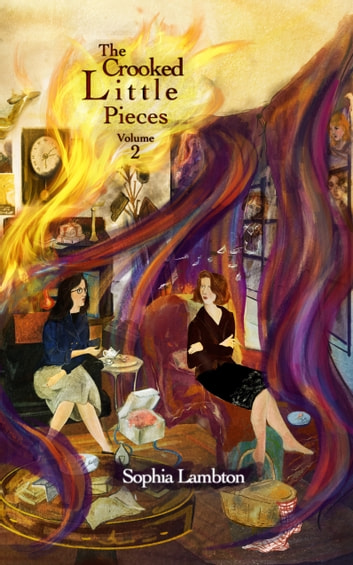
Crooked Little Pieces Book Two: The Lives of Two Sisters Continue

This is the review of the sequel to Crooked Little Pieces Book One.  I posted the review of the first volume here

I received this book from the author Sophia Lambton, who is also the publisher.  She founded Crepuscular Press in order to release her work.

 I learned that crepuscular means like the twilight.  Twilight often refers to when the sun is sinking and the light is fading, but it isn't completely dark yet.  It has a liminal status, which is about being betwixt and between. 


   The two sisters, Isabel and Anneliese, find themselves in careers which are compatible for them.  Although Isabel has a tragic loss and considers her career temporary, Anneliese has incredible good fortune.                                  
Isabel is teaching music at the girls' school that she and her sister attended.  One of the students came to England with her mother illegally.  The school wants to keep this student safe. Her name is Margot. She speaks German.  Isabel is expected to teach her English. In class, Isabel repeated what she said in English in German for Margot.  She also arranged to teach her English on Tuesdays and Thursdays during lunch.  Isabel revealed that she once spoke German herself, and her sister spoke their father's language, Dutch.  To show the similarity of the languages, Isabel had Georgia, who spoke Dutch, speak some Dutch to Margot.  Margot understood some Dutch.  Isabel asked Georgia to make sure Margot wasn't all alone in school.

Isabel was having the students try to define what is modern in music.  She asked if something was modern because Beethoven never composed that sort of music.  She also asked if they were living in a darker age because there had been two world wars.

An old man who was one of Anneliese's patients griped about being picked on for being left handed. I'm left handed myself and have never been picked on for it.  I think that was still happening in my mother's generation, but it stopped in my generation.

We learn that the girls' school was going to have a new headmaster instead of new headmistress.  Isabel was upset that the new headmaster is Jewish.  Anneliese is no angel either.  She stole transcripts from the library  because she didn't have the time to make her own copies of the transcripts.

I assume that the author is showing that the sisters are flawed to humanize them.   It seems to me that Isabel can be humanized without offending a segment of the audience.

This book ends with Benjamin asking Anneliese to accompany him on a housecall on a nine year old suffering from schizophrenia.  We don't learn anything further.

I would have ended it with the school's change from headmistress to headmaster.  It would have seemed more like a stopping point.  Ending with an invitation to join a housecall seems rather abrupt.

Despite this second volume's flaws, I'm going to give this book four stars on Goodreads.   I'm hoping to like the next book better.


Wednesday, October 19, 2022

Crooked Little Pieces : Book One in a Series

 I was asked to read  Sophia Lambton's novel,  Crooked Little Pieces, by the author who had seen my reviews on this blog.  This is the first book in a series which explains why it's not as resolved as a standalone novel would be.


The protagonists are the sisters Isabel and Anneliese who were born six days apart.  I expected to like Isabel because she is a musician, but the focus wanders away from music. I confess that I found her problematic because I am a feminist.  Isabel's perspective is troubling for feminists.  In addition, Isabel is antisemitic which I find offensive.

 Anneliese's scholarly view is more to my taste. She is also more confident  than Isabel.  Isabel is incredibly lucky to have Anneliese as a sister.  Anneliese's support is crucial for Isabel at some points in the narrative.                                   

Although the prologue takes place in 1968, the first chapter opens in the 1920's when the girls were six.  The novel ends in the WW II era. I expect that the second book will continue with this WWII progression.