Showing posts with label Woman Lawyers. Show all posts

Thursday, November 22, 2018

The Widows of Malabar Hill: A Pioneering Lawyer in 1920's India

The Widows of Malabar Hill by Sujata Massey was nominated in the mystery category in the earliest phase of this year's Goodreads Choice Awards. Since I had a copy from the F2F mystery group that I attend, I decided to prioritize it.  I am reviewing it on Thanksgiving because I am thankful for this book.


 I  read some of the books in Sujata Massey's  mystery series about Japanese American Rei Shimura and found them entertaining.  Yet I've always wondered if she could produce more riveting mysteries if they were more related to her own heritage.   I don't believe that authors should be forbidden from writing books that have nothing to do with their heritage. What I do think is that Own Voices work is important and should be encouraged. Sujata Massey is partly Indian.  So I rejoiced when I saw that she had written a mystery taking place in India.  Not only this, but her fictional protagonist was based on real women who were among the first to practice law in India.

I reviewed a mystery about the real woman who was the first to practice law in California here. I hoped that The Widows of Malabar Hill would be better written and more authentic. My expectations were definitely fulfilled. 

The main character of this novel, Perveen Mistry, belongs to a religious and ethnic minority in India.  She is a Parsi.  The Parsis originated in Persia, and continue to practice Zoroastrianism which is an ancient religion that influenced Judaism, the faith of my own ancestors.   I read about this influence in Rav Hisda's Daughter by Maggie Anton which I reviewed here.

Some very traditional Zoroastrians had customs that were abusive to women.  Perveen had some horrifying experiences that many readers will find very troubling. I feel that I have a duty to warn that some readers who are survivors of domestic abuse may find that this section about Perveen's past in The Widows of Malabar Hill triggers flashbacks for them.  So this isn't a book for everyone.

 Perveen had the strength to emerge from the shadow of abuse, but it's important for me to say that she couldn't have done this alone.  As I mentioned in the last review I posted to this blog here , class can be an important factor in women's lives. Without the support of her wealthy and influential lawyer father, Perveen would have had nowhere to go and couldn't have become a lawyer herself.

As a result of the British Raj, India had two types of lawyers--barristers and solicitors. Barristers argue cases in court.  Solicitors write documents and briefs.  They also give advice to clients.  Both types of lawyers are very necessary to the practice of  law. Since both the British and Indian traditionalists didn't believe that it was proper for women to have occupations that required high profile public appearances, it was initially very difficult for a woman to become a barrister.  So the first woman lawyers in India were solicitors.  Perveen became a solicitor at her father's law firm.

The case in The Widows of Malabar Hill illustrates an important role for woman solicitors.  There were devout Muslim women who needed to consult a lawyer and couldn't speak to a man.  So Perveen helps women with their legal difficulties.  The Parsi female lawyer who is the main basis for Perveen, Cornelia Sorabji also began as a solicitor for women.

Another wonderful woman character in this novel is Perveen's closest friend, Alice, an English feminist who Perveen met when she was studying law at Oxford.  I would like to see Alice continue to assist Perveen with her cases in future novels in this series.

I will be very surprised if The Widows of Malabar Hill doesn't turn out to be my favorite mystery of 2018.   I am very much looking forward to seeing more of Perveen in the future.

Thursday, February 22, 2018

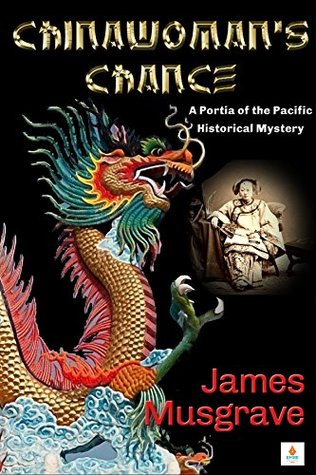
Chinawoman's Chance: First In A Series About A Pioneering Woman Lawyer

When I nominated Chinawoman's Chance on Kindle Scout for an opportunity to be published by Kindle Press, I hadn't heard of its real historical protagonist Clara Shortridge Foltz, the first woman admitted to the bar in California in 1884.   This historical mystery novel wasn't selected by Amazon.  So author James Musgrave self-published and offered all those who had nominated his book a free copy.  I eagerly accepted one, and I am now posting my honest review.


My original intention was to praise this cover's illustrations for drawing my attention to the book.  Yet when I copied and pasted the cover to this blog, I noticed for the first time that the title isn't very legible.  If I hadn't already known that the title was Chinawoman's Chance, I wouldn't have learned it from this cover.   Is the legibility of the title on the cover important for a self-published book?  I would argue that it is important. Readers often look at the cover before anything else on a  book vendor site.  Not being able to read the title creates a bad first impression for a reader deciding whether or not to buy the book.

Next I turn to the series title which is Portia of the Pacific. Yes, titles are very important to me.  They influence me more than cover illustrations.   I have an attraction/repulsion relationship with Shakespeare's Portia.   So  I was attracted by the series title because I love a woman taking a professional role that was forbidden to women in Shakespeare's day.  I love Portia's speech.  Yet  I am repelled by the bigotry toward Shylock that motivated her.  I see Shylock as the victim in Merchant of Venice.   His feelings of outrage over having no rights are used against him.  Portia is clever, but she is supporting a system in which Jews can't get justice.

 The fictional Clara Shortridge Foltz isn't bigoted toward the Chinese.   Not only does she have a Chinese client,  but she helps to thwart a plot against the Chinese community. Yet I learned from Musgrave's acknowledgements that the real Clara Foltz was actually prejudiced against the Chinese and would never have had a Chinese client as she did in Chinawoman's Chance. For me, there is a tension between the real Clara and the fictional Clara.  I ended up feeling as ambivalently toward the protagonist as I do toward Shakespeare's Portia.  

For those who want to see what Clara Shortridge Foltz looked like, I found a public domain photo on Wikipedia.


I admired the role played by the fictional Clara Foltz, but I felt that the novel fell short as a mystery.  There was a plot twist that I didn't find credible from a police procedural perspective.   I also felt that the resolution was formulaic.  I had seen it before a number of times, so it didn't surprise me.

I also had a problem with a Chinese character's name.  Musgrave said in his acknowledgements that he researched Chinese culture.  If so, I don't understand why he didn't seem to know that Guan Shi Yin, also known as Kwan Yin, is a Bodhisattva.  A Bodhisattva is someone who has reached Buddhist enlightenment and decided to help others achieve it.   Kwan Yin is also known as the Goddess of Compassion.  I was taught a mantra for Kwan Yin "Namo Guan Shi Yin pusa."  The English translation would be: Homage to Kwan Yin, compassionate and wise person.  The character in Chinawoman's Chance who was given this name was the reverse of compassionate.   I therefore considered it culturally inappropriate.

I actually did like most of  Chinawoman's Chance. Musgrave's version of Clara Foltz  has so much potential as a protagonist. Her developing friendship with a Chinese woman who escaped prostitution and encouraged independence for other women was also wonderful.   Yet as a mystery it didn't quite measure up, and the instance of cultural inauthenticity that I mentioned really bothered me.