Showing posts with label Historical Mysteries. Show all posts

Tuesday, December 29, 2020

Marion Lane and the Midnight Murder Blog Tour and Review


Book Summary:

Marion Lane and the Midnight Murder plunges readers into the heart of London, to the secret tunnels that exist far beneath the city streets. There, a mysterious group of detectives recruited for Miss Brickett’s Investigations & Inquiries use their cunning and gadgets to solve crimes that have stumped Scotland Yard.

Late one night in April 1958, a filing assistant for Miss Brickett’s named Michelle White receives a letter warning her that a heinous act is about to occur. She goes to investigate but finds the room empty. At the stroke of midnight, she is murdered by a killer she can’t see—her death the only sign she wasn’t alone. It becomes chillingly clear that the person responsible must also work for Miss Brickett’s, making everyone a suspect. 

Almost unwillingly, Marion Lane, a first-year Inquirer-in-training, finds herself being drawn ever deeper into the investigation. When her friend and mentor is framed for the crime, to clear his name she must sort through the hidden alliances at Miss Brickett’s and secrets dating back to WWII. Masterful, clever and deliciously suspenseful, Marion Lane and the Midnight Murder is a fresh take on the Agatha Christie—style locked-room mystery with an exciting new heroine detective at the helm.   


Shomeret's Review 


 I agreed to review Marion Lane and the Midnight Murder because it features underground tunnels underneath the city of London. I've been fascinated with urban underground existence ever since I first watched the Beauty & The Beast TV series starring Ron Perlman as the Beast and Linda Hamilton as the Beauty . In that series New York City had an underground secret society beneath its streets. Yet the underground investigative agency that Marion Lane becomes involved with is no utopian community like the one in that version of Beauty and the Beast. In fact, this mystery novel is for lovers of noir.


Instead of the protectiveness of Ron Perlman's Beast, we have a book in which an underground agency employee named Frank was suspected of murder by the investigative agency. Agency apprentice Marion Lane had to clear his name in order to prevent Frank from being confined to an underground cell for the remainder of his life. For me, Marion's loyalty to Frank redeems this book. Yet fans of dark fiction may be pleased by the threatening underground environment in which people got lost or killed.


The agency is concealing a terrifying secret that goes back to WWII. That actually wasn't that long ago in terms of the book's chronology since this novel opens in 1958. Unless Marion manages to discover that secret, she will never find out the truth about the murder. It really is a terrible secret. Once I found it out, I wished like Marion, that I didn't know about it. Maybe there should have been a sign on entering the agency's tunnels that said "ABANDON PEACE OF MIND YOU WHO ENTER HERE."


  Readers who love a dark tale of suspense will be electrified by Marion Lane and the Midnight Murder.


Author Bio: T.A. Willberg was born in Johannesburg, South Africa, and holds a 

chiropractic masters degree from Durban University of Technology.

 MARION LANE AND THE MIDNIGHT MURDER is her debut novel and launch

 of her detective series. She currently lives in Malta with her partner.


T.A. Willberg photo by Oliver Wentzil


MARION LANE AND THE MIDNIGHT MURDER

Author: T.A. Willberg

ISBN: 9780778389330

Publication Date: 12/29/20

Publisher: Harlequin / Park Row Books


Buy Links: 

Harlequin 

Indiebound

Bookshop

Amazon

Barnes & Noble 

Indigo

Books-A-Million

Target

Walmart

Google

iBooks

Libro.Fm

Kobo


Author's Social Links:

Author Website

Twitter: @Tess_Amy_

Facebook: @tawillberg

Instagram: @ta_willberg


Friday, July 19, 2019

Dead Man's Jazz--Speakeasy Musicians Are Murdered in YA Mystery

Dead Man's Jazz is the second in a mystery series by Connie B. Dowell.  I reviewed The Poison in All of Us, the first book in the series, here. I was looking forward to finding out how the small town Georgia teen investigators, Emmie and Dessa, would deal with crimes in the city of Savannah in 1919.  So I pre-ordered it on Amazon and have finally gotten a chance to review it.


My main impetus for reading The Poison In All of Us was that the case dealt with suffragettes.   There are suffragettes in this novel as well.  I would have to say that this is necessarily so because Emmie's mother, Irene, is a dedicated suffragette.  She decided to make the trip to Savannah in order to network with a Savannah suffragette leader.  Emmie and Dessa came along because they were on summer vacation from school.

I feel that it's important to note that Dead Man's Jazz takes place during the Red Summer of 1919.  This  was exactly a hundred years ago, and involved a nationwide intensification of white supremacist violence in the United States.  I found a relatively recent article about it from Teen Vogue here.  Connie Dowell also discusses it in her Author's Note.  Racism is a theme in  Dead Man's Jazz, but it isn't the primary focus of the novel.  Dowell says in the Author's Note that she didn't feel that she was the right person to write a book about Red Summer, but neither could she ignore the issue. Both Dessa and Irene take affirmative roles in trying to connect with and later assist the local African American Women's Club.  (Though I do think it likely that it would have been called the Colored Women's Club in 1919. "Serial killer" was another example of anachronistic vocabulary in this novel.  See Origin of the Term "Serial Killer" from Psychology Today.) The attitude of the white Savannah suffragette leader toward African American women seemed to imply that she firmly believed in segregation.

The case focused more on the band at a Savannah speakeasy.  It was mentioned that though there was no national prohibition of alcohol at that point, Georgia was a dry state where alcohol was illegal.   There were characters involved in bootlegging.

Another prominent issue was one involving the personal lives of a couple of the characters.  In reviewing The Poison in All of Us, Dessa's sexual identity was a spoiler, but Dowell outs Dessa in the description for this book.  So I guess it's appropriate for me to say in this review that there's lots of focus on lesbian relationship issues.  Theresa, Dessa's former lover, is the catalyst for Dessa and Emmie to be involved in this case since Theresa is a musician in the speakeasy's band.  I found Theresa very sympathetic.  Her inner strength made her my favorite character in this book.

It did seem to me that Dessa was far more dramatically prominent in Dead Man's Jazz than Emmie.  She was motivated by Theresa's involvement to take a more active role in the case and was going through a period of transition.  Emmie seemed to me to be a relatively marginal character.  I also found her less interesting than Theresa and Dessa, though I also very much liked Emmie's mother, Irene. There's a free prequel short story available to subscribers to Connie Dowell's newsletter in which Irene and her brother Charlie investigated a case when they were teens.  It's called "Unwound" and there's a download link for it after the Author's Note.   I think there's potential for an entire series about Irene and Charlie, but there's also potential for books focusing primarily on Dessa.

I was hoping for more focus on jazz  in Dead Man's Jazz since so many of the characters were musicians, but music was relegated to the background.   There were aspects of this book that I liked very much, but there were also parts of the narrative that I didn't find engaging. Yet I would definitely like to read more about some of these characters. 


Sunday, July 14, 2019

Death in a Desert Land--Blog Tour Review of Novel With Agatha Christie as a Detective

Death in a Desert Land by Andrew Wilson is the third book in Wilson's mystery series in which mystery author Agatha Christie is an investigator.  I applied for the blog tour and received a free copy for review from Stephanie Mendoza of Atria Books, the publisher of this novel.

I have a content warning for those who care about animals.   If you strongly object to reading about any incidents of violence against pets, this book isn't for you.


The main reason why I wanted to read this novel is because it begins with Agatha Christie being asked to investigate the  death of Gertrude Bell by British intelligence which sent Christie to the archaeological site in Ur located in Iraq. Gertrude Bell was a fascinating woman who was a major factor in shaping the Middle East as we currently know it.  For more information, readers should see her Wikipedia article that I've linked.  I also knew that Agatha Christie had been to Ur because she met her second husband, archaeologist Max Mallowan, there in 1930.  One of her books, Murder in Mesopotamia, was drawn from her experiences in Iraq.  So Death in a Desert Land did seem historically feasible as well as being of particular interest to me.

The main focus of the case was on archaeologist Leonard Woolley, his wife Katherine, and events at the Ur excavation.  The Woolleys were also real individuals.  People may want to research them after finishing this book.  Wikipedia articles about them contain serious spoilers that would ruin your experience of reading Death in a Desert Land.

This is a tightly plotted mystery with all the requisite twists and a great deal of suspense.  Armchair archaeologists will love all the details about how archaeology was conducted during this period and the environment in which they worked.

A number of the characters are provided with intriguing backgrounds.  Determined women are significant to the story line though I wouldn't really consider this a feminist novel.   There are valid historical reasons why many women during this period could be primarily motivated by their relationships with men.  Agatha Christie, the protagonist, was more independent minded than other women in this book.  I felt that the characters were realistically portrayed.

I thought that Death in a Desert Land was a well-written mystery.  I also liked the opportunities it gave me to find out more about the real people who appeared in the novel. 

                                  Andrew Wilson

                                  photo by Johnny Ring

For more information about Andrew Wilson see his website at https://www.andrewwilsonauthor.co.uk/


Thursday, November 22, 2018

The Widows of Malabar Hill: A Pioneering Lawyer in 1920's India

The Widows of Malabar Hill by Sujata Massey was nominated in the mystery category in the earliest phase of this year's Goodreads Choice Awards. Since I had a copy from the F2F mystery group that I attend, I decided to prioritize it.  I am reviewing it on Thanksgiving because I am thankful for this book.


 I  read some of the books in Sujata Massey's  mystery series about Japanese American Rei Shimura and found them entertaining.  Yet I've always wondered if she could produce more riveting mysteries if they were more related to her own heritage.   I don't believe that authors should be forbidden from writing books that have nothing to do with their heritage. What I do think is that Own Voices work is important and should be encouraged. Sujata Massey is partly Indian.  So I rejoiced when I saw that she had written a mystery taking place in India.  Not only this, but her fictional protagonist was based on real women who were among the first to practice law in India.

I reviewed a mystery about the real woman who was the first to practice law in California here. I hoped that The Widows of Malabar Hill would be better written and more authentic. My expectations were definitely fulfilled. 

The main character of this novel, Perveen Mistry, belongs to a religious and ethnic minority in India.  She is a Parsi.  The Parsis originated in Persia, and continue to practice Zoroastrianism which is an ancient religion that influenced Judaism, the faith of my own ancestors.   I read about this influence in Rav Hisda's Daughter by Maggie Anton which I reviewed here.

Some very traditional Zoroastrians had customs that were abusive to women.  Perveen had some horrifying experiences that many readers will find very troubling. I feel that I have a duty to warn that some readers who are survivors of domestic abuse may find that this section about Perveen's past in The Widows of Malabar Hill triggers flashbacks for them.  So this isn't a book for everyone.

 Perveen had the strength to emerge from the shadow of abuse, but it's important for me to say that she couldn't have done this alone.  As I mentioned in the last review I posted to this blog here , class can be an important factor in women's lives. Without the support of her wealthy and influential lawyer father, Perveen would have had nowhere to go and couldn't have become a lawyer herself.

As a result of the British Raj, India had two types of lawyers--barristers and solicitors. Barristers argue cases in court.  Solicitors write documents and briefs.  They also give advice to clients.  Both types of lawyers are very necessary to the practice of  law. Since both the British and Indian traditionalists didn't believe that it was proper for women to have occupations that required high profile public appearances, it was initially very difficult for a woman to become a barrister.  So the first woman lawyers in India were solicitors.  Perveen became a solicitor at her father's law firm.

The case in The Widows of Malabar Hill illustrates an important role for woman solicitors.  There were devout Muslim women who needed to consult a lawyer and couldn't speak to a man.  So Perveen helps women with their legal difficulties.  The Parsi female lawyer who is the main basis for Perveen, Cornelia Sorabji also began as a solicitor for women.

Another wonderful woman character in this novel is Perveen's closest friend, Alice, an English feminist who Perveen met when she was studying law at Oxford.  I would like to see Alice continue to assist Perveen with her cases in future novels in this series.

I will be very surprised if The Widows of Malabar Hill doesn't turn out to be my favorite mystery of 2018.   I am very much looking forward to seeing more of Perveen in the future.

Thursday, February 22, 2018

Chinawoman's Chance: First In A Series About A Pioneering Woman Lawyer

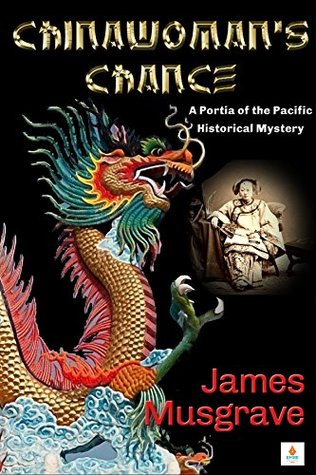
When I nominated Chinawoman's Chance on Kindle Scout for an opportunity to be published by Kindle Press, I hadn't heard of its real historical protagonist Clara Shortridge Foltz, the first woman admitted to the bar in California in 1884.   This historical mystery novel wasn't selected by Amazon.  So author James Musgrave self-published and offered all those who had nominated his book a free copy.  I eagerly accepted one, and I am now posting my honest review.


My original intention was to praise this cover's illustrations for drawing my attention to the book.  Yet when I copied and pasted the cover to this blog, I noticed for the first time that the title isn't very legible.  If I hadn't already known that the title was Chinawoman's Chance, I wouldn't have learned it from this cover.   Is the legibility of the title on the cover important for a self-published book?  I would argue that it is important. Readers often look at the cover before anything else on a  book vendor site.  Not being able to read the title creates a bad first impression for a reader deciding whether or not to buy the book.

Next I turn to the series title which is Portia of the Pacific. Yes, titles are very important to me.  They influence me more than cover illustrations.   I have an attraction/repulsion relationship with Shakespeare's Portia.   So  I was attracted by the series title because I love a woman taking a professional role that was forbidden to women in Shakespeare's day.  I love Portia's speech.  Yet  I am repelled by the bigotry toward Shylock that motivated her.  I see Shylock as the victim in Merchant of Venice.   His feelings of outrage over having no rights are used against him.  Portia is clever, but she is supporting a system in which Jews can't get justice.

 The fictional Clara Shortridge Foltz isn't bigoted toward the Chinese.   Not only does she have a Chinese client,  but she helps to thwart a plot against the Chinese community. Yet I learned from Musgrave's acknowledgements that the real Clara Foltz was actually prejudiced against the Chinese and would never have had a Chinese client as she did in Chinawoman's Chance. For me, there is a tension between the real Clara and the fictional Clara.  I ended up feeling as ambivalently toward the protagonist as I do toward Shakespeare's Portia.  

For those who want to see what Clara Shortridge Foltz looked like, I found a public domain photo on Wikipedia.


I admired the role played by the fictional Clara Foltz, but I felt that the novel fell short as a mystery.  There was a plot twist that I didn't find credible from a police procedural perspective.   I also felt that the resolution was formulaic.  I had seen it before a number of times, so it didn't surprise me.

I also had a problem with a Chinese character's name.  Musgrave said in his acknowledgements that he researched Chinese culture.  If so, I don't understand why he didn't seem to know that Guan Shi Yin, also known as Kwan Yin, is a Bodhisattva.  A Bodhisattva is someone who has reached Buddhist enlightenment and decided to help others achieve it.   Kwan Yin is also known as the Goddess of Compassion.  I was taught a mantra for Kwan Yin "Namo Guan Shi Yin pusa."  The English translation would be: Homage to Kwan Yin, compassionate and wise person.  The character in Chinawoman's Chance who was given this name was the reverse of compassionate.   I therefore considered it culturally inappropriate.

I actually did like most of  Chinawoman's Chance. Musgrave's version of Clara Foltz  has so much potential as a protagonist. Her developing friendship with a Chinese woman who escaped prostitution and encouraged independence for other women was also wonderful.   Yet as a mystery it didn't quite measure up, and the instance of cultural inauthenticity that I mentioned really bothered me.