Showing posts with label San Francisco. Show all posts

Thursday, February 22, 2018

Chinawoman's Chance: First In A Series About A Pioneering Woman Lawyer

When I nominated Chinawoman's Chance on Kindle Scout for an opportunity to be published by Kindle Press, I hadn't heard of its real historical protagonist Clara Shortridge Foltz, the first woman admitted to the bar in California in 1884.   This historical mystery novel wasn't selected by Amazon.  So author James Musgrave self-published and offered all those who had nominated his book a free copy.  I eagerly accepted one, and I am now posting my honest review.


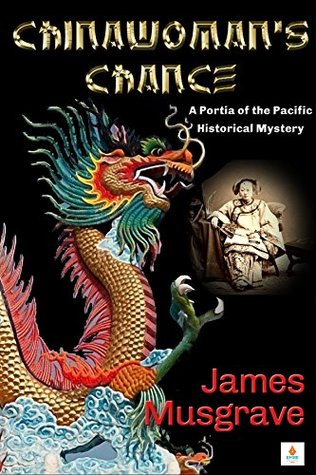
My original intention was to praise this cover's illustrations for drawing my attention to the book.  Yet when I copied and pasted the cover to this blog, I noticed for the first time that the title isn't very legible.  If I hadn't already known that the title was Chinawoman's Chance, I wouldn't have learned it from this cover.   Is the legibility of the title on the cover important for a self-published book?  I would argue that it is important. Readers often look at the cover before anything else on a  book vendor site.  Not being able to read the title creates a bad first impression for a reader deciding whether or not to buy the book.

Next I turn to the series title which is Portia of the Pacific. Yes, titles are very important to me.  They influence me more than cover illustrations.   I have an attraction/repulsion relationship with Shakespeare's Portia.   So  I was attracted by the series title because I love a woman taking a professional role that was forbidden to women in Shakespeare's day.  I love Portia's speech.  Yet  I am repelled by the bigotry toward Shylock that motivated her.  I see Shylock as the victim in Merchant of Venice.   His feelings of outrage over having no rights are used against him.  Portia is clever, but she is supporting a system in which Jews can't get justice.

 The fictional Clara Shortridge Foltz isn't bigoted toward the Chinese.   Not only does she have a Chinese client,  but she helps to thwart a plot against the Chinese community. Yet I learned from Musgrave's acknowledgements that the real Clara Foltz was actually prejudiced against the Chinese and would never have had a Chinese client as she did in Chinawoman's Chance. For me, there is a tension between the real Clara and the fictional Clara.  I ended up feeling as ambivalently toward the protagonist as I do toward Shakespeare's Portia.  

For those who want to see what Clara Shortridge Foltz looked like, I found a public domain photo on Wikipedia.


I admired the role played by the fictional Clara Foltz, but I felt that the novel fell short as a mystery.  There was a plot twist that I didn't find credible from a police procedural perspective.   I also felt that the resolution was formulaic.  I had seen it before a number of times, so it didn't surprise me.

I also had a problem with a Chinese character's name.  Musgrave said in his acknowledgements that he researched Chinese culture.  If so, I don't understand why he didn't seem to know that Guan Shi Yin, also known as Kwan Yin, is a Bodhisattva.  A Bodhisattva is someone who has reached Buddhist enlightenment and decided to help others achieve it.   Kwan Yin is also known as the Goddess of Compassion.  I was taught a mantra for Kwan Yin "Namo Guan Shi Yin pusa."  The English translation would be: Homage to Kwan Yin, compassionate and wise person.  The character in Chinawoman's Chance who was given this name was the reverse of compassionate.   I therefore considered it culturally inappropriate.

I actually did like most of  Chinawoman's Chance. Musgrave's version of Clara Foltz  has so much potential as a protagonist. Her developing friendship with a Chinese woman who escaped prostitution and encouraged independence for other women was also wonderful.   Yet as a mystery it didn't quite measure up, and the instance of cultural inauthenticity that I mentioned really bothered me.


Sunday, June 15, 2014

Frog Music: Murder and Scandal in 19th Century San Francisco

If you look at the summary for Frog Music by Emma Donoghue, you might think that this is a murder mystery investigated by a burlesque dancer in 1876 San Francisco.  While it does contain elements of a murder mystery,  investigation isn't the focus of the plot or the central character.   I had never previously read Donoghue, but I'm aware that she doesn't write genre fiction.  So I didn't really expect a mystery along genre lines from her.  In fact, I wasn't sure what to expect.


The murder victim, Jenny Bonnet, was a real person as Donoghue reveals in her Afterword. If you would like to read an obituary published soon after her death, see Jenny Bonnet Obituary.  Scroll down to the second item on the page.  Jenny was an unusual person in the context of 19th century San Francisco.  She dressed as a man and hunted frogs for her living.  Donoghue portrays her as independent and very outspoken.  In the novel, she often got into fights because she always said exactly what she thought regardless of circumstances, and refused to kowtow to anyone.  In real life, Jenny's murder is still an unsolved case.  Emma Donoghue's  ideas about who murdered Jenny are based on her theories about her.   There have been some very interesting stories told about Jenny Bonnet that Donoghue includes in her Afterword. I agree with Donoghue that her version of Jenny Bonnet is as likely to be true as any other.

  Burlesque dancer Blanche Beunon, the main protagonist, also actually existed.  I have to say that I loved the way she was portrayed in this book initially.  She was so comfortable with her sexuality, and I got a real kick out of one song that she used in her act . I was also interested in her circus background.  Blanche knew Jules Leotard, who invented the flying trapeze.  "The Man on the Flying Trapeze", which was inspired by Jules Leotard's popularity as a performer, is another song that appears in Frog Music.  Donoghue appended notes about the songs in the back of the book, and I was amazed by what she had to say about this famous trapeze song.  I realized that I'd never heard the entire song.You can find the 19th century lyrics here.  You can also find a playlist where you can listen to all the songs from Frog Music at  8 Track Radio.

Blanche's life changed completely in the course of the novel and she becomes a very different woman.  She had never thought of herself as being exploited by men or the sex industry, but her eyes are opened by events.  I am sex positive, and don't personally believe that the sex industry is inherently abusive. Unfortunately, as in many industries, most such businesses are structured to benefit management a great deal more than the employees.  Then there's the problem of sex workers with children.  In the period that the novel deals with,  management was often very unsupportive to sex workers raising their children as Blanche found,and the fate of such children could be quite horrific.  Donoghue shows us the extreme indifference and brutality to which children were routinely subjected in the 19th century.  She shines a light into some very dark corners.

 San Francisco has always been known as a refuge for the unconventional like Jenny Bonnet and Blanche Beunon.  Yet being notorious for non-conformity can be as dangerous in San Francisco as it is in other places.  The murder of Jenny Bonnet and the murder of Harvey Milk were separated by a century. Hate crimes like these can happen anywhere, so long as intolerance continues to be taught. We need books like Frog Music to remind us of this fact.