Monday, June 15, 2015

Sapient: When A Scientist Takes Unbelievably Foolish Risks


I’m seeing in reviews that Sapient by Jerry Kaczmarowski has been shelved as a technological or medical thriller on Goodreads.  For me, it’s science fiction though it certainly has thriller elements.  I received this book from the author for free in return for this honest review.


My biggest problem with this novel is that the research project in the book was supposed to be a cure for autism, and it was never fully explained why autistic individuals  would benefit.   As the book opens, we are shown that the intelligence of some animal subjects was increased by the virus that was being utilized in the study.  Why should this impact autism?  I wonder what the author believes about this condition. Autism isn't mental retardation.  Based on my own reading,  autism seems to represent a spectrum of variant brain organization. While a great number of people with autism are very impaired, some of them have remarkable skills and capabilities that they wouldn't have if they weren't autistic.  Not all of those who are autistic would want to be cured.   I question the premise of this novel.  Would an autism research program, presumably helmed by experts on autism, authorize this research and consider it a likely cure?

Then there's the totally reckless protagonist.  Dr. Jane Dixon knew very well that her research needed to be tested extensively and that it would take years before it would be approved as safe for humans.  She also ought to have known that the reasons why it takes so long are not arbitrary rules.  She didn't even know the long-term effects of the virus on the rats who were her original test subjects.    Yet she made a series of  foolish decisions that were professionally inexcusable.  Yes, she had an autistic son, but it seems to me that her behavior would have been much more forgivable if she had been completely ignorant of the possible consequences.  Since she did have a background in scientific protocols, I considered her as irresponsible toward her child as she'd been with her research.

It seems to me that woman scientists have enough trouble being taken seriously in their profession without a woman in science being portrayed in a novel as clueless and untrustworthy.  This is why I thought  Dr. Beth Thomas from the CDC was a more sympathetic character.  I completely understood her perspective and thought she was shabbily treated within the narrative.  Dr. Thomas recognized the risks, was motivated by a desire to protect the public and was probably more qualified to do Jane Dixon's research.

Another very likeable character was Bear, the dog who had just been brought into the study as the novel opened.  Bear was loyal, trustworthy and ultimately heroic.  

The CDC wasn't the only American agency that was interested in what Jane Dixon was doing.  It turned out that the Pentagon was also interested.  Frankly,  I thought the intentions of the military for this project were quite horrific.  The author didn't explore the ethics of the Pentagon's intentions at all.  If I were the protagonist, I would have wanted to protect any future canine research subjects from the military's  plans for them.

The Pentagon's representative, Jim Rogers, was probably intended to be likeable.  He did have characteristics that made him seem appealing , but I thought that his ethical compass with regard to the treatment of animals was extremely off-kilter.

There is a romance sub-plot and a HEA ending for that romance.  The resolution for the research project, however, was very disturbing to me.  In the end, no one was considering the possibility that the virus could still mutate, and that there might be massively unforeseen consequences.   I don't even want to think about the potential dystopian chain of events that could develop.

I didn't hate Sapient, but I did think that there were some very sizable improbabilities involved in the concept, the plot and the characterization of the protagonist.  This book didn't work for me.


Friday, June 12, 2015

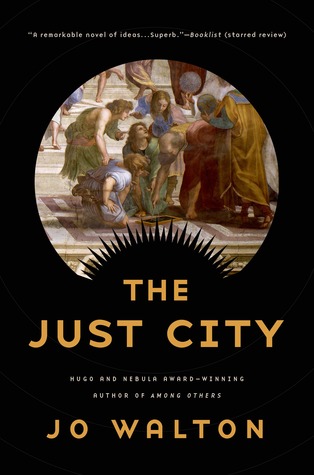
The Just City: One Reviewer Who's Playing on Team Socrates

The odd thing is that like author Jo Walton, I read Plato when I was fifteen. My father had allowed me to read anything on his bookshelves.  So I read his leatherbound  edition of Plato's writings.  My reaction to Plato's Republic was quite different from Walton's.  Reading The Just City caused me to remember.  I was horrified by it. I didn't think that it could possibly be a utopia.  It was too regimented and undemocratic.  Yet Jo Walton says in the notes appended to the novel that she wanted to re-create it at the age of fifteen and that this was the origin of The Just City. 

When I discovered the existence of this novel , I had forgotten how I felt about Plato's Republic when I was fifteen. I was curious about what Jo Walton would do with her re-creation of  Plato's idea of utopia.  It did seem like an original concept.  


                                                    22055276

What I liked most about the concept when I picked up the book is that the city was established by the Goddess Athena.  I thought that was immensely cool ! What I disliked about it is that Plato's Republic was being conflated with Atlantis which Plato wrote about in the Timaeus and Critias  dialogues.

  Plato described Atlantis as being a maritime power that was the rival of Athens which the Gods destroyed.   A civilization that rivaled Athens brings to mind the legend of Theseus.  The Minoans were so powerful that they could demand the youths of Athens as tribute.  Prince Theseus was sent as tribute to King Minos.  He was supposed to be sacrificed to the Minotaur at the heart of the Minoan labyrinth.  Many of us know how he survived the Minotaur with the help of the Minoan Princess Ariadne.

Another thing that is known about the Minoan civilization is that it was destroyed by a massive eruption of the volcano on the island of Santorini which was definitely occupied at the time.  The Minoans wrote in a script called Linear A which has no similarity to any known language.  It still hasn't been deciphered.  This leads scholars to the conclusion that the Minoans certainly weren't Greeks.   Later the script changed to Linear B which was discovered to be a form of Greek.  The islands that had once been ruled by the Minoans had been conquered by the Greeks, but that was a post-eruption development.   I am not the only one who believes that Plato was describing the Minoan Civilization.  There are numerous scholars who have identified Santorini as Atlantis. 

So as I started reading The Just City there was this niggling voice in my head, asking what Athena had done with the Minoans who would have inhabited the island where she had built her re-creation of Plato's Republic.  That voice never went away.  I kept wondering why those of the characters who had read the Timaeus and the Critias dialogues weren't bringing up the original inhabitants of the island.  Socrates was a character in the novel.  Wouldn't he have been asking what happened to them?

I did see references to Thessaly as the location in the novel.  So it occurred to me that the Goddess Athena had placed The Just City  on an uninhabited island in the Thessalian Sporades.   Yet I couldn't find an island in the Sporades with a volcano.  Walton's fictional island did come equipped with a volcano, and the plot required it to have one.  So a Sporades island didn't quite fit.  Walton really needed Santorini, the Minoan inhabited island whose shape changed radically around 1500 B.C.E. as a result of one of the worst eruptions in history. 

Why couldn't I just relax and go along for the ride?  Maybe it's because I'm like the ever questioning Socrates.  When I was a fifteen year old I just loved Socrates.  In fact, I wrote a play based on a few of Plato's dialogues called Socrates of Athens.  Like the Minoan civilization, this piece of juvenilia  no longer exists.

I did go along for the ride to some extent.  Walton created some wonderful female characters who were part of this Goddess given experiment.  The Goddess herself wasn't one of them.  I was delighted by several human women who were brought to the island from various eras.  These were women who were non-conformists within their own historical periods.  They longed for the equality that Plato promised women in his republic.  For their sake, I wished that I could believe that Athena's experiment would succeed. The Just City did initially seem like an improvement to these women who came to instruct the children, and identify the ones who could be potential philosophers.

Yet as their pupils grew, the instructors encountered heartbreaking dilemmas in their lives that were by no means utopian.   The responsibility for many of the problems could be laid at Plato's door.  They were inherent flaws in his concept of the republic that I noticed when I was fifteen.

I didn't expect to find the God Apollo sympathetic.  His track record with regard to women in the  myths about him was abominable.   Yet in this book, Apollo wants to understand why one of those legendary women in Apollo's myths decided to become a tree.  He eventually learns the answer and it results in a radical change in his outlook.  I also really liked Apollo's unwavering support for Socrates who uncovered a major fault line in Athena's re-creation of Plato's Republic for which Plato couldn't be blamed.

As I was approaching the end of the book, I thought to myself that I could lay aside my obsession with historical detail because the book was so well-written and dealt with the issues that arose in this attempt at utopia in a complex and thought provoking manner.    Unfortunately, the abrupt ending annoyed me so much that I nearly canceled my plans to read the sequel.  And I still want to know where that grey eyed Goddess of wisdom mislaid the Minoans.


Thursday, June 11, 2015

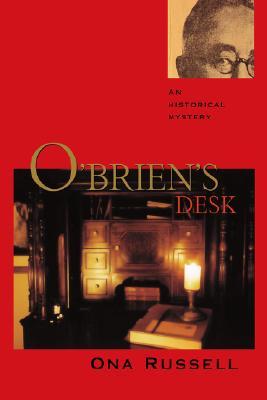
O'Brien's Desk (Historical Legal mystery #1) by Ona Russell

O'Brien's DeskI think this is a great idea for a series. A woman legal aid pre WWII solving cases. Think Law & Order but historical. However, I think I would have enjoyed this story better had it been a case of interest to me. A drug-addicted male judge doesn't interest me much.

I was more interested in Sarah herself. Fascinating woman but the book didn't get as deeply into detail about her and her past as I would have liked.

As for the writing style itself, it's good but at times contains too many info dumps, about the judge, his past, everyone else's history. I felt what could be an exciting story began to drag because of this. But I'm still eager to give books two and three a go. I figure they'll be more enjoyable because I will already know the characters, their histories, and perhaps they'll get more into the heroine herself.

Thanks to the author for sending me a copy of this one.


Wednesday, June 10, 2015

Saying Goodbye To Warsaw by Michael Cargill

This is the second book that I've read by Michael Cargill.   My first was the anthology Shades of Grey which I reviewed on Goodreads hereSaying Goodbye To Warsaw was selected as the Book of the Month for June on the GR group Books, Blogs, Authors and More. I belong to this group and participate in it. It's a WWII novel that takes place in the Warsaw Ghetto, and I received it for free from the author in return for this honest review.

What I liked most about this book was Alenka, a character who appeared late in the novel.  She was spirited, resourceful and optimistic in a situation that left little room for optimism.  She played an important role in Cargill's version of the Warsaw Ghetto Uprising.  I also found her believable unlike the nine year old protagonist, Abigail.

Another review said that Abigail became unbelievable only toward the end of the book during the uprising.  I disagree. I think she was always too good to be true.  She had no flaws other than being young and innocent which was too temporary in her horrifying environment to be a real flaw.  All the children in the Warsaw Ghetto had to grow up in a hurry.   Abigail became much more seriously unbelievable toward the end of the book.  She not only acquired skills too quickly, she was better at them than anyone else.  Credibility went out the window.

I should state at this point  that I took a course on the Holocaust from the Jewish Theological Seminary.  One of the books I read in that course was The Theory and Practice of Hell by Eugen Kogen who was a political prisoner in Buchenwald.  I am mentioning this so that readers are aware that I have also read books from the perspective of non-Jewish Holocaust victims.

Kogen's book shows that the Nazis were quite rigorous about separating non-Jewish prisoners from Jewish prisoners.  The Nuremberg Laws actually required them to make sure that Jews had no contact with other types of prisoners.  They were afraid of "race pollution".  Separation of Jews from non-Jews was also the main reason for their establishment of  Jewish ghettos like the one in Warsaw.  So they wouldn't have deliberately sent someone who was legally non-Jewish to a Jewish ghetto.  From the Jewish perspective, they did send quite a number of non-Jews to Jewish ghettos.  This is because the definition of who is a Jew according to Jewish law was more restrictive than the Nuremberg Laws.

I am bringing up this issue because there is a character in this book who was sent to the Warsaw Ghetto even though he was non-Jewish.  This may seem like a minor point to other readers.  He was portrayed very movingly and I liked the role he played in the novel, but it bothered me that the author didn't understand something very basic about the Nazi mindset.  

Cargill also mentions Israel a few times.  Israel didn't exist until 1948 which was after WWII.  There is a statement made by a character in this novel that the Warsaw Ghetto Uprising was partly funded by "our friends in Israel".  This is highly improbable.  At the time, Jews in America were sending funds to Palestine to help with the struggle of Jewish settlers against the British Mandate.   For more information see the article on the Jewish Insurgency in Palestine on Wikipedia.

I'm picky about the historical details discussed above because they matter to me.  They probably wouldn't even be noticed by many readers.  

From a storytelling perspective, I thought that Saying Goodbye To Warsaw was well-plotted and well-paced.  I also liked the final scene.   It affirms the centrality and sacredness of family.  In the end, family is what matters most.


Tuesday, June 9, 2015

Take an adventure with Treasured Secrets by Kendall Talbot

Get ready for your own treasure hunt in Treasured Secrets by Kendall Talbot.

This was a unique story. There was more to this story then just romance. As a reader you're taken on a treasure hunt. The author did a great job in her writing and I could really see her descriptions. This is a story about a second chance at love. Rosalina spent a lot of time investing in Archer but he would never fully open up to her, so she left which gave Archer the wake-up call that he needed. Rosalina isn't as easy to win back over as he would like. Her character is strong and independent. She needs to know he is really serious this time before she invests in him again.

I really enjoyed the journey this book took me on as I traveled along with them characters, getting the clues and trying to figure them out. It was a fun read. One I would recommend to someone looking for a little mystery as well as some romance. This book has a lot of story packed in, so be ready to sit down and read it from start to finish.


Lacey's Rating:

About the book:

The last place Rosalina expected the clue to a 700-year-old mystery to lead is back into the arms of Archer, the one man who broke her heart. But neither can solve the puzzle without the other, so together they set off on a new adventure, weaving from Tuscany’s underbelly to Archer’s luxurious yacht in the Greek Islands, trying to ignore the sparks that still fly unhindered between them.

Archer desperately wants to salvage the relationship he shattered years before, but fighting for Rosalina’s love soon takes a back seat to fighting for their lives. They aren’t the only one on the trail for the treasure, and their competition isn’t bothered by ethics and morals to achieve their goals. With evil close on their trail, and Archer wrestling with the remnants of a childhood tragedy, Rosalina begins to wonder if perhaps there are some secrets that were never meant to be revealed.

Monday, June 8, 2015

Balm: A Post Civil War Novel of Healing Review and Giveaway

About Balm

Balm
Hardcover: 288 pages
• Publisher: Amistad (May 26, 2015)

The New York Times bestselling author of Wench—called "a fascinating and tragic story" by NPR.org, "deeply moving" by USA Today, and "lyrical and devastatingly beautiful" by People magazine—returns to the Civil War era to explore history's next chapter in this powerful story of love and healing.

The Civil War has ended, and Madge, Sadie, and Hemp have each come to Chicago in search of a new life.

Born with magical hands, Madge has the power to discern others' suffering and ease it, but she cannot heal her own damaged heart. To mend herself and continue to help those in need, she must return to Tennessee to face the women healers who rejected her as a child.

Sadie can commune with the dead, but until she makes peace with her father, she, too, cannot fully engage her gift.

Searching for his missing family, Hemp arrives in this northern city that shimmers with possibility. But redemption cannot be possible until he is reunited with those taken from him.
In the bitter aftermath of a terrible, bloody war, as a divided nation tries to come together once again, Madge, Sadie, and Hemp will be caught up in an unexpected battle for survival in a community desperate to lay the pain of the past to rest.

Beautiful in its historical atmosphere and emotional depth, Balm is a stirring novel of love, loss, hope, and reconciliation set during one of the most critical periods in American history.

Add to Goodreads badge


REVIEW


I’ve read books dealing with slavery and the emancipation of the slaves after the American Civil War.  I’ve read books dealing with traditional herbalists from a variety of cultures. I’ve also read books that deal with trance mediums who can contact the spirits of the dead. Yet I’ve never read a book that focused on all three of these themes.  Balm by Dolen Perkins-Valdez is that book.  I received two copies of this book for free in return for this review. They are a paperback ARC directly from the publisher, and a digital ARC via Edelweiss. 

Because I have two copies, I decided to give away the copy of the print version to a lucky reader. Scroll down for the Rafflecopter Giveaway.   

The slavery and emancipation theme was movingly portrayed through the perspective of Hemp Harrison.   Since he found his slave name demeaning, he decided to name himself after the crop at the plantation where he was a slave followed by the surname of his former owner.  I have often wondered why emancipated slaves chose to identify with slave owners.   Hemp actually had an important reason.  He was trying to reunite with his wife who had been sold away. He had no idea where he would find her.  Hemp thought that his name might be a way for his wife to recognize that it was him searching for her.  A great many slaves were in his situation after the Civil War.  Dolen Perkins-Valdez depicts the affliction of separated African-American families through Hemp’s story. 

Madge, an African American woman who was born free, was the herbalist.  She was brought up in a family of rootworkers who made their living as healers.  Herbalists were often suspected of practicing witchcraft.  Madge did have a paranormal gift that facilitated her diagnosis of the conditions of her patients.  She wanted independence and a successful career, and she was confident that she could achieve these goals.  Yet something was missing in her life, and it took her some time to discover what that was. 

The medium who heard the voices of the dead was Sadie, a white Civil War widow.   I was particularly impressed by the fact that Sadie’s talent was genuine.  I’ve read many books dealing with fraudulent mediums who are eventually exposed.  I find that story line predictable and formulaic.  Sadie had to deal with the voice of a dead man who sometimes came to her involuntarily without being summoned.   She had to struggle to reclaim her freedom from that voice.  She was in a state of inner conflict about her mediumship.  I appreciated the complexity of Sadie’s characterization.

 Sadie decided to employ Madge as a servant.  The relationship between the two women was unsentimental and honestly portrayed.  So if you’re looking for a novel about a heartwarming friendship that transcends the post-slavery rift between the races, Balm is not that book.  I'm glad it isn't that sort of book since I don't subscribe to the delusion that two women could somehow cut through centuries of prejudice within a single generation. 

This is a book that is primarily about healing.  It's about the slow process of healing from the wounds of slavery, divided families and the mental anguish that resulted from these experiences.  I am grateful for the artistry of this author that allowed her to shape a tale of three individuals that is also the story of the beginning of America's emergence from a terrible time in its history.  


Purchase Links


About Dolen Perkins-Valdez

DolenDolen Perkins-Valdez is the author of the New York Times bestselling novel Wench. Her fiction has appeared in the Kenyon ReviewStoryQuarterly, StorySouth, and elsewhere. In 2011 she was a finalist for two NAACP Image Awards and the Hurston-Wright Legacy Award for fiction. She was also awarded the First Novelist Award by the Black Caucus of the American Library Association. She teaches in the Stonecoast MFA program in Maine. A graduate of Harvard and a former University of California President's Postdoctoral Fellow at UCLA, Dolen Perkins-Valdez lives in Washington, D.C., with her family.

Find out more about Dolen at her website, and connect with her on Facebook and Twitter.


a Rafflecopter giveaway