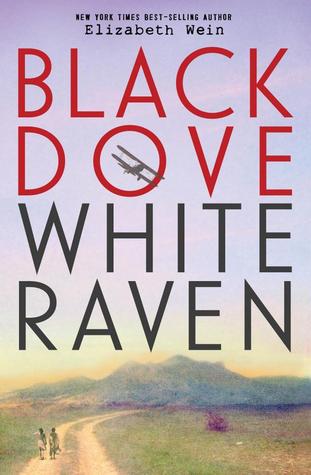
I've read two books by Elizabeth Wein dealing with female pilots, and reviewed one of them on this blog here. Female pilots are a focus of this blog. Wein created some memorable women and girls flying planes in Rose Under Fire and Black Dove, White Raven.
I do need to point out that Julie, the central character of The Pearl Thief , isn't a pilot. She's the spy protagonist of Wein's Code Name Verity which I didn't read because it was written in a way that didn't hold my attention. There's supposed to be a movie in development. If this film ever manifests, I suspect I will like it better than the book.
The Pearl Thief is a prequel about Julie's early life in Scotland. So why would I want to read the prequel to a book I didn't even like, and why would I think the review should be posted to Flying High Reviews? You'll have to read my review to find out the answer to these questions, but I'll tell you right now that I did read every wonderful page of The Pearl Thief.
The main reason why I wanted to read The Pearl Thief is because British Travellers are prominent in the plot. Travellers are often confused with the Romani who are now believed to have originated in India. Travellers are native to Britain. They were also called Tinkers because they mended pots and kettles, but the term Tinker was used as an insult. Elizabeth Wein serves up intriguing snippets of the history and culture of Travellers in this novel. I'd love to find out more.
Yet this blog is supposed to center on strong female characters. Are there any in The Pearl Thief ? You bet! First and foremost is the Traveller girl, Ellen who braves prejudice and abuse whenever she tangles with people in authority. She's also fiercely loyal to her family. Another strong female character is Ellen's dog Pinky who also exhibits bravery in the face of any threat to Ellen. Julie is willing to challenge convention by calling Travellers friends and defending them. She also occasionally dressed in a man's kilt and was mistaken for a boy.
Another reason why I wanted to read this latest book by Wein is that
it's a mystery beginning as a missing person case. I am a fan of the
mystery genre and this one involves several surprising twists. So this is an absorbing and well constructed mystery with great characters and a strong statement against prejudice. I expect this to be one of my best reads of 2017.
Showing posts with label 1930's. Show all posts
Saturday, June 10, 2017
Monday, June 29, 2015
Black Dove, White Raven: Bitter Irony in a Novel of Ethiopia
I really liked Rose Under Fire by Elizabeth Wein. Black Dove, White Raven seemed like it would be unusual because Wein's young pilots grew into maturity in Ethiopia. It was unusual all right. It nearly ripped my heart out.
Rhoda Menotti and Delia Dupré were stunt pilots who performed together in the U.S. in the 1930's. They had to perform for white only audiences because the venues were all segregated. African-American Delia became involved with an Ethiopian pilot in Paris and gave birth to a son. She wanted her son to be raised in an environment where he wouldn't be considered inferior because of his race, and intended to take him to Ethiopia. Rhoda was offended by their segregated shows, but Delia insisted that they had to take any money they could get. She wanted to earn enough to live in Ethiopia, so that her son could be free of American racism.
When Delia died in a tragic accident, Rhoda honored her friend's intentions for her son. She went to live in Ethiopia with Delia's son, Teo and her own daughter, Emilia. I admired and respected Rhoda for her loyalty to Delia's memory, and for treating Teo as part of her family. Rhoda was a credit to her Quaker background. She used her piloting skills to help people in Ethiopia.
Ethiopia in the 1930's was no utopia. There was a nightmare at the heart of Ethiopian society from which it had yet to awaken. Teo was caught up in that nightmare. He was trained to be a pilot and became quite accomplished. When he was sixteen his life took a terrible turn that Delia would never have anticipated. I wept for Teo. His mother wouldn't have even considered bringing Teo to Ethiopia if it had occurred to her that such a thing could happen to him.
Rhoda's daughter Emilia also learned to fly as a teenager, but the drama of this book centered on Teo. Emilia was better at navigation than at flying. She didn't actually enjoy flying which I found disappointing. Yet she was intelligent, resourceful and immensely loyal to Teo.
I was captured by the originality and intensity of Black Dove, White Raven until Rhoda's husband, an Italian military pilot, did something that I considered unbelievable. It was against military regulations and wasn't consistent with the love and concern with which he had previously treated his daughter, Emilia. So it was both implausible and reprehensible. The spell that Elizabeth Wein had woven was broken for me at that point.
For most of this book, I thought it was the best novel that I'd read in the first half of 2015, but the out of character behavior of Orsino Menotti, Rhoda's husband, was significant. So I felt that I had to deduct one bike from my rating.
Labels:
1930's,
Aviation,
Book Reviews,
Ethiopia,
Female Pilots,
Historical Fiction,
Racism,
Young Adult
Subscribe to:
Posts (Atom)