Showing posts with label Gender. Show all posts

Saturday, September 24, 2016

This Above All---A Girl Portrays Shakespeare's Romeo

This Above All by Lindsey Roth Culli is a  contemporary YA novel which is a potent stew of Shakespeare, gender, sexuality, religion and growing up in the American Midwest.   I received a free copy from the indie publisher, Curiosity Quills, in return for this honest review.

I have previously reviewed two other Curiosity Quills releases Alice Takes Back Wonderland, a rather wonderful fairy tale mashup and The Heartless City , an alternate history dystopia based on Dr. Jekyll and Mr. Hyde which I found compelling and enjoyable.  I expected This Above All to be more conventional compared to those previous outings.  In some ways, it was very much like a standard YA novel, but in others it very definitely wasn't.


The conventional aspect of this book was high school.   I tend to avoid YA novels that take place in high school.   Most of these have predictable character types, dynamics and plots.   This Above All contained those elements.  There were false rumors, bullying and relationships plagued by miscommunication.  Juliet was played by a stereotypical popular mean girl.  It seems that the director of this Romeo and Juliet didn't prioritize chemistry between the leads.

Sexuality was a theme, but This Above All didn't really focus on sexual relationships as is appropriate in a YA novel. While the specter of lesbianism fueled controversy, there was no actual lesbianism. Heterosexual romance played a role in the plot of this novel, but it wasn't predominant.   There was a gay character named Tony, but his life wasn't front and center either.  I read a review on Goodreads that was disappointed that we didn't find out more about Tony's family interactions.   Tony played Mercutio.  If it's true that Shakespeare needed to kill off Mercutio to prevent him from taking over the play, as is stated in this book, it's probably also true that Culli wanted to make certain that Tony didn't upstage Piper, her protagonist.

I felt that the way Piper deals with her real female identity while portraying a male role is the most interesting aspect of this book.  She initially had her doubts about whether she could or should be Romeo.  Yet once she became accustomed to the idea, she threw herself into her fictive male identity.   I wouldn't say that Piper is a transgender character.   It seemed to me that Culli wanted to show that it's possible for a girl to play with masculine gender traits in a theatrical context while still retaining a core self-concept of being female.  Piper has more in common with historical women who dressed as men to achieve career goals than with individuals who seek to transition to another gender.

Piper's fundamentalist Christian family brings religion into the mix of themes.  It is they who stir the cauldron of outrage over Piper playing a male role.  Her pastor father is shown as being sincerely concerned about Piper's spiritual well being.   As I am not a Christian myself, I wouldn't presume to make statements about the true nature of Christianity.   Over the course of the narrative, Piper changes her own views about religion.  She ponders how she can maintain a relationship with God, and comes to her own independent conclusions.   It seems to me that for Piper developing a personal approach to religion is part of the process of becoming an adult.

This Above All is a book that will cause readers to reflect on a number of topics, but I think they will also be moved by the courage of Piper and Tony, and the  chosen family they found in the cast of Romeo and Juliet.   As we have seen in the TV series, Glee, communities of performers can be powerful support systems for teens who feel like outsiders in a hostile world.  Anyone who has felt at odds with their families, or with society in general will be able to relate to Piper.




Friday, June 5, 2015

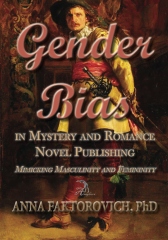
Gender Bias in Mystery and Romance Publishing by Anna Faktorovich


This is an academic study, but I thought I would try asking myself what a general reader would want to know about this book.  I reviewed The Romances of George Sand by Anna Faktorovich on Book Babe.  I also interviewed her.  More recently, I received a free copy of Gender Bias in Mystery and Romance Novel Publishing from the author in return for an honest review. 

                                               
Gender Bias in Mystery and Romance Novel Publishing

                                           
First, I’d like to discuss what Faktorovich did right from the perspective of general non-academic readers.

1) She was honest about the fact that she usually didn’t read these genres, and didn’t portray herself as an authority about them.
 2) She selected both 19th century and 20th century writers in each genre so that long-term trends could be identified.
3) She showed that in the mysteries she studied, authors of both genders tended to be disturbingly sexist in their character portrayals.  In fact, I read the results as showing that mysteries are more sexist than romances because women in most of the romances she studied are active characters, and romance tends to portray the male and female protagonists as having equal social and professional status.
4) She was willing to consider the idea that erotic romances might be explorations of women’s sexuality and could have a feminist impact for authors and readers.
5) She included short biographies of authors that contained interesting facts about their lives which aren’t well known.

Now I’d like to enumerate some serious flaws in this book.

1) She chose mysteries as the most male dominated genre.   Actually, science fiction is more male dominated.
2) She had outdated notions of both the mystery and romance genres.  Both genres have developed in directions that weren’t addressed in this study.
3)  She was completely unaware of mystery sub-genres.  The cozy and paranormal mystery sub-genres which are dominated by female authors would have been particularly relevant to this study.
4) She biased the sample of her survey by mainly distributing it on listservs for educators or librarians.

Although this was an interesting book, Faktorovich missed a great deal in her exploration of these genres.


Friday, December 5, 2014

Revolutionary: An Independent Woman In The War of Independence


I am a particular fan of the historical fiction sub-genre dealing with women who disguise themselves as men.  In most historical societies pretending to be a man was the one way a woman could gain control of her life.    These women were lone feminists who camouflaged themselves because they had no social support. 

Revolutionary was my Thanksgiving Day read.  I was thankful for the fact that Alex Myers, the author of Revolutionary, sees his ancestor Deborah Samson the same way I do.   

                                             
                                                  17571569


Deborah Samson was an actual 18th century American woman who disguised herself as a man to become a soldier in the American Revolution.   Myers portrays her as having self-determination as her number one priority.  Whenever she loses self-determination, she seeks to regain it.  It may seem ironic to modern readers that a woman who seeks independence would subject herself to military discipline, but for Deborah Samson there was no better life and she excelled at it.  Her comrades and superiors considered her a hero. 

There are other novels devoted to this woman warrior, but this one stands out due to the perspective of the author.  When I read in his bio that Alex Myers is a transsexual, I wondered if he would be giving us a transsexual version of Deborah Samson.  It turned out that this wasn’t his intention.  What he has to offer us is his keen insight into gender.   He understood that someone in Deborah Samson’s position might be engaged in an internal struggle over gender identity.  I found it even more interesting that this question of gender was never one that she ever permanently resolved.   Her androgynous nature caused her to have a very fluid sense of herself depending on her circumstances.  I have never seen a historical woman engaged in passing as a man portrayed with such complexity. 

Another historical personage who intersects with Deborah Samson is John Paterson.  Paterson was Deborah’s commanding officer toward the end of her military career.   Myers portrays him as a rather unusual man.  I was interested in finding out more about him.  I learned that there were two American Revolutionary generals with the surname of Paterson, and that John Paterson should not be confused with William Paterson.  William Paterson was a very prominent Federalist while John Paterson was a member of the opposition party founded by Thomas Jefferson, the Democratic-Republicans.   The Wikipedia article about the Paterson who was a character in Revolutionary can be found at John Paterson.  After the American Revolution, he became a U.S. Congressman representing the state of New York.   The Library of Congress has a full biography of John Paterson in its collection by Thomas Egleston.  A digitized version can be downloaded at Archive.org.  

John Paterson's statement in the novel that America needs strong women as well as strong men made as big an impression on me as it did on Deborah.  Alex Myers bestows Deborah with the strength to fight both physical and psychological battles which gives us a winning novel.