Showing posts with label Navajos. Show all posts

Wednesday, September 30, 2015

The Darkness Rolling by Win and Meredith Blevins

I read and reviewed the first Blevins' collaboration, Moonlight Water on my personal blog here.  I first encountered Yazzie Goldman, the fictional male protagonist of  The Darkness Rolling, in Moonlight Water.  Yazzie is part Navajo and part Jewish.  Although Moonlight Water was contemporary fiction, The Darkness Rolling is the first book in a series of historical mysteries that begin right after World War II.  During the war Yazzie received training in NCIS investigative techniques.  I thought that he had potential as a mystery detective.

The reason why I decided to review this book for Book Babe is because there's a rather prominent female character.  She is the real Hollywood star, Linda Darnell.  I knew virtually nothing about her before reading The Darkness Rolling.  After finishing it, I wanted to know a lot more.
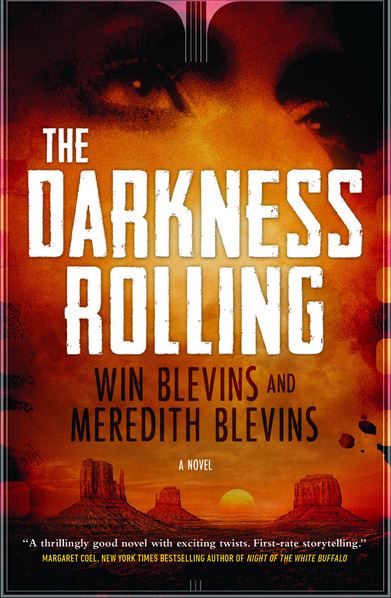


 The Darkness Rolling is actually a crime thriller rather than a mystery. The perpetrator is revealed to readers early in the book.  The suspense arises from how he is caught and captured.

 Yazzie Goldman is hired as part of the security team for Linda Darnell during the filming of a movie directed by John Ford in Monument Valley.  The movie's name is never mentioned in the book.  Based on internal clues and online information about Linda Darnell's career, I'd say that it has to be My Darling Clementine (1946) in which Darnell played a Mexican dancer.  I learned from this novel that Darnell was actually part-Cherokee.  This was confirmed by multiple web pages dealing with Linda Darnell.

This book could have been a standard thriller about a star being stalked. One of the reasons why it wasn't was because of Linda Darnell as portrayed by the Blevins.  She absolutely refused to be treated as a victim.  She was not going to be pitied or allow herself to be sidelined.

Yazzie's rather unusual family also contained several wonderfully strong women.  I especially admired Iris Goldman,  a highly independent artist.  I'm hoping to see more of her in future novels in this series.

I do have to say that Yazzie's grandfather, Mose, was the most extraordinary character.  He had recently had a stroke before the novel began, and his speech was tremendously impaired.   Yet in a crisis he could surmount his medical condition with a toughness and resourcefulness that was nothing short of amazing.

There was some good Navajo cultural and historical content in this novel.  A reference to the Navajo chief Hoskininni led me to research him.  I learned that when the U.S. Army forcibly relocated the Navajo, Hoskininni led many Navajos into hiding where they remained until the Navajo were allowed to return.  I found a very colorful account of Hoskininni's life at Dine Biographies.

So I enjoyed The Darkness Rolling very much.  It was unexpected, and I loved a number of the characters.  I will definitely read the next in the series.


Wednesday, June 17, 2015

Rock With Wings by Anne Hillerman

I'm one of those people who continues to read a series that's been taken over by another writer after the death of the original author if I liked the series.  I sometimes think that the new writer is an improvement.

Anne Hillerman, the daughter of Tony Hillerman, is an improvement when she writes the perspective of Jim Chee's wife, Bernadette Manuelito.   Bernie, as everyone calls her, is a Navajo Tribal Police officer like her husband.  As a feminist,  I'm always hoping to see a woman officer being portrayed as the equal of male officers in police procedurals.  Most police procedurals have male protagonists. That's why I've been pleased by Anne Hillerman's primary focus on Bernie's perspective.


One of the problems that I had with this book is that it seemed to me that Chief Largo was deliberately giving Bernie minor cases while Jim Chee got the high profile action.  I think that the Chief was trying to protect Bernie, but she ended up in a dangerous situation anyway and acquitted herself well.  So Anne Hillerman was really showing that Bernie could handle danger, but I was impatient with all the minor cases that got piled on Bernie.

I also disliked the fact that Anne Hillerman felt the need to pander to the popularity of zombies.  The case that Jim Chee was investigating involved all sorts of illegalities surrounding the making of a zombie movie in Monument Valley.

The associate producer of this movie philosophizes about horror movies saying that "When things go haywire, it's nice to have something to blame that's out of our control."  He thinks this explains the popularity of horror movies. I've always thought that the main appeal of horror is the demonizing of difference.  Horror makes it OK to hate beings who are different because in horror they're always monsters.    I'm absolutely not a fan of the genre. 

 So Anne Hillerman brings zombies into Navajo country.  Traditional Navajos would consider zombies a type of chindi.   Chindis are the spirits of the dead.  The traditional Navajo fear them, consider anything that has been touched or associated with the dead polluted, and avoid mentioning the names of any dead individuals.  In the Navajo religion, it's believed that mentioning the names of dead people summons their chindis.  I would have thought that there would have been some objection from traditional Navajos to the theme of the movie, but apparently the money that the film industry brings is too good to pass up.  When Chee discovers a grave in Monument Valley which would pollute it with  actual chindis (rather than fictional ones), that does become a matter of deep concern to Navajo authorities.

Bernie's most important case ,which started out with her pulling over a speeding motorist, turned out to deal with solar energy.  I'm not sure about the politics of this author on the subject of climate change, but this novel surrounds the solar industry and the use of solar power on the Navajo reservation with all sorts of negativity.  There are extremely unscrupulous individuals using coercion to get people signed up for the installation of solar panels on their property.  There are malfunctioning solar panels and a Navajo elder who objects to solar panels.  He is coming from the perspective of someone who has never had electricity in his home.  This character believes that part of hozho, which is the Navajo concept of harmony,  involves living in a natural way.  He gets up at dawn and goes to bed when it becomes dark. According to this outlook, people who incorporate artificial light in their lifestyle are living out of balance with nature.  It's an interesting viewpoint, but  in my opinion those of us who want to continue utilizing artificial light really need to find a clean renewable source of energy like solar.  I find it troubling that in Rock With Wings the only characters who talk about the benefits of solar energy should be indicted.

I'm interested in reading about opinions other than my own, but my idea of balance is that ideally all perspectives should be fairly represented in both fiction and real life.

Rock With Wings contains some moments of wonderful characterization and deals with one of my favorite American landscapes, but I'd rather not read about zombie movies. I'd also prefer to see a more even-handed presentation of the issue of solar energy.


Wednesday, July 30, 2014

Manroot: A Novel of Rights and Wrongs

Manroot by Anne Steinberg is not a new work.  According to the About The Author notes, it was Steinberg's debut novel originally published with acclaim in the UK in 1994.  I am reviewing a 2014 edition of this novel.  I received it as a gift from the author in return for an honest review.


The cover has been praised as being atmospheric.  It is indeed, but if this cover had been the only thing I knew about Manroot before I read it , I would have assumed that the book took place in the vicinity of some haunted Louisiana bayou. I would have been wrong.  The events of Manroot take place in the Ozarks over the course of a thirty year period beginning in 1939.  Steinberg fast forwards from the 1940's to the 1960's which allows her to display social change and radical differences in values.  That's why I shelved it on Goodreads as historical fiction.  It isn't historical in the sense of dealing directly with major historical events, but it does describe the way people lived and thought in two distinct eras.

Others have shelved and reviewed this book as a romance.  When I look at the predominant content of Manroot, I don't have that impression.  There was a brief romantic interlude which reminded me very much of the similar interlude that took place between Hester Prynne and Arthur Dimmesdale in The Scarlet Letter by Nathaniel Hawthorne, but the consequences were much worse for Manroot's protagonist Katherine  Sheahan.  She was a despised "half-breed" who was already stigmatized before she fell in love with a married man.

From the perspective of 21st century readers, it is difficult to understand how Katherine managed to pick herself up and go on with her life after the terrible events that transpire in the town where she had her short-lived romance.  We wonder why she isn't angry or paralyzed by trauma.  The answer is that both responses would have been luxuries in her situation, and Katherine was a survivor. Survival mattered more to her than justice.  She was also a gifted healer who was fully capable of healing herself. 

I agree with those reviewers who really liked the herbalism aspect, but it's not a source of high drama.  No one wanted to draw and quarter Katherine for providing an alternative to the treatments of medical doctors.  In fact, her skills in this area are the main reason why she was accepted.  I especially enjoyed seeing the increased interest in her herbalism in the 1960's.

The source of Katherine's herbal knowledge was her Navajo grandmother who isn't really shown in the novel, but she may have been like the Navajo herbalist elders of the Plant Watchers Society in the Aimee and David Thurlo mystery, Plant Them Deep.

 The trouble is that Katherine's behavior is contrary to the beliefs of traditional Navajos.  Those who have read Tony Hillerman and the Thurlos are aware that traditional Navajos avoid contact with the spirits of the dead who are called chindi.  Find out more by following the link I provided to the Wikipedia article on the subject.  Let's just say that avoidance isn't Katherine's strategy.  It seems likely that this could be offensive to some Navajo readers, but spirits provide the paranormal aspect of the novel.  The paranormal content doesn't become dominant until fairly late in Manroot.

Skeptics who are determined to find an alternative explanation for the resolution of this novel can probably find one.  Yet if we accept Katherine's version, then it raises a number of questions.  Should we judge actions by their consequences, or are there actions that are always wrong regardless of their context?  Could Katherine have deceived herself into thinking her actions were justified?  Are those who considered Katherine insane correct?  I leave these matters up to the individual reader.

This book is full of both darkness and light.  I found it absorbing, well-written and troubling.  I don't recommend Manroot to people who prefer comfortable reading that doesn't ask disturbing questions.  I do recommend it to people who like their fiction to be memorable.