Friday, June 5, 2015

Gender Bias in Mystery and Romance Publishing by Anna Faktorovich


This is an academic study, but I thought I would try asking myself what a general reader would want to know about this book.  I reviewed The Romances of George Sand by Anna Faktorovich on Book Babe.  I also interviewed her.  More recently, I received a free copy of Gender Bias in Mystery and Romance Novel Publishing from the author in return for an honest review. 
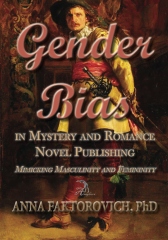
                                               
Gender Bias in Mystery and Romance Novel Publishing

                                           
First, I’d like to discuss what Faktorovich did right from the perspective of general non-academic readers.

1) She was honest about the fact that she usually didn’t read these genres, and didn’t portray herself as an authority about them.
 2) She selected both 19th century and 20th century writers in each genre so that long-term trends could be identified.
3) She showed that in the mysteries she studied, authors of both genders tended to be disturbingly sexist in their character portrayals.  In fact, I read the results as showing that mysteries are more sexist than romances because women in most of the romances she studied are active characters, and romance tends to portray the male and female protagonists as having equal social and professional status.
4) She was willing to consider the idea that erotic romances might be explorations of women’s sexuality and could have a feminist impact for authors and readers.
5) She included short biographies of authors that contained interesting facts about their lives which aren’t well known.

Now I’d like to enumerate some serious flaws in this book.

1) She chose mysteries as the most male dominated genre.   Actually, science fiction is more male dominated.
2) She had outdated notions of both the mystery and romance genres.  Both genres have developed in directions that weren’t addressed in this study.
3)  She was completely unaware of mystery sub-genres.  The cozy and paranormal mystery sub-genres which are dominated by female authors would have been particularly relevant to this study.
4) She biased the sample of her survey by mainly distributing it on listservs for educators or librarians.

Although this was an interesting book, Faktorovich missed a great deal in her exploration of these genres.


Wednesday, June 3, 2015

The Harem Midwife by Roberta Rich


This book is the sequel to The Midwife of Venice by Roberta Rich which I read and very much liked.  In this novel we find that  the Jewish midwife Hannah Levy and her husband Isaac, who had fled persecution in the Christian world, took refuge in the Islamic world.  This is what many Jews had done in the medieval period.  Jews continued to find sanctuary in the Ottoman Empire in the 16th century which is when The Harem Midwife took place.   This may seem ironic to contemporary readers, but the current divisions between some Jews and Muslims are politically motivated and aren’t inevitable.  

                                                      18144034


The plot of this sequel was a tumult of events which were suspenseful.    I also thought that Hannah’s difficult experiences during the course of this novel ultimately strengthened her marriage and caused her to grow as a character. 

 On the other hand, I learned little about the Jewish community in Constantinople because Hannah and Isaac were still culturally identified with Venice, and didn't seem very integrated with the local Jewish community. I felt as if this book was missing a dimension that would have anchored the protagonists in their new home.


Monday, June 1, 2015

If The Oceans Were Ink: The American Woman Journalist and the Islamic Scholar


American journalist Carla Power has had an ongoing friendship with Mohammed Akram Nadwi, an Islamic scholar who teaches in the Islamic Studies program at Oxford University.  Power calls him Akram since Nadwi is the name of the school where he studied Islamic law.  She is a secularist whose parents also didn't practice the religions in which they had been brought up.   I wanted to find out about why Carla Power wanted to explore Islam when she wasn't religiously oriented.  


 After having read the memoir she’s written about her friendship with Akram and her study of the Koran with him, I think that Power wants to be reassured about Islam.  

Akram preaches against involvement in politics.  He also respects women.  He said to Power that women’s scholarship is purer than men’s because they aren’t paid for it.  Their only motivation is spiritual.   This is why he was motivated to write The Women Scholars of Islam which is a forty volume study.  Only the introduction has been published.  His publishers are seeking funding for the remaining thirty nine volumes.  I wanted to know more about these women, but only a few of them are even mentioned in this book which is disappointing. 

Power only writes intermittently about her discussion of the Koran with Akram.  I was intrigued as always by the Bible stories in the Koran.  Akram tells his students that you must be familiar with the Bible to read the Koran.  Actually, if you are familiar with the Bible and its historical context, you are likely to find the Koran’s versions of Biblical personages really strange. I consider this an experience in cognitive dissonance. 

Let me give one example.  Akram spoke at a mosque in England about what the Koran has to say about the Virgin Mary who is called Maryam in Islam.  He said that she was called to serve at the Jewish Temple.  He implies that she was a priestess of some sort.  From a woman’s spirituality perspective, this is a lovely story.  From a historical perspective, it couldn’t have happened.   It isn’t just a matter of women’s status in Biblical times, or the fact that Mary didn’t belong to a priestly family.  Jews had prophetesses, but no priestesses.  The reason is that priestesses are associated with Pagan religions.   Jews wanted to avoid any similarity to the practices of Pagans.  When you add in the element that Mary became pregnant out of wedlock, then you have a reminder of the Sacred Prostitutes of Astarte.  Islam has also tried to avoid any practices similar to the pre-Islamic religions of Arabia.  So they should understand why Jews might consider this idea that Mary was a priestess in the Jewish Temple rather offensive.   Akram said that the Koran wanted to honor Mary.  Perhaps the intention was to show that her virginity was protected in a sacred place, so it couldn’t be that Mary became pregnant as a result of sex.  Neither the Koran’s version nor the New Testament version of the story of Mary could be considered sex positive, but I would love to see a variorum edition which shows each Bible story and its Koran equivalent side by side. 

Power is also a friend of Akram’s family and devotes a great deal of space to his daughter Sumaiya.  As an indicator that Sumaiya made her own decisions, Power tells us that Sumaiya went against her father’s opposition to dying her hair.  She consulted another Muslim scholar who gave her a fatwa (which means an opinion on Islamic law) that hair dying is permissible, and she proceeded to dye her hair.  This also shows that Islamic scholars aren’t united in their interpretations.

There is a bibliography at the end of this book which includes the first volume of Akram’s study on Islamic woman scholars which I would like to read as well as such books as Progressive Muslims: On Justice, Gender and Pluralism edited by Omid Safi and Inside The Gender Jihad by feminist Amina Wadud.  

 Unfortunately, If The Oceans Were Ink is not as interesting or insightful as I had hoped.  My feeling is that a secularist like Power, without any religious background, probably won’t ever have an in-depth understanding of Islam.