Showing posts with label Real Women. Show all posts

Monday, March 13, 2017

Kate Warne: Trailblazing Heroine @theladygreer

Girl in DisguiseI really enjoyed this novel but throughout the reading of it felt something I wanted to be there wasn't. Perhaps it's a case of not as much mystery as I'd hoped for, no "whodunit-ness". I wish there had been more cases honestly, but after reading the author's note and discovering how very little data there is to find about this remarkable woman, I say she did a great job with what she had.

The novel recreates Kate Warne's life from the moment she became a Pinkerton agent. She convinces Pinkerton to hire her, the first woman agent. She learns deceit even though it bothers her at times--the jewelry store manager. It explains why rumors abounded about her and Pinkerton but doesn't make her "that woman". She battles animosity within the ranks. She falls in love. She spies for the Union.

It was intriguing and I thoroughly enjoyed it. I found the writing well done too. I could visualize everything, put myself in the scene.I recommend this story to any woman who chooses that "unconventional" path. Or heck, if you've ever thought of taking that path... A true heroine and trailblazer was Kate Warne.

I received this via Amazon Vine.

Tuesday, January 3, 2017

Margaret Sanger: Champion of Women in Terrible Virtue by Ellen Feldman

Terrible Virtue"A woman's duty: To look the whole world in the face with a go-to-hell look in her eyes, to have an ideal, to speak and act in defiance of convention."

And that is what Margaret Sanger did. She looked everyone in the face with a go-to-hell look in her eyes, and she spoken and acted in defiance of convention. Having watched her mother die older before her time, having raised 13 children, lost about 5, Margaret both loved and hated her mother. She loved her mother yet was disgusted with what her mother was, with what she let herself be: a broodmare...a baby incubator.

This novel is told in the first person, as though Margaret is looking back on her years and her life, her goals, trials, losses, loves. Personally, I loved it. First-person writing can make or break a book. In this case, it worked. The writing was engrossing; the memories were vivid. I never felt as though they were being narrated to me, but that I was living them myself.

I went with her from being called a devil's child and falling over her feet in the woods to her first marriage and the birth of her three children and the battles she fought inside herself between what she should want (what society told her she should want...a loving husband, a nice house, three adorable children) and what she really wanted (free love with whomever she pleased, a basic place in the middle of artists and socialists, and her main child: the birth control movement.

She takes on lovers and never hides who she is. She neglects her children for her one great passion. In her mind, it's better to deprive three than to let thousands of women and unwanted children everywhere suffer. And yet, she suffers herself later.

And was she a Nazi? No. We find later in the novel how that accusation came to pass and that it was a misunderstanding, a twisting of events, a misinterpretation.

I learned so much about this woman, this champion of all women. The only thing I didn't like about the novel was how vague it was about early contraception. Up until 65%, Margaret kept preaching the importance of family limitation yet didn't really offer a solution for it. This came later, after her Europe travels...but in the meantime, like all the women writing her desperate letters, I kept wondering, "What exactly are you wanting the women to do?? French letters are not affordable."

But eventually she got there, with her little possets, or womb veils. And she went to jail, albeit briefly, for her beliefs...and her sister was never the same, as she went to jail too and had a hunger strike.

But she got there...and as a result, ladies, we got there. Us modern women have the means as well the right to choose.

We can thank Margaret for that. I highly recommend reading this novel.

I purchased it via Amazon.


Thursday, July 14, 2016

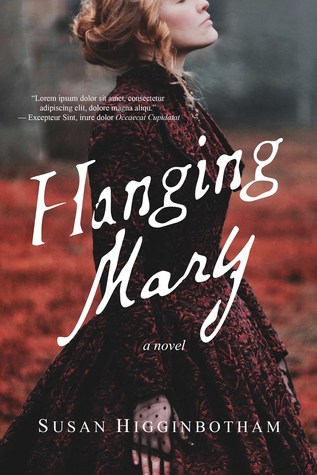
Guilty of a Mother's Love: Hanging Mary by @S_Higginbotham

Hanging MaryA very well-told tale of the circus that ensued after the killing of Lincoln, the incompetence and hasty actions of the government, and two women in the middle of it all.

I knew little about Mrs. Surratt but after reading this novel feel as though I knew her intimately--her hopes, dreams, love for her children, fears, faith. This woman's tale is told through two different narratives: her own and that of one of her lady boarders. Readers will come to their own conclusions as to Mary's involvement in what was an appalling crime.

Mary is guilty of a mother's love more than anything. Wrong place, wrong time. During the Civil War her son begins bringing home questionable characters. She runs a boarding house. What is she to do? Turn them all away? But while turning the other cheek may be one thing, aiding is another, and she ends up doing just that without realizing what exactly she's aiding. There's an innocence mixed in with her guilt, conflicting readers' opinions. One minute she guilty, the next she's not.

Her boarder Nora shows us the goings-on in the house through impartial eyes. We meet a young motherless lady who fears she'll be a spinster. We fall in love with a wounded Union soldier alongside her and get excited about her getting her photo done for her. We smile when she sits with John Wilkes Booth and does little acting skits with him. We see that there was more to him than a monster with rage in his heart.

The world at this time comes alive--the celebrations, the mourning, the captitol, the politics. And oh, what incompetence the investigation yields!! How glad I am that laws have changed since then. People are arrested for merely being related to Mr. Booth, for having known him, for having gone to a show with him at some point. People are arrested with no warning, no "phone call" aka letter for that period.

 And yet Mrs. Surratt faces her demise with such dignity.

Was she guilty? Somewhat, to a point, of a mother's love more than anything. Did she deserve to die? One must read this and decide for themselves.


Friday, May 29, 2015

The Intriguing Life of Ximena Godoy by Graciela Limón

The Intriguing Life of Ximena GodoyWhat drew me to this novel was the promise of...I'll just quote it, "evolving rules that determine women s lives in both Mexico and America."

To be frank, except for women's sexuality, I didn't see anything about evolving women's rules or rights. There's one thing in the book that classifies as evolving women's issues: Ximena's promiscuity and exploration of liberal sex. She has sex because she wants to, with whom she wants to, and the book shows us how unacceptable this was to men who did the same. Double standard much?

Also appealing to me was the promise of revolution, but while Ximena does indeed join the revolution, it's completely without passion for the cause. I don't think she even knows what the revolution is about. She has no desire to help the working class. She just thinks it looks cool to ride around with a sombrero. While the story mentions this supposed battles she fights in, the details are relegated to her fornicating, fights with other women, and smoking weed.

She than abandons her daughter and dares to feel upset when she goes to claim her seven years later. Only then does she realize she had something precious. Beyond this, Ximena is merely a club manager. I didn't find her life intriguing at all. I actually couldn't care less about her or her life by the time I made it to 70%. I was nodding off.

 Besides the above, the story was also very telling, no showing. Borderline biography style.

Much thanks to Netgalley for providing a digital file, but it wasn't for me.


Monday, April 27, 2015

"Just remember, seven-eleven, three-hundred and twenty-two pounds." @joelfishbane

The Thunder of GiantsSometimes I read a book that I just love--and not a moment too soon, especially after a month of duds (You readers know what I speak of, when every book you pick up stinks to high heaven and you begin to despair that you'll ever read another good book...and maybe the problem is you!) and I'm left speechless and don't really know what to say but, "I loved it!!! Read it! You don't want to miss this one!"

I loved this novel and just like Anna Swan's husband's appendage makes the poor examining doctor feel wholly inadequate, I fear my review will be wholly inadequate, but I will do my best.

The real Anna Swan and her parents.
Wiki Commons
First of all, this novel not only transported to me two different times and places in history, but it also made me laugh. From the mention of nervous farts to the witty offhand remarks between characters to the scenes themselves either in the tailor's shop involving a broken foot or the set of a Hollywood movie, the book fairly burst with surprise laughs.

Second, we learn about not one remarkable woman giant, but two, the first--Anna Swan--having been a real woman. I'm sure some artistic license was taken here, but we get the basics of the real woman, her size, her working for Barnum, her marriage and tours. Anna Swan is def my favorite of the two heroines. She's brave and amazing. She saves orphans, helps soldiers during the Civil War, all the while battling with her size. Her parts bring up issues of exploitation and even marriage. She's told she should marry someone like her. But what's so different about her really? She's may be large, may be called a giant lady, but really, she's just a lady. And we follow this lady from childhood in Canada (Pilgrims and New Yorkers will be shot! LOL) to "performing" in a museum to war to marriage, thru loss.

 The second story is just after WWI, and another large lady deals with many of the same issues, combined with guilt over the death of her husband and feelings that things out of her control were caused by her. As another character later points out, she may be the reason for some decisions others made, but she didn't make their decisions for them. But she must realize that for herself.

So we have humor, history told in an entertaining way, two remarkable heroines, real-life struggles, food-for-thought, and all this told in a very engaging narrative.

If I were to complain about anything at all, it'd be that sometimes I became confused between the two heroines. At times the transition between 1930s and the late 1800s wasn't completely smooth, but I still loved this tale. In a time when authors are rewriting the same story over and over and over, to have finally picked up a novel completely and totally unique is a wonderful experience.

Thank you to Netgalley for a digital copy of this.


Wednesday, April 1, 2015

Women of Rome, Pillars of Strength: Lady of the Eternal City (The Empress of Rome #4) by Kate Quinn

Lady of the Eternal City (The Empress of Rome, #4)I'm not a big fan of Rome. Roman stories tend to focus too much on war, bloodshed, and gladiators. It's a lot of testosterone, but Ms. Quinn shows us that the strength and power of Rome not only lied with its men, but also its women, women like Sabina and Annia.

Annia is only a girl in this novel, but I have no doubt (at least I hope!) she'll be in a future novel, kicking butt and taking names--or maybe busting more nuts, literally.

Sabina is Empress, married to an emperor with foul moods, a thirst for blood, and a desire for his own sex. It's an unusual marriage. How she withstands the moods, the tiptoeing, the loneliness...is beyond me, but she does. As the hero's father says to him one day, a true soldier bides his time... I think that's what she does. Because she never comes off weak or out of control. A pillar of strength, she is.

The story periodically strays to Vix, her former lover and the emperor's main "bodyguard". I confess my mind began to stray when it focused on Vix. I didn't care about Judea or its war or his wife or daughters or even the arguments between him and the emperor. It just didn't interesting me as much as Annia....my favorite character in the entire novel, a little girl who loves to run, who busts nuts, who say the wittiest things, and stands up to anyone.

There's an angry emperor, a war, a wall being built, travels, temples, romance, secrets, feisty females, and there's also a murder. Who did it? Why? What will happen to those who find out? The ending is a rush of a excitement that readers will not soon forget.

I also felt that this novel showed different marriages very well. You can be married to your best friend and not feel desire. There's no shame in it. You can be married to someone you have nothing in common with and yet still desire. Vix and his wife wanted different things and in the end, one could not accept the other. Perhaps it wasn't intended, but I began to muse on marriage and how we mustn't want to change our partners but accept them for who they are, much like Sabina and the emperor do.

It's a long book, over 500 pages, and I could reveal more, but I don't wish to spoil it for anyone. Suffice it to say, the writing is well done, the sexual scenes and relationships revealed tastefully, and the history--while I am not an expert on Rome, I can say that I was transported. I was in the story. I was running through the vineyards with Annia, lounging with Antinous and Hadrian on the couch. I was able to transport myself from 2015 Utah to 100-something A.D. Rome. And while it didn't interest me as much, the war in Judea, I walked away having learned much.

I'd also like to add that I have not read books two and three. (Though book two is on my wishlist now!) and yet, I did not "miss a beat" as the saying goes.

I received this from the publisher in exchange for an honest review.


Sunday, March 15, 2015

Mademoiselle Chanel: Lover, Designer, Spy?

Mademoiselle ChanelThere have been other duchesses of Westminster, but there can only be one Coco Chanel.

I've watched two different movies about Coco now. I've had the same complaint about each one.... They show us her childhood quickly--her growing up an orphan in a nunnery, her talent for sewing increasing each day. Then we'll see her singing in a bar, sewing for a cheap shrew nearly in exchange for room and board. Then it introduces us to her first lover, the wealthy horseman, who let her make hats in his home and introduced her to her second lover, Boy.

And Boy comes and sweeps her off her feet and then...he dies.

And perhaps the movie will show Coco designing a line of clothes after that and yet, that's it. The movie, and with it, her story, ends. As if that was all there was to Coco--her love with Boy, her loss of him, and oh, a few clothes.

There was so much more to Coco and C.W. Gortner shows us that. He goes far beyond the death of Boy. When Boy passes on, it's only halfway through the novel, that's how much Gortner gives us of Coco, the woman, the designer, the lover, the spy.

We see her as a daughter, then an orphan who loves to read and sew and feels slighted by her remaining family members, abandoned. Then we live with Coco as young woman working for a pittance, singing, debating whether she wants to take a lover or not. Lover Coco wonders why she doesn't feel the way others do. Marriage and children do not appeal. She wants to be independent and she makes this happen through persistence and hard work. We love Boy with her and feel her frustration at the things he does. We travel all over France with her as she renovates houses and designs clothes, introduces the little black dress, battles over a perfume contract, mourns, takes lovers. We go the ballet with her, get to know her sisters--who pines for marriage, who has a baby out of wedlock--and her friends--artist types and drug addicts.

The writing is terrific, though there are a few spots that are more telling than showing, almost info dumps, almost but not quite. And if my mind began to stray at times, the next page would hook me once again.

Most fascinating of all--and I applaud Gortner for tackling this--we finally see Coco the "spy" during WWII. Was she really a spy or was all she did for the sake of survival? Was she an unwitting accomplice? Did she care about her nephew so very much? Should we shun her for having taken a German lover? Taking a lover doesn't make one a spy...

Everyone will make their own conclusions. Me, I liked Gortner's take on the rumor. I didn't always like WWII Coco, I won't lie. But it all makes sense when you put together the rumors and Gortner's story.

There were many sides to Coco, as there is to all women. I appreciated her drive, her independence, her ability to shun society. I didn't like how she handled her perfume contract (it was your idea, you signed it, you can't change it now), nor did I care for her WWII persona (you've barely paid attention to your nephew), but I related to her (especially the motherhood debate) and she came alive for me in this novel. I also really really enjoyed the history behind No. 5.

Mr. Gortner, excellent job. I can't wait to see what strong woman in history you decide to write about next.

I had to curb my tongue when another corseted-to-her-teeth matron wailed, "Never in my life has anyone dared to make a fool of me until now!" because if she ever bothered to look in her mirror, she would have seen that her dressmaker had done precisely that.

I received a digital ARC via Edelweiss.


Saturday, March 7, 2015

The Theory of Everything Shows the Evolution of Love

When I first contemplated watching this movie, I thought to myself, "But how can it be a romance when we already know they get divorced later in life?"

But I was intrigued...and I watched it...and I must say despite the fact that Jane and Stephen get divorced later, that this is a story about love. There are many different kinds of love and you can love someone one way and later find you love them another way. You don't stop loving them; your love just changes. I think this movie should have been called The Evolution of Love. I do.

The movie starts in 1962(3?) Cambridge and we meet a young student Stephen who is working on his PhD and Jane who is majoring in some kind of poetry. I saw something special in Jane right away. This is a girl/woman is one tough cookie. The girl Jane does not take no for an answer. When she finds out her boyfriend has only two years to live, when Stephen's own family warns her she should walk away now, she sticks to her guns. She's going to marry the man she loves and enjoy what times she has with him.

Woman Jane is amazing. She has to juggle small children as well as an invalid Stephen, so it's like having a grown kid on top of the little kids. I don't mean this in an insulting way, but she has to dress him and feed him and all that, and it's obvious she has her hands full and for many years her husband refused to hire outside help.

And you can tell at times that she's unhappy but she's hanging in there. And she's faced with some difficult choices. And she never breaks down.

She does not walk away until Stephen basically tells her to. And then finally she's permitted to find her own happiness.

And yet she still loved him; her love just evolved into a different type.

There are parts of the movie dedicated to Stephen's theories. I didn't understand much of it. It confused me, to be honest. If you are proving your theory from a few years ago wrong now...what makes this theory right? And why are theories so applauded when they're constantly proved wrong? It's all very confusing to me. Thankfully the movie didn't expand on that stuff too much. I may have blown a brain fuse.

But I really enjoyed this movie, the settings, the acting...omg, the acting was something. I applaud them all, especially the actor who played Stephen. And I walk away from the sofa now with a new thought planted in my head...as long as there is life, there is hope.

I bought this movie expecting a romance or a dramatic biography about the famous physicist, but I think Jane's strength stole the show.


Wednesday, March 4, 2015

Rebel Queen by Michelle Moran

Rebel QueenI won't describe for you the bloodshed and cruelty I saw that day. I don't wish to remember it, and I don't like to accept that I am capable of the acts I committed.

This is a novel about Manu, the last queen of India. I've read about her before...and I cannot remember a thing from the novel I read before, meaning it left no impact on me at all. This one, I will remember.

Something I've noticed with Moran's books....they are appropriate for the young reader as well as the adult. I'm not sure if this is intentional or not, but thought I'd mention it for those of you who may want to know or have teenagers in the household.

This novel is well written and enlightened me on the war between the British and India. I knew the East India Company was naughty whilst there, but I didn't realize the British actually passed a law demanding Indian woman becoming their prostitutes and stuff like that. Nor did I realize how very worthless the queen was in all this, Queen Victoria.

And what a brutal war was this...brutal. Sad. Very sad.

I walked away from this book with a lot more knowledge than I had before.

But if you think it's about war, it's not. As a matter of fact, I feel the blurb is a bit misleading. It says, "Queen Lakshmi raises two armies—one male, one female—and rides into battle like Joan of Arc. "

And she does...but not until about 90% into it. The war actually begins at 83% and the heroine of the tale gets really into it at 89%. The queen becomes "Joan of Arc" at like 95%.

So that's a bit misleading. Until that point it's about Sita and the queen's guard, consisting of ten highly trained women. And this was unusual at the time as India was mostly women confined to their homes. Sita leaves a difficult household in hopes of making enough money to get her sister a dowry. And there's an evil lady guard as the villain and court intrigue and drama as Sita learns to watch her back among jealous, vindictive women. And there's the British trying to take over. It's actually really fascinating and riveting; I just wish there'd been more fighting and warrior stuff on Sita's part, but once she trains, that's pretty much it until that sentence I posted at the beginning of this review. Her fighting bit in the war is told in a paragraph or two.

She does make an entertaining trip to England though as well.

I enjoyed this novel and really liked its heroine. I loved learning about the all-female guard and the customs, the palace, the gods. I felt completely transported and a part of the tale.


Saturday, February 21, 2015

Thousand Pieces of Gold Features Feisty Female from China Making Her Way in the American West

I had no idea this was based on a true story and a book with the same title penned by Ruthanne Lum McCunn. It only crossed my radar at all because it was recommended to me on Amazon Prime.
Thousand Pieces of Gold Movie Poster (11 x 17)Released in 1991, this is a gem that is still worth watching today. It follows the story of Lalu as her family falls on hard times in 1880 China, forcing her father to hand her over one day to a slave trader/wife seller, who then sends her off to gold-mining San Francisco where she's purchased and then taken to a saloon in Oregon.
It's there that things go from bad to worse. Her "owner" Hong King uses her badly and plans to sell her to the rest of the town, but a man named Charlie says he won't have slavery on his property. This made me think. The woman has been enslaved longer than anybody, haven't we? Almost twenty years after the battle against slavery was fought and won, women were still being enslaved, bought and sold, raped and beaten.
Image result for thousand pieces of gold
She brandishes a knife more than once to keep an unwanted "customer" at bay and refuses to lie down for any man but her "husband" Hong King, even though she loathes him. 

Circumstances finally take her away from the awful Hong King and when presented with the opportunity, Lalu immediately attempts to make her own path in the American west whether by taking in laundry or running a little boarding house of sorts. I laughed out loud and with glee when Lalu brandished a knife at the breakfast table. "You don't like my pancakes?"

We also see the hostility and deportation of the Chinese in Oregon. And romance lovers will not be disappointed either.

Long story short, this is not a woman who sits back and accepts whatever crap fate hands her. She makes her own fate, against all odds. Def a historical western movie worth watching. I thought the story, acting, settings were all marvelous. I'd watch this again.


Tuesday, January 27, 2015

I am Sophie Tucker: A Fictional Memoir by Susan Ecker, Lloyd Ecker

I am Sophie Tucker: A Fictional MemoirMama made her way across the bustling road without getting killed by a speeding horse cart, but picked up the phrase "F*ck you!" from a driver who came within inches of running her over. She wrote it down phonetically in Yiddish in a little black notebook she kept in her pocket. She thought it might come in handy someday.

I'd never heard of Sophie Tucker before, but after reading this book, I'll never forget the name or the woman behind it. She was a Vaudeville star with an incredible sense of humor and zest for life. This fictional autobiography takes us from the time she was in the womb and her parents left Russia to come to the States through her first marriage and into the early days of Vaudeville and the Follies.

And everything is told in a humorous manner, with Sohie Tucker wit. The laughs, smiles, and chuckles were endless for me.

Mr. Elliot patiently explained each foreign term, like "marquee." Thankfully that was different than the Marky who sat next to me in grammar school. The only show he could headline was the Breaking Wind Spectacular. 

I enjoyed reading about Sophie and her mother. Her mother was something else. I can see where Sophie gets her "balls". I think one of my favorite scenes in the book was when her mother set a ball of soup in front of her boss and had a few interesting choice words for him.

Sophie is fun and amazing too, as she goes from kitchen slave to singing in a house of ill repute to the stage, as she toes the line between "wholesome" and what sells, as she persistently writes funny letters to important people asking for a chance, as she survives stage rivalry and jealous divas, struggles to fit in dresses, and even becomes friends with Al Capone.

There was one thing in the book that had me frowning at Sophie and it turned out I was wrong about the situation all along. In the end Sophie is a true heroine, selfless, loving, and there for those who need her.

I loved every word of this story. The only thing that bothered me at times was how very often Sophie makes fun of her weight. She acts like she's an elephant. And looking at pictures of her back then, in her early Vaudeville days, I don't see such a large woman. I guess women were smaller then.

This was a fun read and I realize some of it is probably fictional or exaggerated but the authors did a fabulous job in the telling of it. I appreciate this story and the heroines at its heart--Sophie and her mother, two very strong Jewish women. Oh--it even has a murder mystery in a brief bit. A hotel, a dead Russian, and a wedding band. That's all I'm saying.

I received this via Netgalley.


Wednesday, January 14, 2015

Almost Famous Women: Stories by Megan Mayhew Bergman

Almost Famous Women: Stories
Reading the blurb to this one, I very much expected to like--no....love--it. "...a collection of stories that explores the lives of talented, gutsy women throughout history." Sadly, I didn't. While the author may have had the best of intentions, she wrote about many of the characters in such a way that I had no desire to learn about the women. I found myself asking whilst reading more than one story, "What an awful person. Why would I want to learn about this woman? She doesn't deserve to go down in history. She should stay obscure, or almost famous... Why reward people such as this?"

The first story is very cool. It's about conjoined twins, Violet and Daisy, how they were guilt tripped into believing they owed their caretaker for everything--meaning their caretaker used them for profit, putting them on display. They go on to be abused by men in a variety of ways, yet one of them, Daisy, goes down still trying to talk to that "agent", still not ready to give up on her dreams, not ready to settle for being a "nobody". There was a lot to like about this sad story. It was very insightful. I'd never heard of the twins.

The second story I didn't like much at all. It takes us back to WWII when the fastest woman on water, Joe Carstairs, has her very own island on which she treats the "natives" like crap, plays god, changes lady lovers more than some people change underwear, and has a visit from a very snotty Marlene Dietrich. The story is narrated by her current piece of meat, Georgie, who has no spine whatsoever. I didn't feel there were any strong women here. Having tattoos, being butch, riding a bike, and chewing a cigar, and treating others like crap--while it may create an intimidating appearance--does not make one strong. On the contrary, I wondered what this woman was trying to prove. She was obviously very insecure. The story also ended in an unsatisfactory manner. In real life, this woman may have been a wonderful person; this story did not depict her as such.

The third and fourth...the third hardly even stayed in my mind. Even though I read it before bed last night, this morning I had to think long and hard to remember what it was I'd read. It was some singing sisters. It made little sense to me.

The fourth was awful. Narrated by a very jealous caretaker--male--but about a former artist who has become this cranky old lady. The story wasn't necessarily about her though so much about this caretaker's jealousy and how he wants her life.

Have I mentioned there are no quotation marks surrounding the dialogue?

Hazel Marion Eaton's story could have been great, but it limited her to deathbed and all it told me was that she left home, abandoned a baby daughter, to ride bikes in the carnival. That's it. The nunnery story I skipped completely as I didn't care to read about Lord Byron's daughter, especially not as a little girl. That's not interesting to me.

Then there was a tale so short it doesn't bear mentioning.

My favorite is the story about Butterfly McQueen. It's amazing how one short conversation can stay in someone's mind forever and somewhere down the road affect their life choices. I really liked this one.

Dolly Wilde...I wasn't the least bit interested. Perhaps if the story had showed her in her ambulance-driving days rather than her drugged-up days? Again, I must point out the author seemed intent on portraying these women at their absolute worst.

I enjoyed a couple of the last ones: a very short one about the women in concentration camps and lipstick. That is a touching one that reaches deep into the soul. I also enjoyed the jazz player one. I had no idea there was a group of female jazz musicians touring the U.S. (and integrated) called the International Sweethearts. You can watch the trumpet player in the below video. And I must thank the author of this book for introducing me to this group.

I liked some of the stories, but considering I liked only 4 out of...13, I'm afraid I can't rate this very high.

Thank you to Netgalley for the digital review copy.


Sunday, December 14, 2014

Why Someone Should Write a Novel About First Lady Grace Coolidge

Eleanor Roosevelt. Jackie Kennedy. Hilary Clinton. Those are the names most often heard when folks talk about first ladies. Those are the ladies we think of the most.

Grace Coolidge. Can't say that name has ever been at the forefront of my mind. I have a coworker to thank for inadvertently bringing this former first lady to my attention. It all started with her US Mint (coin) catalog. In it, I saw a coin with the finger spellings of USA on one side. The front of this coin, however, has a picture of Grace Coolidge. "What did this first lady have to do with the deaf?" I wondered.

The answer: she was a lip-reading instructor at the Clarke School for the Deaf. 

It was at this very school that she met Calvin Coolidge, her future husband. She was apparently watering the flowers one day when she looked up at the next-door boarding house and saw her future husband and president of the U.S. shaving in front of a mirror in his long underwear, a hat, and nothing else. Her laughter caught his attention...and love story takes off from there. Even as a first lady, her interest in the education and methods of communication for the deaf and hard of hearing continued.

Coolidge was at first a Vice President. His lovely wife was said to be an excellent hostess, the most popular lady in the capitol. She was voted one of America's twelve greatest living women in 1931 in Good Housekeeping and received a gold medal from the National Institute of Social Science as well as an honorary degree from Smith.

There's something secretive too, in her college years. She had to drop out and live with a widowed aunt due to some "health problem". And of course, every marriage has its strife. It seems the president perhaps put her under strict orders not to share her opinions with the American public, giving the impression she had no opinion, which I seriously doubt was the case. She may have had some influence behind closed doors, however. There was also a tiny hint of scandal or an incident blown out of proportion with a handsome single secret service agent. Her husband may have had a jealous streak, evident perhaps also in the fact he would not let her take a flight with the dashing Charles Lindbergh.

She was the mother of two children, was involved extensively in the Red Cross and loved animals and sports.

There's a lot that could be done with a novel about this remarkable lady. Come on, historical writers!

Read more about her here. I found this site to be the most enlightening and educational. They also share a remarkable video of Mrs. Coolidge meeting Helen Keller. Photos are from Wiki Commons.


Saturday, December 6, 2014

Cattle Kate: A Historical Western That Corrects Misconceptions and Educates While Causing an Occasional Rip-Roaring Laugh

Cattle KateI'd spent most of my life working with Pa and my brothers, so I knew how to work with men to get things done. First thing, you can't be bossy. They don't like that. They'll do something the wrong way rather than take a bossy command from a woman.

First a little background...Cattle Kate was a real woman. She immigrated with her family from Canada to Kansas and then left her family to strike out on her own in WY Territory where she became the first female homesteader and cattle owner. She merely wanted to have land and raise cows, but back in those days, the cattle barons, though already filthy rich, couldn't get enough and when Kate refused to sell her land for their grazing purposes, they saw to it she was lynched.

She was then labeled an outlaw and whore.

This novel corrects that misconception, shows us the real Kate, who while not necessarily squeaky clean (keeping her marriage to Jimmy a secret in order to double their land is a bit sneaky), does not deserve the outlaw label. The novel follows her life from Canada to Kansas to WY, from childhood to abused married woman, to cattlewoman and pie-maker. We meet a woman with big dreams who is a bit naive. (I'm not all that certain Jimmy really loved her. I think he wanted to use her to double his land all along, but at least he was nice about it.)

Ella Watson.jpg
I became very wrapped up in this woman's life in the wild west. I also learned an amazing amount about cattle laws, about grazing, about the "war" between the cattle people and the homesteaders, about the fights over water, about Cheyenne and WY history, even about the different cattle brands and how to read them. I wish I'd read this book before driving through Rawlins many years ago. I'd have appreciated where I was at a lot more and perhaps would have looked for a museum or something, and most def would have visited Independence Rock.

I also picked up things like the town of Oskaloose being run by women and was inspired to look up more about Esther Hobart Morris, the first female justice of the peace and WY's mother of the suffragette movement. (Someone, write a novel about this gal, please!)

And I suppose you're wondering how I got any rip-roaring laughs out of such a tragic tale... There is humor all over in this story. From her ranchhand telling jokes (the cowboy from Texas who had to walk) to just bits in the narrative told in a funny way: That wrangler stood there with a mouth so open, flies thought they'd found themselves a hotel. I love how the author did this, kept us smiling and laughing despite the tragedy we knew was coming.

My only complaint is Ella dies too soon in the story. At about 66% we start reading about the aftermath, when her good name was tarnished for the sake of the murdering cattlemen. I realize why this is here, but it was hard for me to read as I felt like I was reading about the debasement of a good friend at this point. It also lost me around this point because it began to read like a biography rather than a memoir. Kate's voice was gone.

I received this from the publisher in exchange for an honest review.


Friday, November 28, 2014

The Tiger Queens: It Was WOMEN Who Carried Genghis Khan's Empire


 photo d735a116-365c-430a-a9d3-57dc3dec8400.png

Publication Date: November 4, 2014 | NAL Trade | Formats: eBook, Paperback
Genre: Historical Fiction
Add to GR Button


02_The Tiger QueensIn the late twelfth century on the sweeping Mongolian grasslands, following a violent feud between blood brothers, the victor Temujin ascends to power, declaring himself Genghis Khan. But behind one powerful man stand many strong women…

After her mother foretells an ominous future for her, darkness looms over Borte’s life. She becomes an outcast among her clan and after seeking comfort in the arms of an aristocratic traveler, she discovers he is the blood brother of Temujin, the man she was betrothed to years ago but who abandoned her long before they could marry. And he will only leave her behind again.

Temujin will make Borte his khatun, his queen, yet it will take many women to safeguard his fragile new empire. Their daughter, a fierce girl named Alaqai, will ride and shoot an arrow as well as any man. Fatima, an elegant Persian captive, seeks revenge against the Mongol barbarians who destroyed her city and murdered her family, but in the end will sacrifice everything to protect the Golden Family. Demure widow to Genghis’ son, Sorkhokhtani positions her sons to inherit the Empire when it begins to fracture from within.

As Genghis Khan sets out to expand his conquests and the steppes run red with blood, Borte and the women of the clan will fight, love, scheme, and sacrifice, all for the good of their family and the greatness of the People of the Felt Walls...

**********REVIEW**********

Absolutely superb writing. Perfect blend of description, detail, history, emotion. I love that Ms. Thornton reveals the bad as well as the good.

The first part of the story follows Genghis Khan's chief wife from her childhood by her parents' side to adulthood after she's given birth to her own children. I'd heard of Khan (great leader, founder of Mongul empire) before but never really knew who he was. I also knew absolutely nothing about these people or their way of life. This story was educational for me as well as entertaining.

We follow his wife as she debates marrying him, knowing her marriage will lead to a great war and a rift between brothers. Through her eyes we see men wrestle for sport, fight for blood, rape and pillage, eat horses, cast bones into fires to see the future. We see a completely different way of life. We see women experience hardships in between preparing meals, beating felt, and bearing children, hardships such as rape and watching their people be slaughtered.

Then we meet his young daughter as she also becomes a bride, but to a man who does not want her. Hers is an alliance doomed from the get-go and instead of enjoying her husband, the new bride fears for her life and falls for his son. While I felt no particular fondness for her character in the beginning, I appreciated her a lot toward the end of her tale and wished it were longer, that it didn't end with her giving birth to a son.

Then the book moves on to a Persian woman who loses her entire family and city to the Mogolians. And here is where I suddenly had a quibble. At this point in Genghis Khan's life, his grown sons are alcoholics and his empire is being ran and his wars apparently being fought by...ready for this...his daughter and daughters-in-laws. His youngest daughter, Al-Altun is running around with a pregnant belly ordering soldiers to slaughter entire cities. At her side is Toregene, a daughter in law. At some point, the women we met earlier in the story have gone from merely beating rugs and bearing babies to ordering and supervising wars and capturing slaves.

Women are literally taking over! His sons are worthless and all the women have taken over to ensure the survival of the empire. Whoo hoo! So what's my quibble?

I really, really, really wish this book had had the POV of Al-Altun, the warrior daughter. Or even Toregene. I'd have liked to have see how these women suddenly went from beating rugs and bearing babies to taking over their husbands' duties. To me, that's the good stuff.

But this was very well written, entertaining, and educational at the same time. I won't forget any of these women any time soon. I feel like I am friends with each and every one. Anytime I hear or see the name Genghis Khan, I shall think not of the bearded, horse-eating warrior, but of his wife, his daughters, and his daughters-in-laws, because while he created a fierce empire, without the women, it wouldn't have lasted as long as it did. The men of his family just ran around and died as a result of their greed. It was the women who were remarkable, in all they did and survived.

I received a digital galley through NetGalley.


Buy the Book


About the Author
03_Stephanie ThorntonStephanie Thornton is a writer and history teacher who has been obsessed with infamous women from ancient history since she was twelve. She lives with her husband and daughter in Alaska, where she is at work on her next novel.

"The Secret History: A Novel of Empress Theodora" and "Daughter of the Gods: A Novel of Ancient Egypt" are available from NAL/Penguin. "The Tiger Queens: The Women of Genghis Khan" will hit the shelves November 4, 2014, followed by "The Conqueror's Wife: A Novel of Alexander the Great" in November 2015.

For more information please visit Stephanie Thornton's website and blog. You can also find her on Facebook, Twitter, and Goodreads.


The Tiger Queens: The Women of Genghis Khan Blog Tour Schedule

Saturday, November 1

Interview & Giveaway at Let Them Read Books
Spotlight & Giveaway at Passages to the Past

Sunday, November 2
Review at Let Them Read Books

Monday, November 3
Review at Oh, for the Hook of a Book
Review & Giveaway at Peeking Between the Pages

Tuesday, November 4
Review at Flashlight Commentary

Wednesday, November 5
Review & Giveaway at Broken Teepee
Interview at Flashlight Commentary

Thursday, November 6
Review at The Mad Reviewer
Review & Giveaway at Peeking Between the Pages
Interview at Jorie Loves a Story

Friday, November 7
Review at Jorie Loves a Story
Review at Scandalous Women

Monday, November 10
Review at Reading the Past
Guest Post & Giveaway at Historical Fiction Connection

Tuesday, November 11
Review at With Her Nose Stuck in a Book
Review & Giveaway at Book Lovers Paradise

Wednesday, November 12
Review at A Bookish Affair

Thursday, November 13
Guest Post & Giveaway at A Bookish Affair

Friday, November 14
Review & Giveaway at The True Book Addict

Monday, November 17
Review at Turning the Pages

Tuesday, November 18
Review & Giveaway at Historical Tapestry

Wednesday, November 19
Review & Giveaway at The Lit Bitch
Interview & Giveaway at Unabridged Chick

Thursday, November 20
Review at Layered Pages

Friday, November 21
Review at Just One More Chapter

Monday, November 24
Spotlight & Giveaway at Reading Lark

Tuesday, November 25
Review & Giveaway at The Maiden's Court

Wednesday, November 26
Review at WTF Are You Reading?

Friday, November 28
Review at Book Babe


Monday, October 27, 2014

A Light in the Wilderness by Jane Kirkpatrick

A Light in the WildernessInside, she didn't have to feel the piercing hurt when a woman "hallo-ed" her and then stopped waving when Letitia turned her dark face toward the westerly-heading wife. She had yet to see another colored woman in all the wagons they'd passed. She longer to share a mother's stories, how Martha curled herself into Letitia's breast, how she nursed, soft and gentle, never greedy, as though she knew her mother had more than enough to give this child. But the women had turned aside.

It's pre-Civil War. There's nothing more treasured to a Negro than "free papers". Unless they get in the wrong hands or a "hunter" tears them up. Letitia has these papers. She plans to take these papers all the way to Oregon with her white husband. Yep. You read correctly.

But sadly, it wasn't legal back then for mixed marriages. All they can do is promise each other to take care of each other, keep each other safe. I guess you could call this a love story, though I couldn't stand the man and doubted his "love" at times. But don't we often doubt the love of men in real life too?

This is the story of that, of trust being stretched, broken, mended. Of a marriage with ups and downs. It's the story of the Oregon trail--rivers forged, sicknesses acquired, rules and captains, Indians, cattle theft, friendships and enemies made, loved ones lost. There's the story of a friendship that knows no color barrier. It's about the plight of not only the American Negro, of former slaves--are they really free as they life a life of fear?, but also of the plight of women, at the mercy of their husbands and being told they must marry again asap when they lose one.

I went through many emotions as I read this. Fear when That G.B. Smith came around threatening Letitia. Anger when Letitia was treated poorly by the other women on the trail. Warmth when she interacted with Nancy. Frustration at her husband's unwillingness to sign some papers. Panic when the flour barrel got swapped. And I was completely immersed in the time period.

And the ending got me so riled up. I had seen it coming, wanted Letitia to act in advance, prevent it, go away, do something...and just as I was about to throw the kindle against the wall, she amazes me. She is amazing, how she stands up for herself and her children and in a way, her people.

I'd also like to add that though Ms. Kirkapatrick is a Christian fiction writer, there was nothing preachy in this story. I've read her books before and this is by far my favorite.

My quibbles: There was so very little of the Native American woman, I feel a tad let down. I don't see why she was even mentioned in the blurb. I also didn't care for the grammar in the dialogue. I get it's accurate, but sometimes it makes an irritating read.

Conclusion: A very thought-evoking historical story about women who braved a LOT: people's cruelty, men's stubborness, weather, life in general, hardships we can't even imagine, fear on a daily basis, and while they lost so much, they never lost their spunk or courage.

I received this via Netgalley.