Sunday, July 19, 2026

When A Mystery Isn't What You Expected

I needed a mystery for my next mystery book club meeting, but I didn't get the usual sort of mystery this time.  That's why I lined up a more conventional mystery for my next read.  So this book has been given the title of A Ghastly Catastrophe.  I got the novel from the library.

Veronica Speedwell, the female protagonist of the series, wants to sue Bram Stoker for writing a novel with similarities to her life.  I don't think it's all that similar.  Her lawyer advised her not to engage in litigation. Veronica nevertheless said "Bram Stoker is a thieving blackguard!" I wrote in my notes that I can't be too upset about a fictional character I've just met thinking she's had her life stolen.

So Speedwell and Stoker have been investigating murders together, but the novel is written from Veronica Speedwell's perspective.   This is the tenth book in the series.  As my readers probably know, I read out of order.  I haven't read any other title in this series. 

I expect that the overwhelming majority of people who read this review will know that Bram Stoker is the author of  Dracula.  He apparently hasn't written it yet within the series continuity.


 Speedwell and Stoker's latest case depicted in A Ghastly Catastrophe  is the death of Maurice Quincey who had been found dead in a carriage outside a cemetery.  He had two puncture wounds on his neck that dripped blood,  but Stoker said that there is no such thing as vampires.  Speedwell wanted to find out the truth, but Stoker wanted nothing to do with it.

There is a Hippolyta Club in the novel.  All the members have to be women with original minds.  Why?  Did Hippolyta in Greek myth have an original mind?  I don't recall any mythic evidence that she did.  I looked her up on Wikipedia and didn't see any indication in the article that she did.  I wonder if the author really meant the historical figure, Hypatia.  The link is to an article that discusses Hypatia's mathematical work. 

 In A Ghastly Catastrophe there was also a discussion of Byron, Shelley and Mary Shelley's famous ghost story competition.  John  William Polidori was Byron's physician and was also present on that occasion.  He wrote The Vampyre, a short story based on the one that Byron told.   Lord Ruthven was a name Polidori got from Glenarvon, a novel in which the author, Lady Caroline Lamb, satirized Lord Byron.  I'd imagine that Polidori didn't exactly hold Byron in the utmost esteem if he was reading a novel of that period that made fun of his aristocratic employer.

The Brisbanes were a pair of aristocrats who became involved in the cases that Veronica Speedwell and Bram Stoker were investigating.  Lord Brisbane turned out to be part Romany. His Romany mother left her people to marry Lord Brisbane's father.  Speedwell learned this when a search for a Romany witness brought them to a Romany camp.  

That's when I found out that Romany don't do divination for each other.  Reading palms or  cards is something Romany do for their survival.  It's not really a Romany cultural practice.  The Romany called Magda read for Stoker.  She asked him to "knock on the cards as if upon a door."  I've never seen that in a card reading.  So I ran a search on it.  I'd imagine that she thought Stoker would like knocking on the cards or be impressed by the idea. There were reasons for knocking on the cards that I found when I did a search for it that resonated for me.  

          *To clear energy--This is clearing residual energy from previous readings.

          *To ground the cards making them more receptive to the reader's energy.              

          *Finding the answers to specific questions.

          *Inviting the spiritual realm such as spirit guides or higher powers. 

Magda dealt five cards in the shape of a cross.  It occurs to me that the cross shape need not be the Christian symbol.  It could represent a crossroads that the person being read for might be experiencing in his or her life.   She called it  "the Cross of Destiny". 

Magda said that the cards were "Romany Oracle Cards".  They were drawn in Bohemia. She informed him that the cards "might call forth memories, emotions and fantasies".

She said the first card represented the present.  Magda called it Sweetheart.  The woman was reading a letter and smiling.  

The second card represented the past.  Magda called it Sorrow.  Veronica knew Stoker's former wife had been a painful experience.  She had been cruel.  

The third card is the near future.  There was a letter on the card with illegible writing.  Magda  said that a communication would come that would be very significant and that it would come soon.  Veronica now thought that Magda was a fraud.  

The fourth card was Misfortune, but it was a burning building.  I'd say that's a good deal more than a misfortune.  It would be a disaster.  There was a fireman on the card, but the water in his hose was obviously inadequate.

The last card was Death.  I've read that the Death card didn't have to be an actual death.  It could be major change. 

    She gave Stoker a white stone and said it came from a place where the magic was old and had never been forgotten.  She called it a Hag Stone. I wondered why a Hag Stone would be white.  In reading about Hag Stones, I learned that they might be stones of any color containing at least one hole.  She said Stoker should wear the Hag Stone to protect him.  He would know when he no longer needed it and could take it off.

Eventually, Veronica and Stoker solved the case, and the villains were defeated.  Vampires usually aren't interesting to me and these weren't at all. The most interesting aspect were the Romany characters, but they didn't appear for very long.  So I gave it a C+. 


Saturday, July 4, 2026

Prison Librarian in Kentucky

 After having read The Mountains We Call Home, I thought it was odd that the book had been given that title.   Perhaps it was done to link it to the earlier books in the series which were much more tied to mountain life.  It seemed to me that the plot of this novel was centered more on life in prison.  That was where the female central character largely spent her days.


The protagonist Cussy was arrested because she was a non-white woman who married a white man.  He too was arrested.  This meant that this pair who loved each other were living in a gender separated prison.

This book also brings to the fore ethical issues in the treatment of prisoners in Kentucky during the early 1950's.  I considered the policy of routinely lobotomizing prisoners particularly heinous.  An article by Esther Annorzie on the subject called A Procedure Gone Wrong  provides an overview on why lobotomy was adopted and the reasons why it has been discontinued.

In "A Note From The Author" at the back of the book, I learned about some library improvements.  One example is that Kim Michele Richardson, the author, got an initiative signed into law in Kentucky to establish 26 libraries in courthouses.  Indiana, California and Ohio are also interested in installing libraries in courthouses.  

Bookmobiles are generally used in isolated areas of the U.S. that don't have libraries.  Kentucky has more bookmobiles than any other state.  Author Richardson tells us this is because Kentucky places a high priority on literacy.  I would suggest that Kentucky also doesn't have very much funding to build libraries.  Kentucky isn't by any means the poorest state.  That is Mississippi which almost certainly doesn't have the funding to provide very many bookmobiles.   On the other hand, the choice of whether to build a library or give the community a bookmobile might be partly based on racism in Mississippi. African American Mississippi author W. Ralph Eubanks gives us his  Bookmobile Memories, but he doesn't ask why there was no library. He was evidently grateful for the bookmobile.  

Actually, I think bookmobiles may be inadequate in some cases.  There could be isolated areas, for which bookmobiles are intended,  that might be better reached with wings. Winged dragons guard treasure, and books are indeed treasures for book deprived readers. A small plane could be painted as if it were a dragon.  So we might have Book Dragons that fly into the more extremely isolated places to transport books. It's a thought.


Saturday, May 9, 2026

Women's Suffrage in Tennessee

Only one more state was needed for women's suffrage to become law throughout the United States in  the novel City of Betrayal by Victoria Thompson. Tennessee seemed to be that final state even though passing women's suffrage there would be a challenge. Suffragists are among my favorite historical subjects.  I checked this book out from the public library.  It's my first read of May 2026.


 No one was willing to introduce it in the state legislature at that point, but the junior U.S. Senator of TN wanted their state to be responsible for the ratification of women's suffrage. A TN State Senator said that those in favor of women's suffrage were being accused of allowing "petticoat government", but ironically women weren't wearing petticoats at that point.

 TN suffragists were looking for a replica of the Liberty Bell so they could ring it when the women's suffrage amendment passed.  They found one that was half the size of the original, and the crack was painted on.

Tom Riddick gave the report of the Amendments Committee.  He said that the South needed to stop being backwards. He had the pledges of 64 members of the House to ratify the 19th Amendment to the U.S. Constitution.  If ratification failed in TN, Riddick said he'd be ashamed of being a Tennessean.  One suffragist said that "Taxation without representation should no longer apply to the women of the United States." This implies to me that if women's suffrage failed, women should revolt as men had in 1776 due to taxation without representation.  

President Woodrow Wilson sent a telegram asking the Speaker of the TN House to support women's suffrage.  The people sitting in the gallery shouted their approval. One woman started chanting the President's name. When the vote was held, there was a tie.  When the tie was announced, one member of the House who hadn't voted said he would vote in favor.  He was threatened and accused of having been bribed.  He escaped out of window, and then went in the window of the library.  I was pleased that the library was considered a place of safety.  The librarian was startled.  The Anti-Suffrage legislators tried to reverse pro-suffrage votes and said they would hold indignation meetings in districts where representatives voted in favor of women's suffrage.  Yet national ratification of the suffrage amendment eventually passed.  The Anti-Suffrage supporters kept on trying to nullify women's suffrage until the Supreme Court ruled against nullifying it. Warren G. Harding was the first President elected with women's votes.

The Tennessee legislators who voted in support of women's suffrage were brave men.  I wasn't surprised that there was so much conflict over the issue.  There is still controversy over women's rights in the U.S. and it still takes courage to support them.


Wednesday, July 16, 2025

Knave of Diamonds: 2025's Mary Russell Novel Gets A Review

I do love Laurie R. King's Sherlock Holmes and Mary Russell series.  I've reviewed Dreaming Spies on this blog here ,  Island of the Mad  also on this blog here  and The Lantern's Dance, last year's Sherlock Holmes and Mary Russell novel here . In addition I reviewed Back To The Garden, a standalone Laurie R. King book  here.  I downloaded a copy of this book from Net Galley.  This means the publisher approved my receiving of this book probably due to my publishing reviews on one of my blogs, and on Goodreads.

I was hoping that Knave of Diamonds would be as dramatic as Island of the Mad or as complex as The Lantern's Dance.   This post on the most recent Laurie R. King mystery will not be quite as positive as those previous reviews.  


 I noted that Mary Russell referred to an American dancer as "Josephine something or other" who had come to Paris to join a "revue negre".  This means that the dancer is African American and is likely to be Josephine Baker.  I reviewed Josephine Baker's Last Dance by Sherry Jones on this blog here.  So Mary Russell had never heard of Josephine Baker, and there is no reason why she should have heard of her.  She had no connections to either African Americans or the dance world.  

Jacob Russell, Mary's Uncle Jake, is a prominent character in Knave of Diamonds.  There are numerous chapters from his viewpoint.  Fortunately, the chapter viewpoints are labeled.  This isn't always the case in multiple viewpoint books.  So I was relieved not to have to do detective work to figure out which character was speaking.  

Jake is a thief, but not entirely reprehensible. Although more ethical than some thieves,  Jake is no Robin Hood.  He may rob from the rich, but he keeps the proceeds for himself.

One detail that I thought I'd include in this review is that Jake didn't realize that a signet ring could be important even though it wasn't part of the Irish Crown Jewels whose theft was the central event of the plot.  Lords used signet rings to validate documents.  So the Vicars, who were the noble family involved in the case, should probably have considered it a significant heirloom. The signet ring didn't come up elsewhere in the plot, and I thought that was rather curious.

The Stealing of the Irish Crown Jewels by Myles Dunegan, which is a factual account of the actual theft of the Irish Crown Jewels,  which is fictionally described  in Knave of  Diamonds, is cited by Laurie R. King as source material.  I decided to buy a Kindle copy, and hope to review it eventually.   

In conclusion, I was intrigued by the historical aspect of Knave of Diamonds and want to find out more about it even though I experienced the novel as overlong.


Tuesday, June 17, 2025

Suffragette Mystery, 1912

 I'm finally reviewing a novel that is allowing me to return to Flying High Reviews three months after I last posted here.  It does center on a strong female protagonist.  I'd like to try to read those more frequently. 

I purchased Lady Rights a Wrong from my public library's bookstore. I was hoping that the suffragette protagonist, Lady Cecilia Bates, would be a character who would capture my interest.  

Cecilia is investigating the death of suffragette leader, Amelia Price, which seems to be an accident.    


Cecilia wanted to learn how to ride a bicycle.  Once you've learned that skill, it makes you more independent.  Unfortunately, as I know from experience, learning to ride a bicycle involves a great deal of falling before you've mastered it.  In that era, it would be considered quite improper for a lady to be seen falling. 

I was engaged by this book through a good proportion of my reading process, but I have to say that I eventually found it tiresome.  I imagine I will give it a B- grade which would be two stars on Goodreads.


Friday, March 14, 2025

The Queens of Crime

 I haven't posted a review on Flying High Reviews in 2025 until now.  This is a blog for books containing strong female protagonists.   It's taken me about two and half months to find them.  I'm not surprised that this review deals with a book I've chosen from the library rather than one that was sent to me by an author or publisher.  

                                 The Queens of Crime

 Queens of Crime by Marie Benedict deals with a group of  real life mystery authors.  Benedict chose  Dorothy Sayers as the viewpoint character.  The others are Agatha Christie, Baroness Orczy who is referred to as Emma in this novel, Margery Allingham and Ngaio Marsh.

From the Wikipedia article on Ngaio Marsh, I learned that Sayers, Christie, Allingham and Marsh have been called the Queens of Crime. Baroness Orczy, who is not known for writing mysteries, is not included in that group.  She is best known for having written the historical fiction, The Scarlet Pimpernel, but she also had written crime novels about which I know absolutely nothing.  In fact, Benedict's novel, the subject of this review, was the first time I learned that Baroness Orczy had written anything other than The Scarlet Pimpernel.  So I definitely got an education from reading this book. 

I feel that I need to mention that although I have read Sayers, Christie and the one well known novel by Orczy, I have never read any books by Margery Allingham or Ngaio Marsh. 

The authors discuss how they write. Agatha Christie says that for her characters come last.  It definitely shows.  That is not a compliment.  Although I watch Poirot on television, I don't find him interesting as a protagonist.  She may start with plot, but her plots are formulaic.  Christie was the first mystery author I read.  Since then I've discovered authors I prefer whose work is more complex.

Dorothy Sayers says that she creates biographies for her characters. She wondered if they should create a biography for the missing May Daniels even though she isn't a fictional character. IMAO, that's definitely the wrong direction. That should be self-evident.   She has an actual life which they need to uncover, not create.  Knowing about her life should be a starting point for their investigation into her disappearance.  

Dorothy realized that May shouldn't be viewed the same way as a fictional character after she attended the police briefing about May's disappearance.  After that, it felt very real.  She shared the information that the police provided with the other women in their group.

Since May's disappearance is the central mystery of the novel, I can't include any further information about it.  I also can't reveal how the novel ended.  I would give it the grade of B.  This means that I liked it, but didn't love it.


Thursday, July 25, 2024

Return to Blood: Underwhelming Sequel to Better the Blood

I was really looking forward to Return to Blood by Michael Bennett.  It's the sequel to Better the Blood which really wowed me.  See my review of Better the Blood here.  Return to Blood was a good deal less engaging.

There were point of view switches that sometimes confused me because it took me some time to determine who the point of view character was,  and when it was taking place within the novel's chronology.  I suppose there might be readers who enjoy trying to figure out what's going on in a book.  The only thing I want to figure out in a mystery is whodunit.   I suppose that makes me a traditional mystery reader.  I don't want to find the book's entire structure mysterious, as I occasionally did while reading  Return to Blood.  

Narrative confusion causes me to lose my involvement with the characters.  If I don't know who's speaking, I can't integrate it with what I'd previously learned about the character or identify with what the character is experiencing.


The protagonist Hana Westerman has left the police, but she has had a long-term  involvement with a man who remains a police officer. At one point he tells Hana that "blue is in your DNA".  This is a reference to blue police uniforms.                                      

There is an important Maori character who had left his tribe and is described as always trying to find a place where he can fit in.  We're never told why he left his tribe.  I would think that this would be a key to understanding him.

I think that I was supposed to be engaged by the fact that the victim, Kiri, was in recovery from drug addiction.  Lorraine, who was a police investigator assigned to Kiri's case, spoke to her recovery group.  She wanted to be supportive toward the group.  The perpetrator was known early in the process, so Lorraine didn't have to treat them as suspects.  Lorraine needed to clinch the case against this killer and arrest him before he killed again.  That was the suspense aspect.  I'd imagine that the recovery group was regarded by police as a pool of potential victims.  That would have been a very predictable direction for the plot.  There was enough predictability in the development of the killer's past without that. 

Return to Blood is peppered with Maori vocabulary.  The word Muru is said to mean justice in this book. Yet when I looked it up on Wikipedia, the article stated that it meant compensation for offenses which is much more specific.  It made me wonder whether I wasn't understanding these Maori words correctly. 

Another example is that the Maori god Tahirimatea is called the god of thunder and lightning in Return to Blood, but Wikipedia says that he is the Maori god of weather in general.  So Michael Bennett might not be portraying the connotations of Maori words with exactitude.

Bennett tells us that Maori consider yellow the color of serenity.  This clashes with my view of yellow.  I primarily associate it with the yellow traffic light that warns me that it will soon turn red. I also associate it with sunlight which increases visibility.  Brighter sunlight means that I know more about what I'm seeing.  So the color yellow is a complex concept for me with more than one meaning.

 A poem written by victim Kiri is included in the book.  I particularly liked the line "so we make homes out of each other".  This resonated for me. I do believe that people consider certain individuals a personal "home" even if they live in a place that they call home.

There is an incident in which the perpetrator chased a religious girl with a scarf on her head.  She hit him on the head with a hockey stick. It seems likely to me that this girl would have been Islamic.  A Jewish girl with a scarf on her head wouldn't have played hockey.  In a Jewish context, the scarf means that she belonged to a particular type of extremely devout separatist community called Haredim.  She wouldn't have been anywhere except home, or in a religious school for girls where they didn't play sports.  An Islamic girl with a scarf on her head could have been attending public school.

I wasn't nearly as impressed by Return to Blood as I'd been by Better the Blood.  This sequel lacks the intensity of the previous novel, and the plot needed more organization.  Toward the end, I was turning pages wishing that Return to Blood would be over.


Friday, June 21, 2024

The Paris Understudy: Are Two Female Protagonists Better Than One?

 It certainly looks like I'm going to have read at least three books in June 2024. I haven't read that many since March.   That gives me hope that my book totals may be heading upward for the rest of the year. 

I've been searching through my e-mail to try to find out who sent me this book.  I haven't been able to find it in any e-mail folder.  So I can't credit the possible publicist who sent me the book that I am reviewing here. Whoever you are, you have my gratitude. 

I can tell you that the author is Aurelie Thiele and that her website can be found at http://aureliethiele.com  There is more than one individual with the name of Aurelie Thiele.  I decided that she must be the Aurelie Thiele on the Goodreads Page devoted to Thiele.                                         


This is a tale of two fictional French opera singers. Madeleine refused to sing in Nazi Germany.  The more influential Madeleine had made her rival Yvonne, her understudy.  So Yvonne feared that she would get no work if she didn't sing in Madeleine's place. This was a serious error in judgement, but she couldn't see the implications for the future of her career.  Even worse, she didn't perceive that the beliefs of the Nazis were unconscionably evil. Singing was apparently all she knew and cared about.  So her professional debut was in Nazi Germany, and it was a triumph.  She sang Isolde in Wagner's Tristan und Isolde to great acclaim. Hitler was present at the performance, and called Yvonne "an enchantress".

In the Author's Note, Thiele reveals that Yvonne was based on the real life opera singer, Germaine Lubin, whose Wikipedia page can be found at the hyperlink.  If you haven't read The Paris Understudy, I would advise you not to read that Wikipedia page because it's virtually identical to the plot of Thiele's novel. 

I did like The Paris Understudy for the historical context even though I didn't enjoy reading about the rivalry between the protagonists.  I prefer reading about women who are friends rather than competitive rivals. 


Sunday, June 9, 2024

Better The Blood: A Female Maori Protagonist in New Zealand

When I ran a search for "Maori", I discovered that I had reviewed a book dealing with this Polynesian people in New Zealand about ten years ago.  You can find that review at Novel Taking Place in the 19th Century Containing Maori Characters.   The book I'm currently reading is a contemporary thriller with a female protagonist.  That means my review of Better the Blood by Michael Bennett belongs here on Flying High Reviews. Kudos to Bennett because this is his first novel.  I checked out the copy of Better the Blood that I read from a public library.

I would like to mention that this book has actual footnotes at the bottom of pages.  This is unusual in recently published books.  Most current publications that contain notes, have endnotes that appear at the back of the volume.


 The protagonist is Maori police detective Hana Westerman.  Hana is a complex character with loyalties to both law enforcement and to her people which can conflict.

An old woman said that her 19th century ancestor burned English buildings.  Then he gathered about a dozen men and they went into the forest.  "From there they waged war."  The men in the forest sounded like Robin Hood's band to me. The woman said her ancestor was hanged in 1863.

The first contemporary crime that appears in this novel was committed by Patrick Thompson, an English descended man who had been convicted of the rape of a Maori woman.  He had openly told Hana that he also wanted Hana's daughter.  Thompson accused Hana of attacking him, but Hana had only told Thompson to stay away from her daughter.

The body of a different rapist, Terrence Sean McElvey, was discovered.  He'd died of blunt force trauma when a weapon connected with his skull.  He'd previously killed his infant daughter who had fallen on her head, and had received a three year sentence for manslaughter.

Yet the actions of the Maori revolutionary/terrorist Poata Raki dominate the narrative.  His violence is viewed negatively by Hana, but she is sympathetic to his cause.  This ambivalence is understandably difficult for her to deal with.  For Raki, this is all very personal.  It's about what's been done to members of his family, and what's been done to his tribe.  Hana sees Raki as a member of her people who has "lost his way".

I thought that this novel was powerful and indeed beautiful and haunting in its resolution.  It's been a while since I'd read any fiction that deserved to be given the grade of A.  Better The Blood  actually got an A+ from me for its thematic focus and the complexity of  Bennet's view of  the various characters who are all parties to this personal and political conflict.


Thursday, May 9, 2024

Rogue Justice: A Book by Stacey Abrams Has A Strong Female Protagonist

When I started 2024 with a post on Flying High Reviews, I didn't imagine that I wouldn't be back for four months--just as I didn't know that I wouldn't post here for all of 2023.  Again, the problem of  not coming across strong female protagonists reared its ugly head.   I can't promise that it won't happen again either.  I already know that the next book I'm reading will be non-fiction.  So I won't review it here.  Hopefully, a novel with a strong female protagonist will surface in the next few months.


It shouldn't astonish anybody that the book that occasioned my return to Flying High Reviews was by real life strong woman Stacey Abrams. For those who don't follow U.S. politics, I have a link to Abrams' Wikipedia article here.

I'm beginning my discussion of Rogue Justice with a brief reference to  African spirit Mami Wata in the book.  Abrams called a company Mami Wata Inc.  I recognized the name and am doing my due diligence by posting a link to an article about Mami Wata from the Smithsonian website for the National Musum of African Art.

Rogue Justice is the sequel to the Abrams thriller While Justice Sleeps.  I read and reviewed that novel in  June 2021 on Goodreads  here.  

The strong female protagonist who had been central to bringing the President of the United States to the brink of impeachment is Avery Keene, a clerk for Supreme Court Justice Winn.  Justice Winn is in a coma, but Avery had uncovered genocide, treason and murder which needed to be investigated.

In Rogue Justice Avery found out about such a terrible threat to the entire U.S. that I thought it could justify the legally compromised President declaring himself a dictator.  The woman behind this threat had been denied justice while she was in the Navy.

There are a number of important revelations by the end of the book, but it didn't seem completely resolved.  So I suspect there will be another sequel.


Saturday, January 13, 2024

The Lantern's Dance: A Mary Russell Book by Laurie R. King To Open 2024

It may seem that I've been neglecting Flying High Reviews . I'd like to emphasize that this is a blog for strong female protagonists.  There actually were no strong female protagonists among the books I read in 2023 in my estimation.  I was hoping for one, but no female protagonist in the novels I read last year met my admittedly exacting standards.

 The Lantern's Dance got my immediate attention.  I was astonished to get an approval of a Laurie R. King novel from Net Galley at the end of last year.  I've never had an approval for such an eminent mystery author.


Mary Russell is one of my favorite female protagonists.  So I was disappointed to see her periodically de-emphasized in favor of characters I hadn't previously encountered. Mary Russell works with Sherlock Holmes. Both Mary Russell and Sherlock Holmes are fictional characters.  Sherlock Holmes was created by Arthur Conan Doyle and Mary Russell was created by Laurie R. King, the author of The Lantern's Dance.  It's the 18th book in the Mary Russell and Sherlock Holmes series.

 There was a complex web of characters in The Lantern's Dance. I sometimes had to page back to where these characters were introduced to identify who they were.  Changes in perspective added to the complexity.  There was at least one moment of confusion about the viewpoint character that I recorded in my notes.

There is a reference to Monet's cataracts in this book.  This sent me to the Wikipedia article dealing with Claude Monet.  I had never focused on Monet because I couldn't recall seeing any of his work in person.  I actually had, but I didn't find it memorable.   So this is the first time I've looked up Monet and read something about his life.  It's tragic for a visual artist to develop cataracts.   

There was also a reference to a controversy over whether art should be decorative in The Lantern's Dance.  I have a comment in my handwritten notes on this novel dealing with seeing Picasso's "Guernica" in person.  "Guernica" had a strong impact on me.  In 10 Facts About Guernica  I learned that Picasso considered this painting to be centrally about fascism.  I conclude that for Picasso, art wasn't about being decorative.  If art is supposed to be decorative, then "Guernica", one of the most memorable pieces of art I've ever seen, is not art.  

Indigo and the Indian revolt against growing it in 1859 is mentioned in The Lantern's Dance. The British had forced Indians to grow indigo instead of a food crop.  I found a Wikipedia article about a play called Nil Darpan that deals with the revolt against growing indigo.  The play was controversial.  James Long, the man who published it in English, was charged with sedition and imprisoned.  I found the play in pdf  format at Nil Darpan on Internet Archive if you're interested in reading it.

The real artist, Horace Vernet, who is often referenced in The Lantern's Dance, had an 1835 self-portrait that Laurie R. King calls Holmesian in her Author's Note.  I am including this self-portrait below in a resized format that will fit on the page.  I agree that this image of  Vernet does resemble the way some might view Sherlock Holmes.  Since Laurie R. King is one of them, we must give serious consideration to her view.  

Here is the self portrait of Vernet in question:


                           https://upload.wikimedia.org/wikipedia/commons/a/a8/Emile_Jean_Horace_Vernet_002.jpg


The author notes that 2024 marks 30 years since the first  Mary Russell and Sherlock Holmes novel , The Beekeeper's Apprentice, appeared.  So I would like to wish Laurie R. King a happy anniversary and felicitations on publishing this very labyrinthine mystery.


Monday, December 26, 2022

Back To the Garden: A Standalone Thriller by Laurie R. King

This is the third novel by Laurie R. King that I am reviewing.   The other two were Dreaming Spies and Island of the Mad which are books in King's Mary Russell series.  The reviews are at the hyperlinked titles.   The genre of Back to the Garden  may be best described as contemporary/historical thriller, but the historical scenes don't feel very historical to me since they took place during my lifetime.  Yet there may be readers of this review who weren't born yet during the 1970's.   So whether a period feels historical can be very subjective.


Bones had been found underneath a three headed triple Goddess statue by a fictional artist named Miriam Gaddo, who is supposed to have worked with the real artist, Judy Chicago .  Gaddo is referred to in the book and the investigating officer has a conversation with her, but she can't be said to be a major character in Back to the Garden.

The identification of the bones continues to be an ongoing issue because the lab that is doing the identification is behind in its work.  

There are numerous local missing women and it's assumed by law enforcement that the bones may be one of these women.  When the bones are finally identified, it really is a shocker.  The book changed for me.

The story line led us "down the garden path", so to speak.  When we find out the truth, the entire focus of Back to the Garden changed.  There is a suspenseful climactic scene at the end.

There could conceivably be future books involving Raquel Laing, who was investigating this case, but I was glad to know that Laurie R. King is working on a new novel in the Mary Russell series.  I will look forward to it.


Wednesday, December 14, 2022

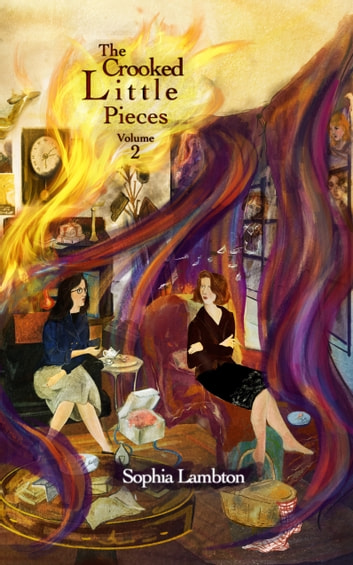
Crooked Little Pieces Book Two: The Lives of Two Sisters Continue

This is the review of the sequel to Crooked Little Pieces Book One.  I posted the review of the first volume here

I received this book from the author Sophia Lambton, who is also the publisher.  She founded Crepuscular Press in order to release her work.

 I learned that crepuscular means like the twilight.  Twilight often refers to when the sun is sinking and the light is fading, but it isn't completely dark yet.  It has a liminal status, which is about being betwixt and between. 


   The two sisters, Isabel and Anneliese, find themselves in careers which are compatible for them.  Although Isabel has a tragic loss and considers her career temporary, Anneliese has incredible good fortune.                                  
Isabel is teaching music at the girls' school that she and her sister attended.  One of the students came to England with her mother illegally.  The school wants to keep this student safe. Her name is Margot. She speaks German.  Isabel is expected to teach her English. In class, Isabel repeated what she said in English in German for Margot.  She also arranged to teach her English on Tuesdays and Thursdays during lunch.  Isabel revealed that she once spoke German herself, and her sister spoke their father's language, Dutch.  To show the similarity of the languages, Isabel had Georgia, who spoke Dutch, speak some Dutch to Margot.  Margot understood some Dutch.  Isabel asked Georgia to make sure Margot wasn't all alone in school.

Isabel was having the students try to define what is modern in music.  She asked if something was modern because Beethoven never composed that sort of music.  She also asked if they were living in a darker age because there had been two world wars.

An old man who was one of Anneliese's patients griped about being picked on for being left handed. I'm left handed myself and have never been picked on for it.  I think that was still happening in my mother's generation, but it stopped in my generation.

We learn that the girls' school was going to have a new headmaster instead of new headmistress.  Isabel was upset that the new headmaster is Jewish.  Anneliese is no angel either.  She stole transcripts from the library  because she didn't have the time to make her own copies of the transcripts.

I assume that the author is showing that the sisters are flawed to humanize them.   It seems to me that Isabel can be humanized without offending a segment of the audience.

This book ends with Benjamin asking Anneliese to accompany him on a housecall on a nine year old suffering from schizophrenia.  We don't learn anything further.

I would have ended it with the school's change from headmistress to headmaster.  It would have seemed more like a stopping point.  Ending with an invitation to join a housecall seems rather abrupt.

Despite this second volume's flaws, I'm going to give this book four stars on Goodreads.   I'm hoping to like the next book better.


Wednesday, October 19, 2022

Crooked Little Pieces : Book One in a Series

 I was asked to read  Sophia Lambton's novel,  Crooked Little Pieces, by the author who had seen my reviews on this blog.  This is the first book in a series which explains why it's not as resolved as a standalone novel would be.


The protagonists are the sisters Isabel and Anneliese who were born six days apart.  I expected to like Isabel because she is a musician, but the focus wanders away from music. I confess that I found her problematic because I am a feminist.  Isabel's perspective is troubling for feminists.  In addition, Isabel is antisemitic which I find offensive.

 Anneliese's scholarly view is more to my taste. She is also more confident  than Isabel.  Isabel is incredibly lucky to have Anneliese as a sister.  Anneliese's support is crucial for Isabel at some points in the narrative.                                   

Although the prologue takes place in 1968, the first chapter opens in the 1920's when the girls were six.  The novel ends in the WW II era. I expect that the second book will continue with this WWII progression.

Friday, September 30, 2022

Paths For The Divergent

A curandera was mentioned in my recent review of  the mystery Shutter which centered on a Navajo woman photographer. (See my review of  Shutter here .)  I am now reviewing a book in which a curandera is a major point of view character.  The title is Witches and the author is Brenda Lozano. 


It seems to me that Witches is a somewhat misleading title.   Curanderas are more specialized than witches.  Witches may perform all sorts of magic.  The magic of a curandera is focused on healing.  She also practices a particular Mexican tradition of healing that may have similarities to magical healing practices in other cultures, yet there are also important differences.  I have never believed in erasing unique aspects that occur in the variety of cultures on our planet.  We can then lose wisdom, and are poorer because of it.

Wisdom is not the same as what we learn in school.  I believe that the characters of  Witches demonstrate that this is true.  Yet there is value in schooling. Literacy can broaden your knowledge of cultures other than your own.  The amazingly gifted healer Feliciana was illiterate.  She learned about peoples from outside Mexico when they traveled to meet her.  This normally wouldn't have happened to a woman who grew up in Feliciana's village.  She would have been quite culturally isolated.

If the village had been less isolated, another divergent character could have found connections with others who were like her.   Paloma was born with the name Gaspar and was raised as a male in a family tradition of men who were curanderos.  Curanderos are paranormal healers.   Over time Gaspar began to exhibit the female traits that were natural to her.  She was attacked for becoming who she was meant to be.  In Mexico she was considered a muxe, which is a third gender.  She called herself Paloma.  Few people in this village could accept Paloma, even though Paloma was the one who taught Feliciana who  became a powerful curandera. 

We learn that Feliciana and her sister Francisca first began to eat the hallucinogenic mushrooms that were tools for healing because there wasn't enough food.  It's sad that a family that had been healers for generations were so impoverished.

In the next generation of what had been a family of curanderos and curanderas, the divergent one was Leandra.  Leandra was a rebel who started fires and was kicked out of schools.   She told her sister Zoe that she had gotten married to a girl.  She asked Zoe not to tell their parents because she hadn't invited them to the wedding.  I suspect her parents wouldn't have come if they had been invited.  Leandra doesn't seem to have any awareness of the existence of homophobia.  

Professionally, Leandra wanted to be an art photographer whose work is exhibited in galleries.  The first time this happened, Leandra had three photos chosen for a group show.  Leandra's work attracted the interest of a collector who specialized in Latin American woman artists.

I liked this book dealing with unconventional people very much and decided to give it a B+ which is four stars on Goodreads. 

Monday, September 12, 2022

Female Navajo Photographer Protagonist in a Mystery

 In order to make sure I would get a mystery read in September, I got one picked out even before I'd arrived at the halfway point. It was Shutter by Ramona Emerson.  The copy I'm reviewing is a library book.  The protagonist is a photographer which isn't all that unusual.  I've reviewed several books with photographer protagonists -- most recently Michael Angelo & the Stone Mistress by Steve Moretti.  Yet this is my first female Navajo photographer protagonist. 


As the book opens, Navajo Rita Todacheene is a forensic photographer.  This means that she photographs crime scenes. Yet she also sees spirits which isn't a trait that would be considered compatible with professionalism in most work environments.  Needless to say, Rita must be careful not to reveal her paranormal gift  to officers in the Albuquerque PD. 

Being paranormally gifted, isn't the only way that Rita's job is problematic. I also knew that the Navajo avoid mentioning the dead or even the names of dead relatives.  So it seemed to me that Rita's job was extremely incompatible with her culture. 

The issue of the Navajo belief that the spirits of the dead (called "chindi" in mysteries by Tony Hillerman) could contaminate them, arose when Grandma took Rita to a church where ghosts were lingering.  I wondered why Navajo spirits of the dead would linger if they believed they were contaminating people that they loved.  Her grandfather's spirit worried that inimical spirits could make Rita crazy.

 I was interested in the fact that Rita's neighbor was evidently a curandera.  Curandismo is a a Mexican healing tradition. She rubbed Rita with an egg, then she cracked the egg into a glass of water and told Rita to put the egg in the glass of water under her bed.  "Whoever has their eye on you will let you go," said the curandera.  There were also jars to put in each corner of the room.  Rita thought it was superstition.  I think that Rita's lack of belief in the measures that Rita's neighbor was taking to protect Rita would undermine their efficacy.

<Spoilers--


Rita learned Police Lieutenant Garcia was behind most of the local distribution of meth. This was a major revelation.  I wondered if Garcia did that because Latinos were being discriminated against when it came to advancement in the police department.  


End spoilers.>


It was mentioned in this book that Saint Veronica is the patron saint of photography.  Since I had never heard this before, I looked for a confirming link.  I found it at St. Veronica which links to a page about this saint's connection to photography.  Since Rita doesn't seem to be a devout Catholic, I didn't think that St. Veronica would have been significant for Rita.

There is a positive resolution to the book from a law enforcement perspective.  I decided to give Shutter a B+.


Sunday, May 8, 2022

Cleopatra's Dagger: A Journalist in New York in 1880

Since the last book I reviewed on this blog also had a journalist protagonist, readers will get the idea that I like journalists.  They'd be right.  I count ten previous reviews of books with journalist protagonists on this blog, and seven more on my other blog.  I identify with journalist protagonists because I once wanted to be a reporter.  I got no further toward that goal than writing for school newspapers, but that was some time ago. 

 I received a copy of Cleopatra's Dagger by Carole Lawrence from a publicist back in January.  Many apologies for the delay.  I got behind with my reviews this year.  With this review, I expect to be caught up.


 My reviews are based on voluminous notes from my book journal on every book I read.  So I very much related to what the protagonist, Elizabeth, had to say about her process. "The very act of putting her impressions down on paper helped her to understand what she thought and felt."

Elizabeth's editor warned her not to trust the police.  He told her about the Tompkins Square Park Riot of 1874 in which the police beat peaceful protestors with clubs.  I considered this indicative of the period and what it was like.  I am going to reproduce an illustration from the Wikipedia page devoted to this riot below.


Elizabeth's family seemed to be rather well off , belonging to the late 19th century equivalent of the aristocracy of New York. Her father was concerned that being a crime reporter was an improper occupation for his daughter.  I really liked Elizabeth's response.  "I'm not certain it's a proper occupation for anyone...[but] I am determined it will not be closed to women."  

According to the blog Women's Views on News ,  the 1880 U.S. Census recorded 288 women journalists but that their stories were much like Elizabeth's assignment to report on Mrs. Astor's garden party in this novel.  Elizabeth's articles for The New York Herald on killings would have been very atypical for the period.  Yet my favorite real woman journalist, Nellie Bly, was also working during this period and she sure wasn't writing about garden parties.  See the section in the Wikipedia article on Nellie Bly about her career. I'm glad to see a fictional equivalent of Nellie Bly in this novel. 

Elizabeth became a crime reporter when she discovered a body wrapped as a mummy on a walk, and insisted on covering the story. She convinced the detective in charge of the case that if the photo of the body was put on the front page of The New York Herald, they would find someone to identify the corpse more quickly.

When a second body was found in the East River, Elizabeth was summoned to the scene via telegram.  Detective Inspector Thomas Byrnes described her jewelry and how she was dressed.  Elizabeth said it sounded like this victim was dressed like the Egyptian water goddess, Anuket.  There was an ankh on a leather thong hanging on her neck.  I'm afraid I couldn't resist adding "Ankh if you love Anuket!" in my notes. One of the policemen who responded recognized this second victim as a prostitute named Mary Mullins.

When the mystery was resolved, it seemed anti-climactic to me. I gave the book a B.