I'm glad to be reviewing a historical fiction with a strong woman protagonist during women's history month. I won a digital copy of The Peddler of Wisdom by Laura Matthias Bendoly in a giveaway on the Historical Fictionistas group on Goodreads. The author sent it to me as a gift from Amazon, and this is my honest review.
Central character Irène Guéri is a healer and a diviner who resides in Les Échelles, a fictional village in the south of 17th century France. Les Échelles was invaded by an army of Sardinians led by Domenico, a tyrannical nobleman with strange obsessions that involved cruel practices. When Domenico demanded that the villagers consult his alchemist/physician instead of Irène, I expected that she would become the victim of a witchcraft hysteria which were quite common in the 17th century. It turned out that I was being too pessimistic. While there were a few collaborators with the invaders, most of the village wanted to resist Domenico. So Irène became a rebel. I love women who take a stand.
There were other amazing female characters. One of them was Bijou, a female raptor who was very protective of Noisette, the ten year old girl who'd adopted Bijou. I was also impressed by the courage of Irène's closest friend, Simone.
There's a romance element in The Peddler of Wisdom. We even get a HEA ending. Yet I wouldn't categorize this novel as a romance. I think that the romance content is insufficient. I would say the same about characterizing The Peddler of Wisdom as a fantasy. There is a great deal of discussion about magic, but there are relatively few magical acts.
I wouldn't count Irène's Tarot readings as magic. For me, they exhibit insight/intuition. Some would say that the 17th century was too early for Tarot divination since the earliest historically recorded use of Tarot for that purpose was in the 18th century. Tarot images were originally utilized for playing cards, not as divination tools. I should point out that recorded history has tended to focus exclusively on the doings of the wealthy and powerful. Irène learned about divination with Tarot cards from a Romani woman. It seems to me at least possible that the Romani might have been reading Tarot
somewhat earlier than history indicates.
The Romani are called "gypsies" in this book. I have been guilty of using the term "gypsies" myself, but that was before I learned the history of "gypsy" as a pejorative. It's enough for me that members of this ethnic group prefer Romani. My policy is that people should be called what they want to be called. Of course, 17th century Irène wouldn't have known better. It did bother me that Irène was insulting toward Romani at the end of the book. Hurtful stereotypes about the Romani have been common and they still do have a great deal of currency. Irène seemed advanced in a number of ways. That comment caused me to think less of her. It also left a bad taste in my mouth since it was literally the last thing Irène said.
The protagonist of The Peddler of Wisdom was by no means perfect, nor did she need to be perfect. Characters seem more real if they have flaws or complexity. A number of characters in Bendoly's book were well-developed including the villainous tyrant Domenico who had a background, and an unpredictable degree of ambivalence.
I had some minor problems with this novel that I won't discuss here. I did like The Peddler of Wisdom for the most part, and was glad to have the opportunity to read it.
Showing posts with label France. Show all posts
Sunday, March 24, 2019
Friday, February 27, 2015
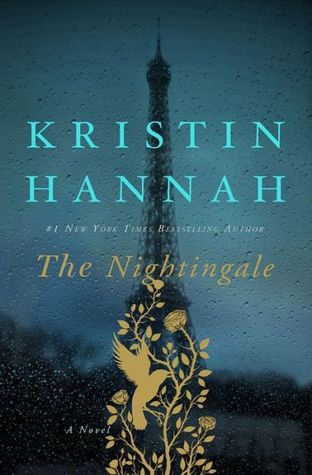
The Nightingale by Kristin Hannah: A Story of Survival in WWII France
This is a story about war, the women who wait for the men to come home, the different ways women handle it, the things they'll do for their children. It's about men who train to fight for their country in hopes their families will be proud, only to end up ashamed. It's about persecution.I thought this novel started a bit rough. We meet two women, sisters, Isabelle and Viann. Viann seems weak, lost now that her husband has gone to war, spineless, with no drive to defend others or see what's going on around her. Isabelle is the opposite: brave, daring, angry, ready to flaunt rules, including that of the Germans, whether it means distributing fliers or taking downed RAF pilots over the mountains to Spain. But she's also a bit irritating in that she doesn't help Viann much around the house and does behave like a petulant child much of the time.
But as the book and story progress, as events unfold, we see both women grow. In times of war, of duress, in harrowing situations, is that not when we show our true colors? While Isabelle runs around France and Spain helping pilots, Viann tries to help her Jewish friends and their children and we all know what happened to the Jews during the war. (To be perfectly honest, though I enjoyed this story, even got teary eyed at times, I must confess I did not get anything new from it.)
I could have done without the hints of romance between Viann and the captain. That is very overdone and I'm never fond of that story line.
I also noticed some strange discrepancies throughout the story. I probably would not have noticed if I didn't have editing experience, but little things such as being told Isabelle sat on Sophie's bed and Viann is talking to her and saying, "You'll sleep upstairs on Sophie's bed" popped out at me often. I'd have liked more details as well about Isabelle's missions. Four men suddenly appear in a town with "I'm deaf.." signs and nobody notices the deaf male population multiplied overnight? I found some things preposterous and perhaps more detail would have made it more believable. At the same time, I found the book way too long and drawn out. Perhaps had the Nazi romance been eliminated, more time could have spent on the more interesting parts.
I'd also be happy not read the words Mon Dieu again.
But it was emotional. At times I felt anger, fear, disgust, sadness. The story evoked a lot of different emotions from me and I appreciate that. It takes a fine, skilled writer to create such a roller coaster of feelings.
I received this via Netgalley.
Labels:
Book Reviews,
France,
Historical Fiction,
World War II
Wednesday, February 18, 2015
Doctor Death (Madeleine Karno #1) by Lene Kaaberbøl
This is a very dark historical tale/mystery following disturbed people with diseases, sexual desires, secrets, and religious delusions. Some of the occurrences within shocked me. It made me think of a historical Patricia Cornwell novel with this heroine, Maddie, as the historical Dr. Scarpetta.It's very long ago France. Women still wear corsets. Men inherit everything. Women are NOT supposed to be doctors, let alone coroners or the like, but Maddie wants to do this above all else and a carriage accident finally provides her the chance to step into her father's shoes for a while and get in on a case involving dead bodies on ice, wolves, a convent, and nasty little mites in the nose.
And then there's a very dashing professor who suddenly has his sights on Maddie.
There were lots of twists and turns in this story. The mystery is not easy to piece together. Too many of the characters withhold information. I was kept guessing and as I said above, repeatedly shocked. The heroine is strong but not unbelievably so. She has her moments in which she's shaken by what's she witnessed--understandably. She has good intentions and a lot of drive.
I think the story lacked emotion though. There were many instances with her, her father, the professor, others, that I felt exhibited too little emotion for the situation; they were a bit too robotic. Despite this, the writing itself is stellar.
The ending didn't adequately explain some things for me. It's hard for me to convey what I mean without putting spoilers in this though. There are many things in the story that I mustn't reveal.
And to be frank, I found some things just a bit too perverted. I was saying, "Um, seriously? That's sick."
But I was entertained and I liked it enough to possibly check out the second book whenever it comes out. It truly is like a historical Dr. Scarpetta. I'd also like to add that there is a moral I appreciate: never jump to conclusions, especially if it's an assumption that someone has done wrong. Being weird does not make one a killer.
I received this via Netgalley.
Tuesday, December 30, 2014
Violins of Autumn by Amy McAuley
All I have to do is drop into a foreign country, aid and train members of the ever-growing Resistance movement, sabotage railways, travel the country on a bicycle while concealing top-secret information, blow things up, and try not to get killed.
That sounds pretty exciting, right? Sounds like a story I should love. Truth is, despite dedicating three days to it, I couldn't make it past the 50% mark. But I paid for it, so I'm going to post my two cents.
The 411: You got a 17-year-old American female who has lied about her age, joined the British SOE, and has jumped into occupied France to save the people.
It's been done before and it's been done better. Check out Becoming Clementine by Jennifer Niven. Or for a better story of a heroine helping the French Resistance: Chateau of Secrets by Melanie Dobson.
My quibbles: I was expecting her to train members of the resistance, maybe blow up train tracks...gee, I wonder why I got that impression?...but in the first half of the story she does nothing but ride around on a bike and seem lost and do things that are just too stupid for words. I'll get to that. If there's any intense action, it comes very late in the tale.
She is 17, claims she's 22, and acts 11. That could be because this book is marketed toward the younger crowd, but still....she's supposed to be an agent/spy.
There's supposed to be some love triangle and as soon as I got a "whiff" of one of the participants (Pierre) I was rolling my eyes and dreading it. What did she see in him? He's rude, doesn't even like her, isn't remotely kind.
There's a war on but the characters are like children playing war games. Everything is really too preposterous. In Nazi-occupied France, an American airman is NOT going to merely sit on a parachute and pretend to be picnicking, nor is he going to be able to walk the streets of Paris without anyone asking for his papers, not when every single able-bodied man in France has been sent to Germany to work in factories. His haircut and height alone will be a dead giveaway. Be real.
And what kind of idiots sing American songs for all to hear?
And to just peddle up to a Nazi factory and began taking pictures? Is this girl for real? And get offered a tour to boot? No, no, no. The author made things way too easy for this so-called agent. Easy to the point, the story lost its seriousness.
I bought this on Amazon. It simply wasn't for me.
Labels:
Book Reviews,
France,
Historical Fiction,
World War II,
Young Adult
Sunday, June 22, 2014
What's Really Interesting About George Sand?
I confess that I have never read George Sand's work and couldn't name a single book by her until very recently. I only knew about the prominent men in her life. Perhaps this is why Anna Faktorovich decided to call her novelized version of the life of this author The Romances of George Sand. Yet it's really sad when what we most remember about a feminist writer is her romantic entanglements with men. Now that I've read Faktorovich's book, I am here to tell you that the romances were the least interesting aspect of George Sand's life.
One personal fact that I had previously known about George Sand was that she had cross-dressed. The image on the upper left of the cover depicts George Sand cross-dressed as a man. The reason why women who cross-dressed interest me is because historically women engaged in this practice because they wanted to involve themselves in activities that weren't considered acceptable for women. According to Faktorovich, George Sand's mother first dressed her as a boy because she wanted her four year old daughter to accompany her father, an officer in Napoleon's army, when he met with important people. It apparently was considered appropriate for a four year old son to see what his father did, but not his daughter. Faktorovich also tells us that the French fairy tale "Belle-Belle ou Le Chevalier Fortune" influenced George Sand a great deal when she was a child. It was about a girl who dressed as a man in order to become a soldier in the King's army. Here is an English translation of this fairy tale that is ascribed to Madame D'Aulnoy (1650-1705).
George Sand came from a privileged background. She was the heir to her grandmother's estate, Nohan. I was amazed to learn that George Sand's tutor, Deschartres, who was a physician, taught her about medicine and other sciences. He also utilized her as an assistant for amputations and other types of surgeries. After Deschartres death, she stepped into his duties as a physician to the local peasants providing free medical care to them. Because she wanted to find a source of independent income, she wondered if wealthier patients would pay her. When she broached the concept to wealthy individuals of her acquaintance, they laughed at the idea of a woman physician. If she had been born somewhat later, a medical career could have been a real possibility for her. In 1875, the year before George Sand died, Madeleine Brès became the first female physician in France. See Doctors' Wives and Women Doctors: Imagining Medical-Scientific Women in Early Twentieth Century France by Martha L. Hildreth which deals with the struggle of Frenchwomen for recognition in scientific fields such as medicine.
Sand was also a political activist. She wrote political articles for left wing newspapers such as Le Figaro which was named after the revolutionary Barber of Seville created by the radical 18th century French playwright Pierre-Augustin Caron de Beaumarchais. Sand's novel Engelhard dealing with a man who wanted to kill Napoleon caused her to be placed under police surveillance. Horace, another of her novels, was rejected by her publisher for being too radical. So she went indie. She and two other radical authors started publishing a journal called The Independent Review where she serialized both Horace and a later novel of hers called Consuelo. Now I'd definitely like to know what it was about Horace that was considered too radical for publication. It's too bad that Faktorovich doesn't tell us.
Faktorovich also doesn't give us an author's note distinguishing between fact and fiction in her novel. She tells us what her sources were, but she doesn't make clear to her readers exactly why she chose to publish this as a novel. The book is written almost entirely in third person narrative like a biography. It also contains digressions by the author in which she gives her opinions on various matters which would be more appropriate in a work of scholarship than in a work of fiction.
In conclusion, I actually would have liked The Romances of George Sand better if Faktorovich had called this book a biography of George Sand. I was very interested in a large portion of the content, but I don't think much of it as a novel. One of the reasons why the romance aspect didn't work so well for me was because I didn't think that Faktorovich wrote especially good sex scenes. They felt inauthentic and sometimes poorly motivated from a character perspective. I didn't always understand why George Sand was reacting the way she did. I like to see characterization that is more solid in fiction.
One personal fact that I had previously known about George Sand was that she had cross-dressed. The image on the upper left of the cover depicts George Sand cross-dressed as a man. The reason why women who cross-dressed interest me is because historically women engaged in this practice because they wanted to involve themselves in activities that weren't considered acceptable for women. According to Faktorovich, George Sand's mother first dressed her as a boy because she wanted her four year old daughter to accompany her father, an officer in Napoleon's army, when he met with important people. It apparently was considered appropriate for a four year old son to see what his father did, but not his daughter. Faktorovich also tells us that the French fairy tale "Belle-Belle ou Le Chevalier Fortune" influenced George Sand a great deal when she was a child. It was about a girl who dressed as a man in order to become a soldier in the King's army. Here is an English translation of this fairy tale that is ascribed to Madame D'Aulnoy (1650-1705).
George Sand came from a privileged background. She was the heir to her grandmother's estate, Nohan. I was amazed to learn that George Sand's tutor, Deschartres, who was a physician, taught her about medicine and other sciences. He also utilized her as an assistant for amputations and other types of surgeries. After Deschartres death, she stepped into his duties as a physician to the local peasants providing free medical care to them. Because she wanted to find a source of independent income, she wondered if wealthier patients would pay her. When she broached the concept to wealthy individuals of her acquaintance, they laughed at the idea of a woman physician. If she had been born somewhat later, a medical career could have been a real possibility for her. In 1875, the year before George Sand died, Madeleine Brès became the first female physician in France. See Doctors' Wives and Women Doctors: Imagining Medical-Scientific Women in Early Twentieth Century France by Martha L. Hildreth which deals with the struggle of Frenchwomen for recognition in scientific fields such as medicine.
Sand was also a political activist. She wrote political articles for left wing newspapers such as Le Figaro which was named after the revolutionary Barber of Seville created by the radical 18th century French playwright Pierre-Augustin Caron de Beaumarchais. Sand's novel Engelhard dealing with a man who wanted to kill Napoleon caused her to be placed under police surveillance. Horace, another of her novels, was rejected by her publisher for being too radical. So she went indie. She and two other radical authors started publishing a journal called The Independent Review where she serialized both Horace and a later novel of hers called Consuelo. Now I'd definitely like to know what it was about Horace that was considered too radical for publication. It's too bad that Faktorovich doesn't tell us.
Faktorovich also doesn't give us an author's note distinguishing between fact and fiction in her novel. She tells us what her sources were, but she doesn't make clear to her readers exactly why she chose to publish this as a novel. The book is written almost entirely in third person narrative like a biography. It also contains digressions by the author in which she gives her opinions on various matters which would be more appropriate in a work of scholarship than in a work of fiction.
In conclusion, I actually would have liked The Romances of George Sand better if Faktorovich had called this book a biography of George Sand. I was very interested in a large portion of the content, but I don't think much of it as a novel. One of the reasons why the romance aspect didn't work so well for me was because I didn't think that Faktorovich wrote especially good sex scenes. They felt inauthentic and sometimes poorly motivated from a character perspective. I didn't always understand why George Sand was reacting the way she did. I like to see characterization that is more solid in fiction.
Labels:
19th century,
Book Reviews,
France,
George Sand,
Real Women
Monday, November 4, 2013
Daughter of the God-King (Regency #2) by Anne Cleeland
What works for one book may not work for another... Once again, Anne Cleeland gives readers a spunky, headstrong heroine in historical (regency) times. This one takes place in France and Egypt. More spying is underfoot, more intrigue, more confusion, and once again, readers are kept in the dark and while this method worked for the more exciting and fast-paced Tainted Angel, it didn't work for this one. I confess that while I thoroughly enjoyed the beginning and the unfolding of the mystery itself, by the 60% mark I felt it had all gone on long enough, answers were overdue, and the book needed to conclude already.I did like it, just didn't love it. In Tainted, this writing style of giving just enough emotion to make us wonder what exactly the heroine is feeling was adequate, because the heroine herself was part of the mystery. In this, the heroine is different--she's not a spy; she's a woman whose parents have gone missing, whose being harassed constantly about a missing strongbox, and finding love for the first time. SHE wasn't the mystery. So some emotion was desperately needed.
The story takes us from France to Egypt to tombs and it contains a long list of characters and it's not clear if they are bad or good. It did become difficult to keep track of who was who and who had done what to who.
I really appreciated the humor, especially between Hathor and Bing. They had some cute conversations. I also love the heroine's spunk and internal thoughts. She made me chuckle more than once.
To her dismay, his gaze rested discreetly on her breasts for the barest moment.
"You relieve me no end," Hattie assured him in a brittle tone, and wondered if it would provoke an international incident if she pushed the old lecher out the door.
Anne Cleeland has a very unique, literary writing style, and I appreciate that the most. She uses prose from that time period and it def doesn't feel like fifth-grade writing, like most books do nowadays. Here is a real writer and one to watch.
Labels:
Anne Cleeland,
Book Reviews,
Egypt,
France,
Historical Fiction
Sunday, October 20, 2013
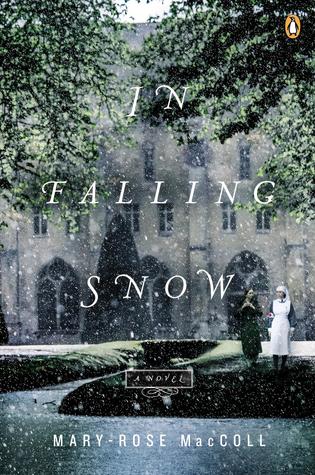
In Falling Snow: A Novel by Mary-Rose MacColl
What a well-written story. It kept me on the edge of my seat and surprised me. I thought it went one way, but it went another. It honors the nurses of WWI while at the same time slowly unfolds a shocking secret. You really get to know the characters; you love them at times, hate them at others.They feel so real.
In a nutshell: The backstory is WWI France. A group of Scottish and English nurses are opening a hospital. An Australian girl joins them. Her goal is really to collect her much-too-young (15) brother and take him back home, but she gets immersed in the cause. She feels she belongs and she's needed, and she's got drive. She wants to be a doctor maybe one day... But fate does what it does.
The modern story is Iris's granddaughter. She's a doctor who has no idea the struggles Iris faced during the war. And finding out may just give her a new appreciation for the benefits she has had...
Heck, it made me appreciate what us woman have and can do nowadays. Not saying we don't still have barriers to break down, but as I said above, I felt this book was a great tributes to the nurses of WWI. Imagine tending the wounded, watching them die, shift after shift, driving an ambulance in the worse conditions, fighting to show the world you're capable of being a doctor.
The modern story also make me think on something many of us are guilty of...if we don't know about it, we can pretend it's not there... Is living in blindness, however, the solution? I'm not going to elaborate further. I'd hate to spoil it for others.
It's a book full of strong women, I'll say that. Iris for pretty much running a hospital, for being a mother before her time, for doing what had to be done even if it meant giving up her dreams. Violet...driving an ambulance night after night, doing what she felt was right in the end, striving to succeed. Miss Ivers...for running the hospital, starting it, standing up to others, uniting women, inspiring... And Grace, who though she doubts herself at times, manages motherhood while being a doctor herself.
I give this a four because it's a tad long-winded. There were times it could have gotten to the point more. But I really liked it.
ARC received via Netgalley.
Tuesday, October 8, 2013
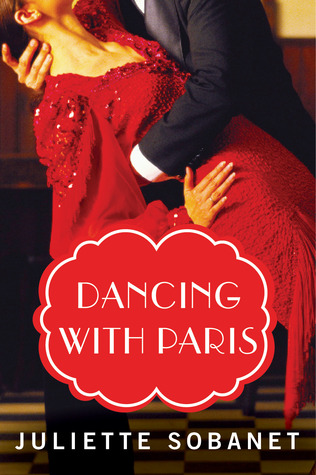
Dancing with Paris by Juliette Sobanet
And there you have it. Modern-day pregnant therapist is torn from the arms of the man she loves and time-travels back to 1959 Paris where she's a murder suspect, a dancer, a prostitute, and best friends with her future grandmother. And she has to change fate...or lose her life and baby girl forever. After all, she hasn't been born yet...and what if she isn't?
It's extremely exciting and fast paced. Everyone is just dropping dead around Ruby, the past-life heroine and she has to save herself, change what's to come without even knowing what's to come, and figure out who's killing people. I was wholly entertained and dying to know what happened next. It's more mystery than romance, I think, and I like that I wasn't able to figure out whodunit by page 50. Matter of fact, I thought I had a pretty good idea toward the end, but I was wrong.
The first-person narrative worked well, but I am disappointed that there wasn't more historical data. Traveling from 2012 to 1959 can't be peachy. A part of me couldn't help comparing it to another recent time-travel romance I read that jumped similar dates, Hindsight by Sarah Belle. While that author had details about trying to LIVE and perform what in 2012 are much easier tasks (Imagine not having a modern-day washing machine all of a sudden!), this book didn't even touch on that stuff.
It also tied up too quickly and too cheesily in the end. I was left with a lot of questions and it being such a long book, it's not like it didn't have the time to tie them up.
-"When I kill you, your soul won't ever be reborn."
Why not?? Huh? She was killed the first time around and still lived in another life.
-The wife following Ruby around...I seriously doubt she knew Ruby would be in that office and got there before her in time to plant that photo. No... The timing here was all off.
-How could you not notice you haven't had a period in four months? Get real.
-I was also slightly alarmed that the heroines always seem to go for taken men, in both lives, except for in the case of JP. I laughed when Claudia said this, "I'm not normally like this, running from one man to the next."
Errr. Married lover fathered your baby, and three months later the man you love is engaged and then you time travel and a mere three days after you have sex with a married politician in that life, you're having sex with another taken man.
-I was also really put off by the unprotected sex. Granted, the doctor could just shoot himself with penicillin afterward, but really, she's still a prostitute. He's seen the photos and heard it from her own mouth. This grossed me out. I don't care that it was a different soul in the prostitute's body, the body had been around, and just days before. Is the scenario likely? Yep. But I can't help that my nose wrinkled anyway.
![]() |
| From Wiki Commons |
Anyway, EW. That being said:
I bought this on Amazon.
Labels:
Book Reviews,
France,
Historical Fiction,
time travel
Wednesday, October 2, 2013
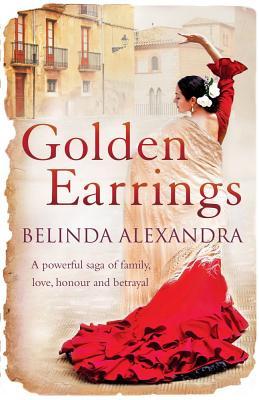
Golden Earrings by Belinda Alexandra
It took me a long time to read this, as I had to juggle it with review-required books, but it's a book that one needs to savor bit by bit anyway.
It goes from Paloma in 1970s France--a ballet dancer estranged from her father, living with her Spanish grandmother who is full of secrets--to Evelina in a turbulent Spain--a wealthy pampered girl I never came to like--to La Rusa, a flamenco dancer accused of betraying Evelina's family.
I won't deny that I became confused at times with jumping around, but not to the point it detracted from my enjoyment of the story and the lessons and history within. The Spanish Civil War is a difficult one to grasp--so many parties, so much hatred, so many factions, but the book simplifies it as much as a historical novel possibly can. The church, Franco, the Republicans, the Socialists...etc.
There's three romances, though I would say La Rusa's steals the show. There's secrets, lies, betrayal, and it being over 500 pages, we'd be here all day if I tried to tell you even a quarter of them. It's great story telling though and as I said above, educational about the war. I also appreciated the awareness of class division. It's something we must never forget--how it can tear apart a nation, how things can go so badly when the rich get richer and the poor get poorer... The moment we forget history is the moment we risk repeating it. That makes books like this even more important.
My only solid quibble is I freaking hated Evelina. Never came to like her. Spoiled brat, if you ask me--as a young girl, as a woman, as an old lady. I prefer to like the main players of a story--especially the heroines, and she came across as one.
"I imagined that Margarida had become a famous writer and was living in a cottage somewhere with dozens of cats. She would write about us, and we would live on her fiction."
Why don't you, like, try to do something yourself, Evelina?
I almost took away a star I hated her so much (and Conchita too), but La Rusa's experiences as an ambulance driver redeemed the book. She had enough guts for all three women combined. :)
I bought this on Amazon Kindle a long time ago. It appears to no longer be available in the States. :(
Tuesday, January 29, 2013
The Ambassador's Daughter by Pam Jenoff
I walk away from this novel very enlightened on the Treaty of Versailles. WWI and its consequences sadly seem to go largely unnoticed in history and in school. Ms. Jenoff does a remarkable job educating while entertaining.
The setting is France. A young woman who'd been rather...coerced into agreeing to marry a man when war hit is trying to postpone her impending marriage by staying with her ambassador father for the conducting of the treaty. She's German in a country that at the moment, hates Germans.
There's so much going on here... there's duty. Does she do her duty because it's the right thing to do or does she follow her heart? Is it wrong to just want to LIVE for a while before typing oneself down? When does doing the right thing really become doing the wrong thing? There's information falling into the wrong hands. Betrayal: the act of committing and the act of being betrayed. There's the after effects of war, how people are treated. There's politics. And above all it's the story of how lies...no matter how small...often have the most dire of consequences.
There's spying, intrigue, romance, and history.
I really enjoyed it thought at times I struggled with the heroine and her decisions. I'd like to have seen her handle some things differently, namely her fiance Stephan, but had t his story not gone the way it did, the moral would not have been as strong.
Wonderful writing. It really planted me in France during the signing of the Treaty. I didn't find the love was all that passionate as in a previous book I read by Jenoff, but I could feel the heroine's guilt and turmoil just pop off the page.
Four bikes. Brace yourself for lots of surprises. And that's hard to do nowadays, what with every plotline being done over and over and over. Ms. Jenoff really pulled this off. I received this from netgalley.
Saturday, January 12, 2013
The Painted Girls by Cathy Marie Buchanan
Three sisters, each one striving for something. Antoinette wants to be adored. Marie wants to take care of her family. Charlotte wants to be successful. And yet, they all become whores. One is a whore to love. One is a whore because in the end, despite all she does, she's left with nothing else. One is a whore in order to succeed, and in the end it's utterly sad.
Though very true to the era it's penned about, I had a hard time with Antoinette's story. She was just terribly dumb in my eyes. The truth was in front of her face so much...but it's amazing what a girl will do to have a man's approval. This book really makes you think of that.
Marie, the trial, the guilt she felt for the decision she made...very gripping.
Vivid. Realistic, sad, and wrenching. This is the kind of book you pick up when you wish to time travel. But it is full of heartache. In the middle, my mind began straying and at times the book lost my interest as it got repetitive, but it hooked me again towards the end.
Monday, November 19, 2012
Becoming Clementine by Jennifer Niven
After delivering a B-17 Flying Fortress to Britain, an American volunteers to copilot a plane carrying special agents to their drop spot over Normandy. Her personal mission: to find her brother, who is missing in action. Their plane is shot down, and only she and five agents survive. Now they are on the run for their lives.
As they head to Paris, the beautiful aviatrix Velva Jean Hart becomes Clementine Roux, a daring woman on an epic adventure with her team to capture an operative known only as "Swan." Once settled on Rue de la Néva, Clementine works as a spy with the Resistance and finds herself falling in love with her fellow agent, Émile, a handsome and mysterious Frenchman with secrets of his own. When Clementine ends up in the most brutal prison in Paris, trying to help Émile and the team rescue Swan, she discovers the depths of human cruelty, the triumph of her own spirit, and the bravery of her team, who will stop at nothing to carry out their mission.
Review:
Absolutely loved book two, Velva Jean Learns to Fly and so was super excited about this. So excited I broke my price rule and spent 9.99 on the Kindle edition.
But...if you're expecting lots of flying, you'll be disappointed. The story starts with her landing in England, then she crashes a plane and later steals a plane, but most of the book is her acting like a spy. I say "acting" cause really, she doesn't any real spying. I'll get to that.
She crashes in France, which in under the Germans so she's in enemy territory. Still searching for her brother, she insists on joining the resistance. She's mighty brave. I still love her. She ends up in Paris and has all these Resistance friends, even a French lover, but despite being surrounded by these people and making big plans, she does nothing.
She wears fancy lipstick, eats a map, PLANS to save a girl from prison, but gets arrested herself, wears knife bobby pins, but really, never once does she deliver pertinent information to anyone, just runs around with the Resistance. She can't even take credit for saving the girl in the end, because she didn't bomb the train and Eleanor is capable of escaping herself.
It's isn't until the very end of the book that Velva Jean aka Clementine does something worthwhile. Though I must give her credit for not caving under interrogation.
The beginning and ending was great, but the middle really dragged for me. As I said, she just runs around with these important people and spends time in prison.
So compared to Learns to Fly, it didn't wow me. But then again, that was more up my alley as I love aviation.
Three bikes.
Saturday, October 20, 2012
The Walnut Tree by Charles Todd
A unique holiday tale...of heartache, unrequited love, despair and hope both, and a woman who does what she feels is right and follows what she feels is her path.
WWII. Elspeth is in France when all hell breaks loose. In the excitement of the moment, she agrees to marry Alain, her best friend's brother, even though she really only feels for him the way she does her fondest cousin. But she doesn't know or understand this at the time...some things come with maturity and war makes one grow up fast.
He's gone. Something calls her back to her native England, a desire, a feeling. On the way there, she meets a soldier and finds love as well as a calling...nursing.
There's much ado about her being a nurse as she's also a lady. Her cousin/guardian doesn't approve. But as morbid as this will sound, the ravages of the battlefield, the wounds she tends, the trials she faces in the war zone were the best parts of the book. I liked how she stood by the wounded and defied orders to do otherwise. She is fearless.
What I did not like: Everywhere she goes, she conveniently runs into someone she knows. In the middle of war, the hospital, etc. The world is not that small a place. I also didn't buy into the instant love. She and Peter spend one day in each other's company, and that day is constantly interrupted by him tending his troops, by mortar, by danger... For him to declare his undying love for her the next time he sees her? No. I also grew weary of hearing how pampered her previousl life was, how large the rooms, how much of a "step down" she had taken.
Lots of suspense leading up to an ending one can't really predict. Both sad and happy.
Four bikes. I was given this by the publisher in exchange for an honest review.
He's gone. Something calls her back to her native England, a desire, a feeling. On the way there, she meets a soldier and finds love as well as a calling...nursing.
There's much ado about her being a nurse as she's also a lady. Her cousin/guardian doesn't approve. But as morbid as this will sound, the ravages of the battlefield, the wounds she tends, the trials she faces in the war zone were the best parts of the book. I liked how she stood by the wounded and defied orders to do otherwise. She is fearless.
What I did not like: Everywhere she goes, she conveniently runs into someone she knows. In the middle of war, the hospital, etc. The world is not that small a place. I also didn't buy into the instant love. She and Peter spend one day in each other's company, and that day is constantly interrupted by him tending his troops, by mortar, by danger... For him to declare his undying love for her the next time he sees her? No. I also grew weary of hearing how pampered her previousl life was, how large the rooms, how much of a "step down" she had taken.
Lots of suspense leading up to an ending one can't really predict. Both sad and happy.
Four bikes. I was given this by the publisher in exchange for an honest review.
Labels:
Book Reviews,
Charles Todd,
England,
France,
Historical Fiction,
World War II
Tuesday, September 25, 2012
With a Sword in My Hand by Jean-Claude van Rijckehem & Pat van Beirs
The story really sucks you in, except for some odd moments where it prattles on about war, a battle, or a fairy tale. The heroine...def a strong one. I think much of the tale was preposterous. I had a very hard time really believing a young girl spoke to her king father the way she did and the bath house scene..oi.
It's a mixture of heartache and humor. The humor shocked me, but first the heartache... Marguerite's mother is the first sign of tragedy. She can't bear a son, and when she does, she goes insane. Marg must grow up without a mother...she becomes somewhat unruly. Her father and her are always on the outs. She gets into a a ton of trouble, fights with boys, learns to sword fight, pelts men with dung, romps in bath houses... a tad preposterous considering the time, 1300s.
But it was enjoyable and funny. There were random bursts of LOL moments.
Chaplain von Izeghem also insists that all girls keep their ears covered when they enter the church, for it has been positively proven that the impregnation of the Virgin Mary by the Holy Ghost took place through her auditory canal. If you want to make the chaplain lose his place when he is reading the gospel, you just nee to pull your cap off and have a good poke around in your ear.
"Well, if I put Godfried, Hendrik and you together, it occurs to me that you are the only one who has the manners not to break wind when I'm around. I think that's, let's say, knightly of you."
But all good things come to an end as Marg soon discovers when she's declared the fiance of the prince of the enemy England. At first he woos her, then she sees his acne and changes her mind. I began to dislike her around this point. As her father says, she has more whims than a dog has fleas, and at times she treats people appalling. She makes fun of Phillip and when Godfried comes back from pestilience ravaged towns, she cares not...until it's too late.
And tragedy again befalls her.
Told in the present tense, but not one iota distracting. A strong heroine who stands up for herself. A major dose of humor. And, oh, one really does feel as though they are medieval days as they read this.
Five bikes. I bought this via Book Depo a year ago.
Labels:
Book Reviews,
France,
Historical Fiction,
Real Women,
Young Adult
Tuesday, May 3, 2011
The Soldier's Wife by Margaret Leroy
Vivienne's husband is a soldier who is gone fighting. They had a troubled relationship before he left and one has to wonder if they will have a relationship at all when he gets back. See, Vivienne has taken up with the enemy. This is the passionate part. Germans have taken over the house next door as most of the islanders left for England before the Germans arrived. Vivienne at some point (it's not clear where) fell in love with Gunther and proceeds to take him secretly into her bed each night. This was supposed to be passionate, but I didn't really feel this romance between them. It was implied more than experienced.
I was in a turmoil over this aspect of the novel. I couldn't help but think that what Vivienne is doing would be the equivalent of me bedding down with the Taliban whilst my own soldier husband was over in Afghanistan.. However, I also seen the moral behind it: Soldiers are just doing their jobs and you cannot hold the actions of a country against a single man.
Troubles arise with the building of labor camps.. Many islanders wish to help the starving, beaten prisoners but to do so puts one's own family at risk...
Despite the Occupation, Vivienne's daughters still grow up. Her teenage daughter disobeys Vivienne to consort with the enemy herself before seriously stopping to think of what she is doing. The younger daughter makes a special friend and inadvertently causes her own mother to "grow a pair" as I like to say and stand up for what is right.
A couple issues I had: 1) The lack of passion in the romance department. It came from nowhere and all of a sudden. 2) The heroine is a wimp until the end. When her little daughter hurts her leg, Vivienne doesn't even have the balls to poor medicine on it. Throughout the entire novel, her daughters have her "whipped." 3) WAY too much description. Everything from the flowers to the sea to her bedroom is described in detail. If I won't remember it once I turn the page, please don't waste my time describing it.
What I liked: 1) The mother in law's dementia added an interesting and sad twist. 2) The book is very well written despite being overly descriptive. I was entertained. 3) The moral I mentioned above about soldiers. "You do your job. You do what you have to do. You don't always look around you. You don't always think about everything..."
I received two ARCs of this book (oops), one from the publisher and one via Amazon Vine. My bad.
Three stars.
Sunday, September 26, 2010
Warrior Girl by Pauline Chandler
Yes, she is talking to angels in this book, but the novel is told from the viewpoint of her cousin Marianne so it's not a looney first person narrative. That just doesn't work with Joan of Arc. Marianne accompanies Jehanne on her quest to liberate the people of France and crown the rightful king.
Upon approaching De Baudricourt about leading his army, Jehanne is told:
"..if your're to lead an army! What did you imagine it would involve? Cheering them on from the sidelines? Bathing their hurts with vinegar water? Patting their hands and telling them everything would be different after a good night's sleep?"
So Jehanne and Marianne both don armour and learn to fight and they shed blood, sometimes their own in battle. Jehanne and the captains butt head numerous times. The Captains say to wait.. follow logic.. blah blah.. Jehanne says that god says "Avance!!" (Attack!!)
Courageous or stupid, however way you look at it, Jehanne was just what France needed during that time.
Meanwhile, Marianne (Did I mention she was mute? Another intriguing story there.) has her own mystery going on irrelevant to Jehanne. Her father was an important man to who died when she was a baby and left her a wealthy estate, but with her mother dead, she is struggling to keep the estate from her evil uncle. It all depends on a ring seal and her ability to hold on to it.
The ending was lovely. I thought it superb.
Favorite quote: Jehanne is dictating a letter to the English,
"...abandon your forts and go back where you belong. If you fail to do this, I, Jehanne de Pucelle, will make such brouhaha as will be remembered forever."
Balls!!!
I got this book from the library.
Labels:
Book Reviews,
France,
Historical Fiction,
Hit,
Pauline Chandler,
Real Women,
Warrior Girl,
Young Adult
Saturday, September 18, 2010
Signed, Mata Hari by Yannick Murphy
This is a fictional account of the life of Mata Hari, infamous dancer and spy. It's written much like a diary except for suddenly switching to third person narrative here and there, which I hated. I would have preferred the book stick to the journalized account from Mata's POV.
Anyways, the book goes back and forth between Mata's narrative which chronicles her early years in a nunnery, her sexual abuse at the hands of a teacher, her abusive marriage, her moving to and falling in love with Indonesia, the loss of her children either to death or divorce, and her numerous affairs. She is telling this from a prison cell. The third person parts tell of her prison situation, her brief interrogations as she is being accused of being agent H21, and her living conditions in the prison cell.
Basically, after a very tumultous life, Mata Hari is being accused of spying for the Germans. She swears she is a spy for the French and has been set up. Which is it? She mourns for her lost daughter, desires to marry again, and just makes one bad decision after another... but she is sentenced to death. Will one of her many men come to her aid? Perhaps her loyal maid will come to her rescue? Or will she be shot to death?
I liked it despite its lack of quotation marks. Well, I liked the journalized first person POV, but I didn't like the third person POV and those parts def needed better punctuation. Something I truly and utterly grew tired of tho as well as the switching narrative (and thus, the three star rating): throughout the novel Mata constantly repeats one thing and it gets OLD not even a quarter into the novel. "I walked across the sea.. blah blah blah.. the shores of Ameland.. blah blah.. I walked across the sea.."
This was a library book.
Subscribe to:
Posts (Atom)